EN
EN 中文
中文
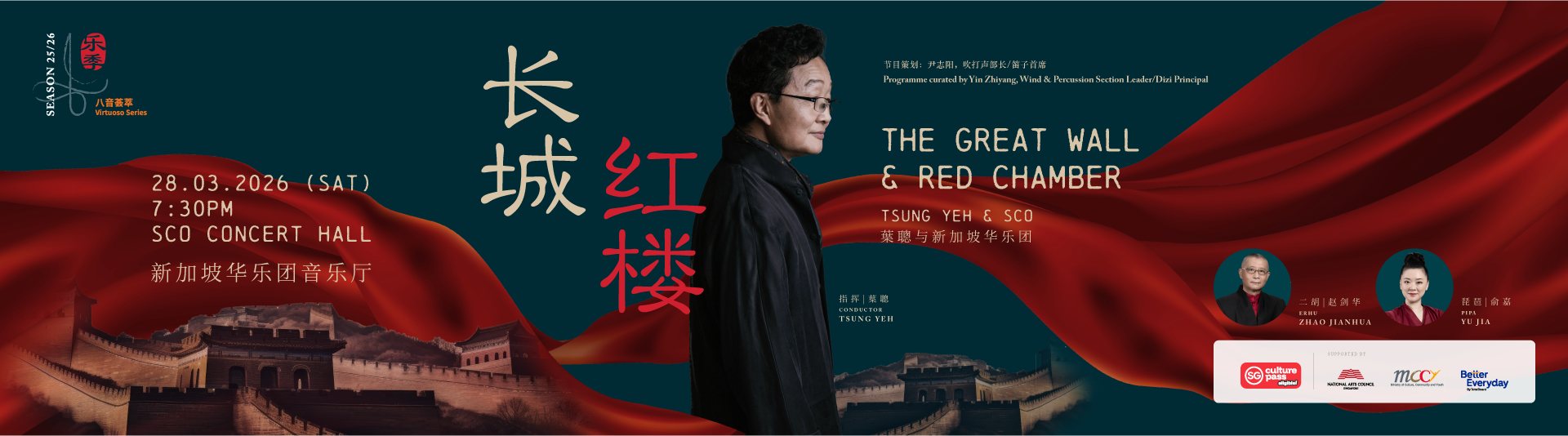


A programme anchored by The Great Wall Capriccio and Dream of the Red Chamber Suite sets up more than a contrast between these two landmark works. It places side by side two distinct imaginative horizons: one expansive and monumental, carrying the weight of historical memory; the other intimate and inward, attuned to the fragility of human feeling. Between these horizons unfold scenes of festivity and bloodshed, alongside contemporary reflections on Guo Feng—the voice of a nation.
The concert opens with Harvest, arranged by Peng Xiuwen and Cai Huiquan. Evoking scenes of rural abundance, the work incorporates regional percussion traditions and elements drawn from local operatic drumming, setting up a vivid contrast between driving rhythms and lyrical melodic lines. More than a celebratory soundscape, it lays down a distinctly Chinese musical character that underpins the larger narrative to come.
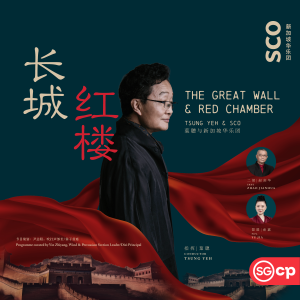
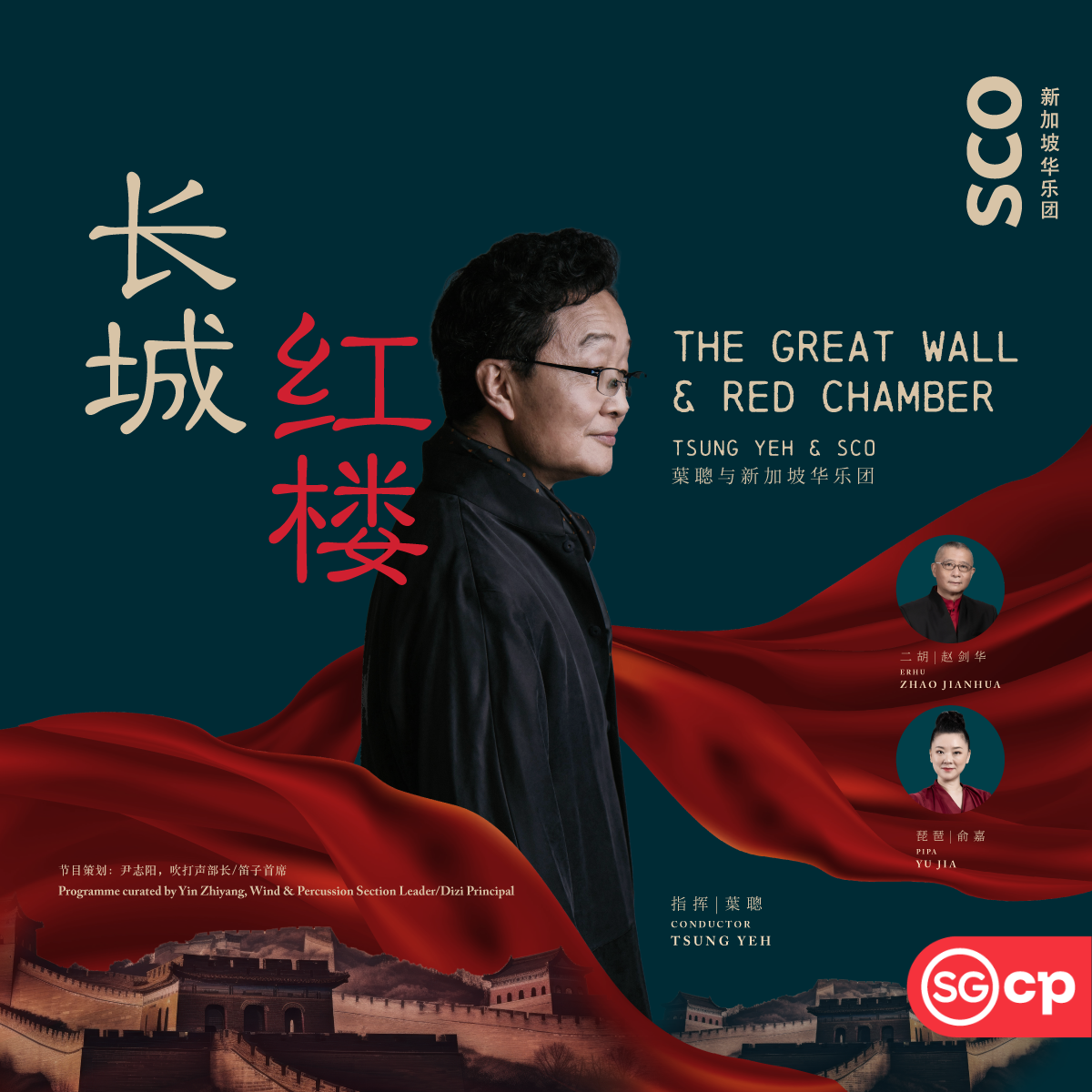
The Great Wall Capriccio is a four-movement concerto for erhu and Chinese orchestra composed by Liu Wenjin. The work was conceived in the late 1970s during Liu’s visit to the United States with the erhu virtuoso Min Huifen, when a monumental tapestry of the Great Wall displayed at the United Nations headquarters prompted the initial idea. Completed in the spring of 1981, it premiered in 1982 by Min Huifen with the Shanghai Chinese Orchestra. The soloist in this performance, Zhao Jianhua, is a leading disciple of Min Huifen, lending the work a clear sense of artistic lineage and continuity.
Though titled a Capriccio, the work unfolds along a deliberate arc: from the ascent of the mountain pass, to the urgency of blazing beacons, through solemn remembrance of fallen patriots, and finally toward a distant horizon. The Great Wall is depicted not as a static monument, but as a living emblem of unity, resilience, and collective resolve. In its musical language, The Great Wall Capriccio draws freely from traditional vocal and instrumental idioms. It moves between the heightened intensity of Peking Opera and the pulse of northern drum storytelling, while echoing the glissandi of the guqin, the tremolo of the pipa, and the agile bowing of the jinghu (Peking erhu), all woven into the concerto’s expressive fabric. In Zhao Jianhua’s interpretation, technique serves expression, shaping the music with poise rather than display.
While the Great Wall projects a public symbol of the nation, the second half turns inward with the Dream of the Red Chamber Suite. Composed by Wang Liping for the celebrated 1987 television adaptation of Dream of the Red Chamber, the music took shape over more than four years. Its melodies are direct and unadorned, yet have resonated with millions. Drawn from the original soundtrack—Lament of the Red Chamber, The Song of Qing Wen, Grandma Liu, The Lantern Festival, and Elegy on Flowers—the suite brings the novel’s emotional world into sound.
The Dream of the Red Chamber Suite turns its focus to character and feeling. Its power lies not in spectacle, but in emotional nuance. Wang Liping writes with a rare balance between classical poise and popular accessibility. In Elegy on Flowers, the music reaches beyond the fate of its heroine. What emerges is a meditation on impermanence—on beauty at its most fragile, and on the awareness that loss is woven into youth itself.
Ambush from All Sides stands as one of the defining works of the pipa’s martial repertoire, based on the Battle of Gaixia in 202 BCE between the forces of Chu and Han. The opening unfolds with imposing breadth, portraying the Han army drawn up for battle. It then shifts to the chaos of encirclement and close combat, as the Chu forces are driven into desperate struggle. Through techniques such as twisting and bending the strings, the soloist evokes the clash of weapons and the cry of war horses, concentrating the tension of the battlefield at the fingertips. In the closing section, victory is secured and the Han dynasty established, the music gathering into a final, resolute affirmation.
In 2018, Wang Chenwei created a concerto version of the work for the Singapore Chinese Orchestra, giving the ancient piece renewed structural breadth and dramatic tension. By incorporating Beijing opera percussion and having the orchestral musicians recite a line from the ancient poem Pounding War Drums from the Classic of Poetry in reconstructed Old Chinese pronunciation, the arrangement sharpens the sense of confrontation between soloist and orchestra. At this point, the pipa—performed by Yu Jia—moves to the forefront. Her playing drives the music forward with focused intensity, turning virtuosic display into dramatic momentum.
The concert concludes with Zhao Jiping’s Guo Feng. Commissioned by the China National Traditional Orchestra, the work carries in its title a deep cultural reflection. In the Classic of Poetry, “Guo Feng” refers to the “Airs of the States”—folk songs rooted in daily life, shaped by lived experience, and reflective of the emotional currents of their time. A synthesis of inherited musical tradition and contemporary compositional craft, Guo Feng draws on the guqin classic Three Variations on the Plum Blossom as a thematic source. Integrating Western formal design with a distinctly Chinese expressive core, the work speaks with both structural clarity and cultural depth.
From the epic sweep of The Great Wall Capriccio, to the inward lyricism of the Dream of the Red Chamber Suite, and the dramatic confrontation of Ambush from All Sides, the programme ultimately converges in Guo Feng. In giving ancient poetry new form, the music goes beyond sound to become a passage toward shared cultural memory.