EN
EN 中文
中文
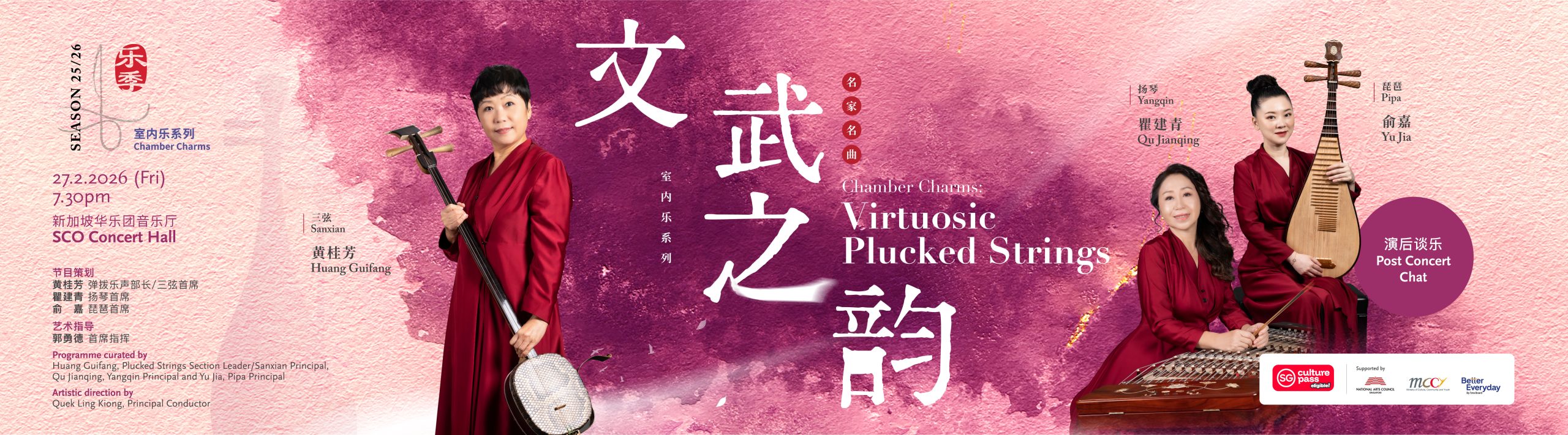
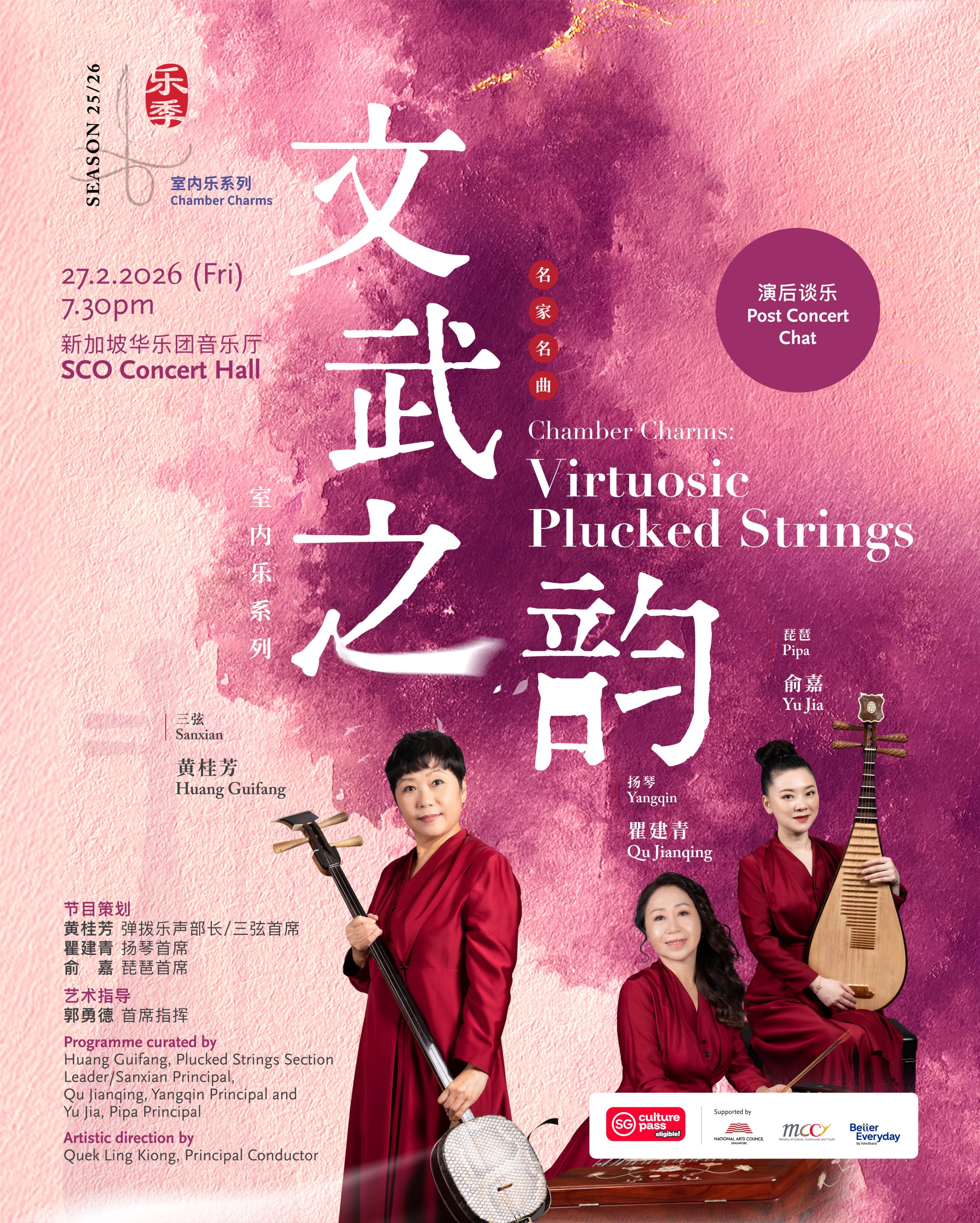
Chamber Charms
Virtuosic Plucked Strings
Sanxian: Huang Guifang
Yangqin: Qu Jianqing
Pipa: Yu Jia


- Yangqin: Qu Jianqing
Composed by Xiang Zuhua
Summer•Lotus
Composed by Xiang Zuhua
In the hot summer days, cicada songs fill the air. Lotus blooms saturate the ponds, and their refreshing fragrance spreads far and wide. Song Dynasty poet Yang Wanli described the scene as such, "Lotus leaves reach to the sky, a boundless sea of green. Petals dyed by the sun, an exquisite shade of pink." Li Bai, the great poet of the Tang Dynasty, was also an admirer of the lotus. His poetic line, "The lotus rises from clear water, natural and unadorned," has become a well-known literary classic through the generations. People often refer to how lotuses in summer "arise unsullied from the mud, cleansed by clear water yet not ostentatious," embodying the values of purity and integrity. Such characteristics of the lotus have led to the flower becoming a symbol of nobility, for the& untainted nature of the lotus encapsulates the virtues of honesty, righteousness, and a refusal to be complicit in the evils of the world. This musical piece is derived from Lotus Emerging from Water, a Guangdong Hanyue piece, and incorporates the "zhong san liu" (literally, "emphasis on threes and sixes") rhythm unique to this musical genre. The gliding and gentle notes of the yangqin offer deliberate embellishments. These elements come together to create an elegant and timeless tune that soothes the listener's soul.
Xiang Zuhua
Xiang Zuhua (1934-2017) was a famous yangqin musician, composer, and music educator. A master of the Jiangnan sizhu and playing the yangqin in the Guangdong tradition, Xiang Zuhua simultaneously drew upon different music traditions and broke new ground with his creativity. Over the course of his career, Xiang Zuhua had been a musician with the Shanghai Chinese Orchestra, an educator at the Shanghai Conservatory of Music, and a professor at the China Conservatory of Music and the Central Conservatory of Music. Having adapted and composed close to 100 works of yangqin and Chinese music from both China and other countries, his oeuvre includes the yangqin cyclic suite Spirit of the Nation, comprising Qu Yuan's River Sacrifice, Su Wu Tending Sheep, Wang Zhaojun's Marriage to the Xiongnu, and Lin Chong Flees by Night, as well as the yangqin suite Fragrance of the Seasons. Additionally, with the many books and papers he had published on the yangqin, Xiang Zuhua was a highly established academic and influential social figure.

Xiang Zuhua
Xiang Zuhua (1934-2017) was a famous yangqin musician, composer, and music educator. A master of the Jiangnan sizhu and playing the yangqin in the Guangdong tradition, Xiang Zuhua simultaneously drew upon different music traditions and broke new ground with his creativity. Over the course of his career, Xiang Zuhua had been a musician with the Shanghai Chinese Orchestra, an educator at the Shanghai Conservatory of Music, and a professor at the China Conservatory of Music and the Central Conservatory of Music. Having adapted and composed close to 100 works of yangqin and Chinese music from both China and other countries, his oeuvre includes the yangqin cyclic suite Spirit of the Nation, comprising Qu Yuan's River Sacrifice, Su Wu Tending Sheep, Wang Zhaojun's Marriage to the Xiongnu, and Lin Chong Flees by Night, as well as the yangqin suite Fragrance of the Seasons. Additionally, with the many books and papers he had published on the yangqin, Xiang Zuhua was a highly established academic and influential social figure.
Featuring

Qu Jianqing
Qu Jianqing is currently the Yangqin Principal of Singapore Chinese Orchestra. She is also a Committee Member of the Cimbalom (Yangqin) World Association, Honorary Committee Member of the Yangqin Professional Committee of the China Ethnic Music Society, guest professor at the Tianjin Conservatory of Music and advisor at the Hong Kong Yangqin Association.
Qu was born in Shanghai, China, where she began learning yangqin at the age of 9 under the tutelage of Wang Youde, and was accepted by the Shanghai Chinese Orchestra at the age of 13 based on her extraordinary musical talent. Over the years, she also received tutelage under various Yangqin masters like Xiang Zuhua, renowned Yangqin performer Pang Bo-er and Zhang Xiaofeng. She received many awards, such as, Shanghai City “Literary Arts New Talent” Title in 1980, Shanghai City “Striker of the New Long March” Title (and Outstanding Youth) in 1981, China National Ethnic Music Emulation Performance Prize in 1982, 14th “Spring of Shanghai” Outstanding Performance Prize in 1991.
Qu Jianqing has performed in Europe, Asia and America, and has visited many countries like America, France, England, Greece, Switzerland, Hungary, Yugoslavia, Belarus, Australia, New Zealand, Japan, Malaysia and Taiwan. She is an active participant in many World Yangqin Festivals. In 1997 (Belarus), 1999 (Moldova), 2003 (Switzerland), 2005 (Beijing, China), 2011 (Hungary), 2019 (Hefei, China) she represented Singapore to the 4th, 5th, 7th, 8th, 11th and 15th International Yangqin Convention, and presented recital. In 2006, she was invited to Poland in Chamber Music Festival ‘Arsenal Nights’ to present the Yangqin and chamber music Phoenix with distinguished Wroclaw Chamber Orchestra.
Qu Jianqing is also the premier performer of many influential yangqin music, including The Phoenix (Xu Changjun), Yellow River (Arrangement by Qu Chunquan), Rhapsody on Dinühua (Phoon Yew Tien) etc. She has also recorded five personal albums.
She migrated to Singapore in 1994, and has devoted much attention to music education. She currently teaches in the Nanyang Academy of Fine Arts, National University of Singapore, National Institute of Education. Her students have won first prize in the Singapore national Chinese orchestral soloist competitions.
Yangqin
Qu Jianqing
Qu Jianqing is currently the Yangqin Principal of Singapore Chinese Orchestra. She is also a Committee Member of the Cimbalom (Yangqin) World Association, Honorary Committee Member of the Yangqin Professional Committee of the China Ethnic Music Society, guest professor at the Tianjin Conservatory of Music and advisor at the Hong Kong Yangqin Association.
Qu was born in Shanghai, China, where she began learning yangqin at the age of 9 under the tutelage of Wang Youde, and was accepted by the Shanghai Chinese Orchestra at the age of 13 based on her extraordinary musical talent. Over the years, she also received tutelage under various Yangqin masters like Xiang Zuhua, renowned Yangqin performer Pang Bo-er and Zhang Xiaofeng. She received many awards, such as, Shanghai City “Literary Arts New Talent” Title in 1980, Shanghai City “Striker of the New Long March” Title (and Outstanding Youth) in 1981, China National Ethnic Music Emulation Performance Prize in 1982, 14th “Spring of Shanghai” Outstanding Performance Prize in 1991.
Qu Jianqing has performed in Europe, Asia and America, and has visited many countries like America, France, England, Greece, Switzerland, Hungary, Yugoslavia, Belarus, Australia, New Zealand, Japan, Malaysia and Taiwan. She is an active participant in many World Yangqin Festivals. In 1997 (Belarus), 1999 (Moldova), 2003 (Switzerland), 2005 (Beijing, China), 2011 (Hungary), 2019 (Hefei, China) she represented Singapore to the 4th, 5th, 7th, 8th, 11th and 15th International Yangqin Convention, and presented recital. In 2006, she was invited to Poland in Chamber Music Festival ‘Arsenal Nights’ to present the Yangqin and chamber music Phoenix with distinguished Wroclaw Chamber Orchestra.
Qu Jianqing is also the premier performer of many influential yangqin music, including The Phoenix (Xu Changjun), Yellow River (Arrangement by Qu Chunquan), Rhapsody on Dinühua (Phoon Yew Tien) etc. She has also recorded five personal albums.
She migrated to Singapore in 1994, and has devoted much attention to music education. She currently teaches in the Nanyang Academy of Fine Arts, National University of Singapore, National Institute of Education. Her students have won first prize in the Singapore national Chinese orchestral soloist competitions.
- Yangqin: Qu Jianqing
- Sanxian: Huang Guifang
Selection from 13 Suites for Strings, score by Pu Xuezhai
arranged by Xiao Jiansheng
Song-Poem: Happy Together
Selection from 13 Suites for Strings, score by Pu Xuezhai
arranged by Xiao Jiansheng
He Huan Ling is a selection of scores originally from the 13 sets of Xiansuo as arranged by Xiao Jiansheng. Xiansuo was a form of instrumental ensemble, popular during the periods of the Ming and Qing Dynasties and was later developed into 13 sets of Sanxian (3-stringed plucked instrument). Being one of the 13 sets, it is smooth and powerful, simple and classical.
Xiao Jiansheng
Xiao Jiansheng graduated from the Central South Army Academy of Arts in 1952, after taking lessons under renowned sanxian artists such as Bai Fengyan, Bai Fengqi, Pu Xuezhai, and Cao Dongfu. Since 1964, he has been an educator and professor at the China Conservatory of Music. During his career, Xiao Jiansheng developed sanxian techniques, thus enabling it to become an expressive solo instrument. In addition, he also wrote and adapted a number of sanxian solo pieces, created systematic teaching materials, and nurtured performers and professional educators. Two of his revolutionary sanxian instrumental reforms won him the Scientific and Technological Achievements Award given out by the Chinese Ministry of Culture.
Xiao Jiansheng
Xiao Jiansheng graduated from the Central South Army Academy of Arts in 1952, after taking lessons under renowned sanxian artists such as Bai Fengyan, Bai Fengqi, Pu Xuezhai, and Cao Dongfu. Since 1964, he has been an educator and professor at the China Conservatory of Music. During his career, Xiao Jiansheng developed sanxian techniques, thus enabling it to become an expressive solo instrument. In addition, he also wrote and adapted a number of sanxian solo pieces, created systematic teaching materials, and nurtured performers and professional educators. Two of his revolutionary sanxian instrumental reforms won him the Scientific and Technological Achievements Award given out by the Chinese Ministry of Culture.
Featuring

Huang Guifang
Huang Guifang enrolled in the affiliated high school of the Central Conservatory of Music at age 13 and began her full-time professional learning of the sanxian from renowned sanxian musician Professor Xiao Jiansheng. In 1986, Huang Guifang graduated from the conservatory with outstanding results and stayed on to teach at the affiliated high school. Huang won the First Grade Prize in the First National Ethnic Music Performing Competition in 1982 and First Prize in the China International Ethnic Music Grand Competition in 1995. Huang was a member of the Musicians’ Association of China and joined the Singapore Chinese Orchestra as a sanxian and ruan musician in 1997. She is currently the Sanxian Principal.
Between 1982 and 1997, Huang Guifang represented Chinese artists in her visits to more than 10 countries where she participated in exchange and publicity activities, and received high acclaims. She recorded sanxian solo, ensemble and concerto music for the China Central Broadcasting Station, China Central Television and Music Channel. She also embarked on a series of experimental chambers including plucked strings quintet “Wu Duo Jin Hua” by Mr Liu Dehai, “Jiu Fang” and “Ai Yue Nü”. These experiences developed her sanxian performing style and furthered the potential of the instrument. Huang debuted performances of many sanxian works, including Fantasy of the Dance (Xu Xiaolin), Untitled (Zhang Qianyi), Su Xiao Xiao (Yang Qing), Eighteen Stanzas on the Barbarian Reed Pipe (Li Heng) and the King of Single Stroke (Cui Quan) with critical acclaim.
Sanxian / Zhongruan
Huang Guifang
Huang Guifang enrolled in the affiliated high school of the Central Conservatory of Music at age 13 and began her full-time professional learning of the sanxian from renowned sanxian musician Professor Xiao Jiansheng. In 1986, Huang Guifang graduated from the conservatory with outstanding results and stayed on to teach at the affiliated high school. Huang won the First Grade Prize in the First National Ethnic Music Performing Competition in 1982 and First Prize in the China International Ethnic Music Grand Competition in 1995. Huang was a member of the Musicians’ Association of China and joined the Singapore Chinese Orchestra as a sanxian and ruan musician in 1997. She is currently the Sanxian Principal.
Between 1982 and 1997, Huang Guifang represented Chinese artists in her visits to more than 10 countries where she participated in exchange and publicity activities, and received high acclaims. She recorded sanxian solo, ensemble and concerto music for the China Central Broadcasting Station, China Central Television and Music Channel. She also embarked on a series of experimental chambers including plucked strings quintet “Wu Duo Jin Hua” by Mr Liu Dehai, “Jiu Fang” and “Ai Yue Nü”. These experiences developed her sanxian performing style and furthered the potential of the instrument. Huang debuted performances of many sanxian works, including Fantasy of the Dance (Xu Xiaolin), Untitled (Zhang Qianyi), Su Xiao Xiao (Yang Qing), Eighteen Stanzas on the Barbarian Reed Pipe (Li Heng) and the King of Single Stroke (Cui Quan) with critical acclaim.
- Sanxian: Huang Guifang
- Pipa: Yu Jia
Henan Bantou Tune, performance score by Cao Dongfu
arranged by Lin Shicheng
Mountains and Stream
Henan Bantou Tune, performance score by Cao Dongfu
arranged by Lin Shicheng
This piece is one of the most renowned works in the Henan Bantou repertory and is often used as the prelude to a “Dapai” vocal piece. Its title alludes to the classical story of Yu Boya and Zhong Ziqi’s “Mountains and Streams”. This score was compiled by Lin Shicheng based on a 1957 recording of pipa performance by Cao Dongfu. It presents one of the commonly found variations in folk music, fully reflecting the flexibility of folk performances and its rich expressive potential.
Cao Dongfu
Cao Dongfu (1898-1970) was a famous Chinese guzheng musician who founded the Henan Zheng playing style. He is known for the guzheng solo pieces High Mountain Flowing Water, The Nostalgia of Su Wu, Lady Chen Xingyuan's Arranged Marriage to the Xiongnu, and Lady Chen Xingyuan in the Garden, as well as adapted works for the guzheng, such as Celebrating Yuanxiao, Liu Hai and Hu Xiuying, and Lady Meng Jiang Variation. These pieces have all become classics in the guzheng world. Cao Dongfu was the first person to introduce Henan Zheng to the Central Conservatory of Music, and also one of the founders of the Chinese Music Department at the Conservatory. On the cultural front, Cao Dongfu consolidated knowledge about the Henan Bantou tune, which is one of China's intangible cultural heritage. He also founded the Cao Style Piece in Major, which is the mainstream school of the Henan Piece in Major genre.
Cao Dongfu
Cao Dongfu (1898-1970) was a famous Chinese guzheng musician who founded the Henan Zheng playing style. He is known for the guzheng solo pieces High Mountain Flowing Water, The Nostalgia of Su Wu, Lady Chen Xingyuan's Arranged Marriage to the Xiongnu, and Lady Chen Xingyuan in the Garden, as well as adapted works for the guzheng, such as Celebrating Yuanxiao, Liu Hai and Hu Xiuying, and Lady Meng Jiang Variation. These pieces have all become classics in the guzheng world. Cao Dongfu was the first person to introduce Henan Zheng to the Central Conservatory of Music, and also one of the founders of the Chinese Music Department at the Conservatory. On the cultural front, Cao Dongfu consolidated knowledge about the Henan Bantou tune, which is one of China's intangible cultural heritage. He also founded the Cao Style Piece in Major, which is the mainstream school of the Henan Piece in Major genre.
Featuring

Yu Jia
Yu Jia began learning pipa at the age of four from her father Yu Song Lin, and entered the Central Conservatory of Music’s Junior Department at age of nine. She has studied under pipa master Li Guanghua and won numerous awards. In 1997, she graduated from the Central Conservatory of Music with a Bachelor of Arts degree. In the same year, she joined SCO, and is currently SCO’s pipa principal. In 2018, Yu Jia entered the China Conservatory of Music to study a Master's degree in pipa. She graduated in 2021 and is currently pursuing a Master's degree in zhongruan.
Yu Jia was invited by the National Experimental Chinese Orchestra in Taipei and its conductor, Chen Teng-Hsiung, to take part in a collaborative project and performance, the Ink-splashed Immortal. In Mexico, Yu Jia has also shared the stage with conductor, Chen Zuohuang, to perform a pipa concerto, Spring & Autumn. Working with Taiwanese label Poem Culture, she has recorded four pipa albums dedicated to solo and concerto music. Over the past few years, she has also been invited to participate in arts festivals in Denmark, Mexico, Hong Kong and Singapore, receiving good reviews for her appearances.
In SCO, Yu Jia has performed as a soloist with many well-known conductors in concerti such as The River Red, Se, Anger, Capriccio of the Ancient Path, Hua Mu Lan, Spring & Autumn and Joy of a Toast & Whirling Dance. SCO has specially invited well-known composer Liu Xijin and Kuan Nai-chung to compose pipa and erhu concerto, Tian Yuan and pipa concerto, Flying Asparas. The award-winning piece performed by Yu Jia – pipa concerto Arise, You Lion of Glory! – won the Composition Award first prize at the Singapore International Competition for Chinese Orchestral Composition 2015 and also garnered the most votes from the audiences.
In September 2019, SCO embarked on a four-city concert tour to Europe. Yu Jia performed Arise,You Lion of Glory! by Gordon Fung Dic-Lun, in Berlin and Prague, and her performances had received well acclaims.
Pipa
Yu Jia
Yu Jia began learning pipa at the age of four from her father Yu Song Lin, and entered the Central Conservatory of Music’s Junior Department at age of nine. She has studied under pipa master Li Guanghua and won numerous awards. In 1997, she graduated from the Central Conservatory of Music with a Bachelor of Arts degree. In the same year, she joined SCO, and is currently SCO’s pipa principal. In 2018, Yu Jia entered the China Conservatory of Music to study a Master's degree in pipa. She graduated in 2021 and is currently pursuing a Master's degree in zhongruan.
Yu Jia was invited by the National Experimental Chinese Orchestra in Taipei and its conductor, Chen Teng-Hsiung, to take part in a collaborative project and performance, the Ink-splashed Immortal. In Mexico, Yu Jia has also shared the stage with conductor, Chen Zuohuang, to perform a pipa concerto, Spring & Autumn. Working with Taiwanese label Poem Culture, she has recorded four pipa albums dedicated to solo and concerto music. Over the past few years, she has also been invited to participate in arts festivals in Denmark, Mexico, Hong Kong and Singapore, receiving good reviews for her appearances.
In SCO, Yu Jia has performed as a soloist with many well-known conductors in concerti such as The River Red, Se, Anger, Capriccio of the Ancient Path, Hua Mu Lan, Spring & Autumn and Joy of a Toast & Whirling Dance. SCO has specially invited well-known composer Liu Xijin and Kuan Nai-chung to compose pipa and erhu concerto, Tian Yuan and pipa concerto, Flying Asparas. The award-winning piece performed by Yu Jia – pipa concerto Arise, You Lion of Glory! – won the Composition Award first prize at the Singapore International Competition for Chinese Orchestral Composition 2015 and also garnered the most votes from the audiences.
In September 2019, SCO embarked on a four-city concert tour to Europe. Yu Jia performed Arise,You Lion of Glory! by Gordon Fung Dic-Lun, in Berlin and Prague, and her performances had received well acclaims.
- Pipa: Yu Jia
- Sanxian: Huang Guifang
- Yangqin: Qu Jianqing
- Pipa: Yu Jia
Composed by Zhou Chenglong
Charms of Tanci
Composed by Zhou Chenglong
The music is adapted from the pipa solo "Xue Diao Tanci", which describes the poetic and pictorial beauty of the Jiangnan water village. The point-to-point and irregular accents of the 3 plucked instruments fully express the charm of Suzhou Tanci.
Zhou Chenglong
Zhou Chenglong is a first-class composer in China. The former Vice-Chairperson of the Shanghai Chinese Orchestra, Zhou Chenglong is now a member of the Chinese Musicians' Association, a council member of the Shanghai Musicians' Association, a standing member of the China Nationalities Orchestra Society, the Chairperson of the Chinese Music Professional Committee at the Shanghai Musicians' Association, and the Artistic Director of the Shanghai Youth Philharmonic Chinese Orchestra. Zhou Chenglong is a very active and prolific composer, and his works include the erhu concerto Love of the Yangtze, pipa concerto Sunset Glow of Xishuang Banna, zhonghu concerto Legend of the Khorchin Grassland, dizi concerto Mountain Wind, guqin concerto Guangling San, and orchestral piece Capriccio of Western Sichuan. He has composed nearly 500 works spanning different styles and musical combinations, as well as composed the score for more than 20 television series.
Zhou Chenglong
Zhou Chenglong is a first-class composer in China. The former Vice-Chairperson of the Shanghai Chinese Orchestra, Zhou Chenglong is now a member of the Chinese Musicians' Association, a council member of the Shanghai Musicians' Association, a standing member of the China Nationalities Orchestra Society, the Chairperson of the Chinese Music Professional Committee at the Shanghai Musicians' Association, and the Artistic Director of the Shanghai Youth Philharmonic Chinese Orchestra. Zhou Chenglong is a very active and prolific composer, and his works include the erhu concerto Love of the Yangtze, pipa concerto Sunset Glow of Xishuang Banna, zhonghu concerto Legend of the Khorchin Grassland, dizi concerto Mountain Wind, guqin concerto Guangling San, and orchestral piece Capriccio of Western Sichuan. He has composed nearly 500 works spanning different styles and musical combinations, as well as composed the score for more than 20 television series.
Featuring
Huang Guifang
Huang Guifang enrolled in the affiliated high school of the Central Conservatory of Music at age 13 and began her full-time professional learning of the sanxian from renowned sanxian musician Professor Xiao Jiansheng. In 1986, Huang Guifang graduated from the conservatory with outstanding results and stayed on to teach at the affiliated high school. Huang won the First Grade Prize in the First National Ethnic Music Performing Competition in 1982 and First Prize in the China International Ethnic Music Grand Competition in 1995. Huang was a member of the Musicians’ Association of China and joined the Singapore Chinese Orchestra as a sanxian and ruan musician in 1997. She is currently the Sanxian Principal.
Between 1982 and 1997, Huang Guifang represented Chinese artists in her visits to more than 10 countries where she participated in exchange and publicity activities, and received high acclaims. She recorded sanxian solo, ensemble and concerto music for the China Central Broadcasting Station, China Central Television and Music Channel. She also embarked on a series of experimental chambers including plucked strings quintet “Wu Duo Jin Hua” by Mr Liu Dehai, “Jiu Fang” and “Ai Yue Nü”. These experiences developed her sanxian performing style and furthered the potential of the instrument. Huang debuted performances of many sanxian works, including Fantasy of the Dance (Xu Xiaolin), Untitled (Zhang Qianyi), Su Xiao Xiao (Yang Qing), Eighteen Stanzas on the Barbarian Reed Pipe (Li Heng) and the King of Single Stroke (Cui Quan) with critical acclaim.
Sanxian / Zhongruan
Huang Guifang
Huang Guifang enrolled in the affiliated high school of the Central Conservatory of Music at age 13 and began her full-time professional learning of the sanxian from renowned sanxian musician Professor Xiao Jiansheng. In 1986, Huang Guifang graduated from the conservatory with outstanding results and stayed on to teach at the affiliated high school. Huang won the First Grade Prize in the First National Ethnic Music Performing Competition in 1982 and First Prize in the China International Ethnic Music Grand Competition in 1995. Huang was a member of the Musicians’ Association of China and joined the Singapore Chinese Orchestra as a sanxian and ruan musician in 1997. She is currently the Sanxian Principal.
Between 1982 and 1997, Huang Guifang represented Chinese artists in her visits to more than 10 countries where she participated in exchange and publicity activities, and received high acclaims. She recorded sanxian solo, ensemble and concerto music for the China Central Broadcasting Station, China Central Television and Music Channel. She also embarked on a series of experimental chambers including plucked strings quintet “Wu Duo Jin Hua” by Mr Liu Dehai, “Jiu Fang” and “Ai Yue Nü”. These experiences developed her sanxian performing style and furthered the potential of the instrument. Huang debuted performances of many sanxian works, including Fantasy of the Dance (Xu Xiaolin), Untitled (Zhang Qianyi), Su Xiao Xiao (Yang Qing), Eighteen Stanzas on the Barbarian Reed Pipe (Li Heng) and the King of Single Stroke (Cui Quan) with critical acclaim.
Qu Jianqing
Qu Jianqing is currently the Yangqin Principal of Singapore Chinese Orchestra. She is also a Committee Member of the Cimbalom (Yangqin) World Association, Honorary Committee Member of the Yangqin Professional Committee of the China Ethnic Music Society, guest professor at the Tianjin Conservatory of Music and advisor at the Hong Kong Yangqin Association.
Qu was born in Shanghai, China, where she began learning yangqin at the age of 9 under the tutelage of Wang Youde, and was accepted by the Shanghai Chinese Orchestra at the age of 13 based on her extraordinary musical talent. Over the years, she also received tutelage under various Yangqin masters like Xiang Zuhua, renowned Yangqin performer Pang Bo-er and Zhang Xiaofeng. She received many awards, such as, Shanghai City “Literary Arts New Talent” Title in 1980, Shanghai City “Striker of the New Long March” Title (and Outstanding Youth) in 1981, China National Ethnic Music Emulation Performance Prize in 1982, 14th “Spring of Shanghai” Outstanding Performance Prize in 1991.
Qu Jianqing has performed in Europe, Asia and America, and has visited many countries like America, France, England, Greece, Switzerland, Hungary, Yugoslavia, Belarus, Australia, New Zealand, Japan, Malaysia and Taiwan. She is an active participant in many World Yangqin Festivals. In 1997 (Belarus), 1999 (Moldova), 2003 (Switzerland), 2005 (Beijing, China), 2011 (Hungary), 2019 (Hefei, China) she represented Singapore to the 4th, 5th, 7th, 8th, 11th and 15th International Yangqin Convention, and presented recital. In 2006, she was invited to Poland in Chamber Music Festival ‘Arsenal Nights’ to present the Yangqin and chamber music Phoenix with distinguished Wroclaw Chamber Orchestra.
Qu Jianqing is also the premier performer of many influential yangqin music, including The Phoenix (Xu Changjun), Yellow River (Arrangement by Qu Chunquan), Rhapsody on Dinühua (Phoon Yew Tien) etc. She has also recorded five personal albums.
She migrated to Singapore in 1994, and has devoted much attention to music education. She currently teaches in the Nanyang Academy of Fine Arts, National University of Singapore, National Institute of Education. Her students have won first prize in the Singapore national Chinese orchestral soloist competitions.
Yangqin
Qu Jianqing
Qu Jianqing is currently the Yangqin Principal of Singapore Chinese Orchestra. She is also a Committee Member of the Cimbalom (Yangqin) World Association, Honorary Committee Member of the Yangqin Professional Committee of the China Ethnic Music Society, guest professor at the Tianjin Conservatory of Music and advisor at the Hong Kong Yangqin Association.
Qu was born in Shanghai, China, where she began learning yangqin at the age of 9 under the tutelage of Wang Youde, and was accepted by the Shanghai Chinese Orchestra at the age of 13 based on her extraordinary musical talent. Over the years, she also received tutelage under various Yangqin masters like Xiang Zuhua, renowned Yangqin performer Pang Bo-er and Zhang Xiaofeng. She received many awards, such as, Shanghai City “Literary Arts New Talent” Title in 1980, Shanghai City “Striker of the New Long March” Title (and Outstanding Youth) in 1981, China National Ethnic Music Emulation Performance Prize in 1982, 14th “Spring of Shanghai” Outstanding Performance Prize in 1991.
Qu Jianqing has performed in Europe, Asia and America, and has visited many countries like America, France, England, Greece, Switzerland, Hungary, Yugoslavia, Belarus, Australia, New Zealand, Japan, Malaysia and Taiwan. She is an active participant in many World Yangqin Festivals. In 1997 (Belarus), 1999 (Moldova), 2003 (Switzerland), 2005 (Beijing, China), 2011 (Hungary), 2019 (Hefei, China) she represented Singapore to the 4th, 5th, 7th, 8th, 11th and 15th International Yangqin Convention, and presented recital. In 2006, she was invited to Poland in Chamber Music Festival ‘Arsenal Nights’ to present the Yangqin and chamber music Phoenix with distinguished Wroclaw Chamber Orchestra.
Qu Jianqing is also the premier performer of many influential yangqin music, including The Phoenix (Xu Changjun), Yellow River (Arrangement by Qu Chunquan), Rhapsody on Dinühua (Phoon Yew Tien) etc. She has also recorded five personal albums.
She migrated to Singapore in 1994, and has devoted much attention to music education. She currently teaches in the Nanyang Academy of Fine Arts, National University of Singapore, National Institute of Education. Her students have won first prize in the Singapore national Chinese orchestral soloist competitions.
Yu Jia
Yu Jia began learning pipa at the age of four from her father Yu Song Lin, and entered the Central Conservatory of Music’s Junior Department at age of nine. She has studied under pipa master Li Guanghua and won numerous awards. In 1997, she graduated from the Central Conservatory of Music with a Bachelor of Arts degree. In the same year, she joined SCO, and is currently SCO’s pipa principal. In 2018, Yu Jia entered the China Conservatory of Music to study a Master's degree in pipa. She graduated in 2021 and is currently pursuing a Master's degree in zhongruan.
Yu Jia was invited by the National Experimental Chinese Orchestra in Taipei and its conductor, Chen Teng-Hsiung, to take part in a collaborative project and performance, the Ink-splashed Immortal. In Mexico, Yu Jia has also shared the stage with conductor, Chen Zuohuang, to perform a pipa concerto, Spring & Autumn. Working with Taiwanese label Poem Culture, she has recorded four pipa albums dedicated to solo and concerto music. Over the past few years, she has also been invited to participate in arts festivals in Denmark, Mexico, Hong Kong and Singapore, receiving good reviews for her appearances.
In SCO, Yu Jia has performed as a soloist with many well-known conductors in concerti such as The River Red, Se, Anger, Capriccio of the Ancient Path, Hua Mu Lan, Spring & Autumn and Joy of a Toast & Whirling Dance. SCO has specially invited well-known composer Liu Xijin and Kuan Nai-chung to compose pipa and erhu concerto, Tian Yuan and pipa concerto, Flying Asparas. The award-winning piece performed by Yu Jia – pipa concerto Arise, You Lion of Glory! – won the Composition Award first prize at the Singapore International Competition for Chinese Orchestral Composition 2015 and also garnered the most votes from the audiences.
In September 2019, SCO embarked on a four-city concert tour to Europe. Yu Jia performed Arise,You Lion of Glory! by Gordon Fung Dic-Lun, in Berlin and Prague, and her performances had received well acclaims.
Pipa
Yu Jia
Yu Jia began learning pipa at the age of four from her father Yu Song Lin, and entered the Central Conservatory of Music’s Junior Department at age of nine. She has studied under pipa master Li Guanghua and won numerous awards. In 1997, she graduated from the Central Conservatory of Music with a Bachelor of Arts degree. In the same year, she joined SCO, and is currently SCO’s pipa principal. In 2018, Yu Jia entered the China Conservatory of Music to study a Master's degree in pipa. She graduated in 2021 and is currently pursuing a Master's degree in zhongruan.
Yu Jia was invited by the National Experimental Chinese Orchestra in Taipei and its conductor, Chen Teng-Hsiung, to take part in a collaborative project and performance, the Ink-splashed Immortal. In Mexico, Yu Jia has also shared the stage with conductor, Chen Zuohuang, to perform a pipa concerto, Spring & Autumn. Working with Taiwanese label Poem Culture, she has recorded four pipa albums dedicated to solo and concerto music. Over the past few years, she has also been invited to participate in arts festivals in Denmark, Mexico, Hong Kong and Singapore, receiving good reviews for her appearances.
In SCO, Yu Jia has performed as a soloist with many well-known conductors in concerti such as The River Red, Se, Anger, Capriccio of the Ancient Path, Hua Mu Lan, Spring & Autumn and Joy of a Toast & Whirling Dance. SCO has specially invited well-known composer Liu Xijin and Kuan Nai-chung to compose pipa and erhu concerto, Tian Yuan and pipa concerto, Flying Asparas. The award-winning piece performed by Yu Jia – pipa concerto Arise, You Lion of Glory! – won the Composition Award first prize at the Singapore International Competition for Chinese Orchestral Composition 2015 and also garnered the most votes from the audiences.
In September 2019, SCO embarked on a four-city concert tour to Europe. Yu Jia performed Arise,You Lion of Glory! by Gordon Fung Dic-Lun, in Berlin and Prague, and her performances had received well acclaims.
- Sanxian: Huang Guifang
- Yangqin: Qu Jianqing
- Pipa: Yu Jia
- Sanxian: Huang Guifang
- Accompaniment: Ma Huan (Yangqin), Xu Wenjing (Erhu), Wu Xiangyang (Percussion)
Arranged by Wang Zhi & Tan Longjian
Variations in Three Positions
Arranged by Wang Zhi & Tan Longjian
The piece draws inspiration from a bridge melody played by plum blossom drums. "Variations in Three Positions" is a bridge from a plum blossom drum piece that emphasises instrumentality and allows the performer to flaunt their skills. Playing this piece, the musician perfectly brings together the musicality of the sanxian and its technical expressiveness.
Wang Zhi
Wang Zhi is a member of the Chinese Musicians' Association, a standing member and Head of the Youth Division of the China Nationalities Orchestra Society, Associate Professor at the Central Conservatory of Music, and former director of the Ensemble Course under the Teaching and Research Laboratory, Chinese Music Department, Central Conservatory of Music. His music career began in 1948. In the military arts troupe, Wang Zhi was the Principal Violinist, conductor, composer, and Orchestra Chairperson. He graduated from the Chinese Music Department of the Central Conservatory of Music in 1963, having majored in Chinese Music Education. After graduation, Wang Zhi worked at the Hubei Music and Dance Troupe before returning to the Central Conservatory of Music as a teacher in 1977. There, he taught ensemble classes and Chinese music arrangement. He has published many articles on the establishment and development of Chinese Orchestras, and also mentored several professional and folk orchestras. Wang Zhi has a keen interest in popularising and raising awareness of Chinese music among the youth, adolescents, and young children.
Wang Zhi
Wang Zhi is a member of the Chinese Musicians' Association, a standing member and Head of the Youth Division of the China Nationalities Orchestra Society, Associate Professor at the Central Conservatory of Music, and former director of the Ensemble Course under the Teaching and Research Laboratory, Chinese Music Department, Central Conservatory of Music. His music career began in 1948. In the military arts troupe, Wang Zhi was the Principal Violinist, conductor, composer, and Orchestra Chairperson. He graduated from the Chinese Music Department of the Central Conservatory of Music in 1963, having majored in Chinese Music Education. After graduation, Wang Zhi worked at the Hubei Music and Dance Troupe before returning to the Central Conservatory of Music as a teacher in 1977. There, he taught ensemble classes and Chinese music arrangement. He has published many articles on the establishment and development of Chinese Orchestras, and also mentored several professional and folk orchestras. Wang Zhi has a keen interest in popularising and raising awareness of Chinese music among the youth, adolescents, and young children.
Featuring
Huang Guifang
Huang Guifang enrolled in the affiliated high school of the Central Conservatory of Music at age 13 and began her full-time professional learning of the sanxian from renowned sanxian musician Professor Xiao Jiansheng. In 1986, Huang Guifang graduated from the conservatory with outstanding results and stayed on to teach at the affiliated high school. Huang won the First Grade Prize in the First National Ethnic Music Performing Competition in 1982 and First Prize in the China International Ethnic Music Grand Competition in 1995. Huang was a member of the Musicians’ Association of China and joined the Singapore Chinese Orchestra as a sanxian and ruan musician in 1997. She is currently the Sanxian Principal.
Between 1982 and 1997, Huang Guifang represented Chinese artists in her visits to more than 10 countries where she participated in exchange and publicity activities, and received high acclaims. She recorded sanxian solo, ensemble and concerto music for the China Central Broadcasting Station, China Central Television and Music Channel. She also embarked on a series of experimental chambers including plucked strings quintet “Wu Duo Jin Hua” by Mr Liu Dehai, “Jiu Fang” and “Ai Yue Nü”. These experiences developed her sanxian performing style and furthered the potential of the instrument. Huang debuted performances of many sanxian works, including Fantasy of the Dance (Xu Xiaolin), Untitled (Zhang Qianyi), Su Xiao Xiao (Yang Qing), Eighteen Stanzas on the Barbarian Reed Pipe (Li Heng) and the King of Single Stroke (Cui Quan) with critical acclaim.
Sanxian / Zhongruan
Huang Guifang
Huang Guifang enrolled in the affiliated high school of the Central Conservatory of Music at age 13 and began her full-time professional learning of the sanxian from renowned sanxian musician Professor Xiao Jiansheng. In 1986, Huang Guifang graduated from the conservatory with outstanding results and stayed on to teach at the affiliated high school. Huang won the First Grade Prize in the First National Ethnic Music Performing Competition in 1982 and First Prize in the China International Ethnic Music Grand Competition in 1995. Huang was a member of the Musicians’ Association of China and joined the Singapore Chinese Orchestra as a sanxian and ruan musician in 1997. She is currently the Sanxian Principal.
Between 1982 and 1997, Huang Guifang represented Chinese artists in her visits to more than 10 countries where she participated in exchange and publicity activities, and received high acclaims. She recorded sanxian solo, ensemble and concerto music for the China Central Broadcasting Station, China Central Television and Music Channel. She also embarked on a series of experimental chambers including plucked strings quintet “Wu Duo Jin Hua” by Mr Liu Dehai, “Jiu Fang” and “Ai Yue Nü”. These experiences developed her sanxian performing style and furthered the potential of the instrument. Huang debuted performances of many sanxian works, including Fantasy of the Dance (Xu Xiaolin), Untitled (Zhang Qianyi), Su Xiao Xiao (Yang Qing), Eighteen Stanzas on the Barbarian Reed Pipe (Li Heng) and the King of Single Stroke (Cui Quan) with critical acclaim.

Ma Huan
Ma Huan began learning Yangqin at 4 under the tuteledge of Professor Wei Yanming. She was admitted to the China Conservatory of Music in 2002 and become the protégé of renowned Yangqin educator Xiang Zuhua. Furthermore, she learned the Hungarian dulcimer from Ms. Viktoria Herencsar and studied percussion under Professor Wang Yidong. After graduating in 2008 with a Master degree, Ma Huan was employed as an instructor by the Chinese Opera Institute. In 2010, she joined the Singapore Chinese Orchestra as a Yangqin musician. After which, she learned about composing from the famed Singapore local musician Law Wai Lun and music conducting from local famed conductor Dr. Tay Teow Kiat. She is currently the Vice Chairperson of Singapore Yangqin Association.
In 2002, Ma Huan won the Young Professional Group Performance Award and set up a String Chamber Orchestra which won a group gold medal in the International Youth Instrumental Competition in Macau in 2003. During her years in college, she participated in the CCTV “Teochew Music Festival special” performance, the Seventh Beijing International Music Festival, Sino French Music Festival, and Hungarian Music Festival. She successfully held a series of “Yangqin Works of Xiang Zuhua Teacher Student” concerts and performed in the first public performance of the double Yanqin piece The Butterfly Lovers. • Butterfly Qin Tunes, after which she participated in recording the Best of Xiang Zuhua Yangqin Collection II CD.
In January 2013, she held a concert named Silken Expressions at Esplanade Singapore Theatres on the Bay. In 2015, she was invited as the judge of NAFA music contest. Her students have won numerous awards at the Singapore National Music Instrumental Competition. As a composer, her works include Lost, school song of Pei Qun Primary School, Let it go, Dream chaser and Fantasia twinkle twinkle little star. She also produced a orchestra piece with distinctive Singaporean characteristics, titled A Ditty of Nyonya.
Yangqin
Ma Huan
Ma Huan began learning Yangqin at 4 under the tuteledge of Professor Wei Yanming. She was admitted to the China Conservatory of Music in 2002 and become the protégé of renowned Yangqin educator Xiang Zuhua. Furthermore, she learned the Hungarian dulcimer from Ms. Viktoria Herencsar and studied percussion under Professor Wang Yidong. After graduating in 2008 with a Master degree, Ma Huan was employed as an instructor by the Chinese Opera Institute. In 2010, she joined the Singapore Chinese Orchestra as a Yangqin musician. After which, she learned about composing from the famed Singapore local musician Law Wai Lun and music conducting from local famed conductor Dr. Tay Teow Kiat. She is currently the Vice Chairperson of Singapore Yangqin Association.
In 2002, Ma Huan won the Young Professional Group Performance Award and set up a String Chamber Orchestra which won a group gold medal in the International Youth Instrumental Competition in Macau in 2003. During her years in college, she participated in the CCTV “Teochew Music Festival special” performance, the Seventh Beijing International Music Festival, Sino French Music Festival, and Hungarian Music Festival. She successfully held a series of “Yangqin Works of Xiang Zuhua Teacher Student” concerts and performed in the first public performance of the double Yanqin piece The Butterfly Lovers. • Butterfly Qin Tunes, after which she participated in recording the Best of Xiang Zuhua Yangqin Collection II CD.
In January 2013, she held a concert named Silken Expressions at Esplanade Singapore Theatres on the Bay. In 2015, she was invited as the judge of NAFA music contest. Her students have won numerous awards at the Singapore National Music Instrumental Competition. As a composer, her works include Lost, school song of Pei Qun Primary School, Let it go, Dream chaser and Fantasia twinkle twinkle little star. She also produced a orchestra piece with distinctive Singaporean characteristics, titled A Ditty of Nyonya.

Xu Wenjing
Xu Wenjing started learning erhu at the age of five and gained admission into the Affiliated High School of Tianjin Conservatory of Music and the Central Conservatory of Music. She received tutelage by many renowned erhu masters including Li Mingfang, Ji Guizhen, Wong Guoyong, Zhao Hanyang, Zhang Shao and Zhang Yuming. Xu Wenjing also went on to win many major international and national awards. Upon her graduation, she joined the China Broadcasting Chinese Orchestra as an erhu performer, playing in many countries together with the orchestra. At the same time, she was also appointed as a tutor at the Central Conservatory of Music, with her students achieving remarkable results.
Since migrating to Singapore in 1997, Xu Wenjing has been an erhu musician performing with the SCO. Her performances of classical Chinese repertoire such as Story of the River, Red Plum Capriccio, Heavenly Matched, The Parting of the Newly-Weds have received extremely positive reviews from audiences and critics. In 2005, she performed as a soloist in an SCO concert as part of the Singapore Season in London. Her execution of memorable passages in Tan Dun’s Crouching Tiger, Hidden Dragon won critical acclaim in local and overseas media. The same year, she represented the SCO, performing at concerts in Washington, D.C. In 2008, Xu Wen Jing was invited to perform the Crouching Tiger, Hidden Dragon at the Esplanade Concert Hall with the Singapore Arts Festival Symphony Orchestra, under the baton of the composer, Tan Dun, and received well acclaim.
Xu Wenjing is known for her pure and clear tone on the erhu and her ability to evoke deep and poignant emotions with her playing. A critic once described of her: “otherworldy and beautifully smoky, Xu’s tone elucidates; her innate and sincere femininity extends from the deep to her fingertips, riding on wondrous notes.”
Gaohu
Xu Wenjing
Xu Wenjing started learning erhu at the age of five and gained admission into the Affiliated High School of Tianjin Conservatory of Music and the Central Conservatory of Music. She received tutelage by many renowned erhu masters including Li Mingfang, Ji Guizhen, Wong Guoyong, Zhao Hanyang, Zhang Shao and Zhang Yuming. Xu Wenjing also went on to win many major international and national awards. Upon her graduation, she joined the China Broadcasting Chinese Orchestra as an erhu performer, playing in many countries together with the orchestra. At the same time, she was also appointed as a tutor at the Central Conservatory of Music, with her students achieving remarkable results.
Since migrating to Singapore in 1997, Xu Wenjing has been an erhu musician performing with the SCO. Her performances of classical Chinese repertoire such as Story of the River, Red Plum Capriccio, Heavenly Matched, The Parting of the Newly-Weds have received extremely positive reviews from audiences and critics. In 2005, she performed as a soloist in an SCO concert as part of the Singapore Season in London. Her execution of memorable passages in Tan Dun’s Crouching Tiger, Hidden Dragon won critical acclaim in local and overseas media. The same year, she represented the SCO, performing at concerts in Washington, D.C. In 2008, Xu Wen Jing was invited to perform the Crouching Tiger, Hidden Dragon at the Esplanade Concert Hall with the Singapore Arts Festival Symphony Orchestra, under the baton of the composer, Tan Dun, and received well acclaim.
Xu Wenjing is known for her pure and clear tone on the erhu and her ability to evoke deep and poignant emotions with her playing. A critic once described of her: “otherworldy and beautifully smoky, Xu’s tone elucidates; her innate and sincere femininity extends from the deep to her fingertips, riding on wondrous notes.”

Wu Xiangyang
Wu Xiangyang, a percussionist from Shanghai. Wu Xiangyang started learning percussion and piano from his father at a tender age. He graduated from the Shanghai Conservatory of Music under the tutelage of Li Min Xiong and Xue Bao Lun. He served as the Percussion Sectional Principal at the Shanghai and Jiangxi Song and Dance Theatres. Currently, he is a Singapore Chinese Orchestra percussionist. In 1992 and 1993, he won the second prize at the International Jiangnan Chinese Orchestra Music Competition and the first prize at the Taiwan Southeast Asia University Students’ Composition and Performance categories respectively. He has performed in Beijing, Shanghai and Xiamen with the Singapore Chinese Orchestra.
Percussion
Wu Xiangyang
Wu Xiangyang, a percussionist from Shanghai. Wu Xiangyang started learning percussion and piano from his father at a tender age. He graduated from the Shanghai Conservatory of Music under the tutelage of Li Min Xiong and Xue Bao Lun. He served as the Percussion Sectional Principal at the Shanghai and Jiangxi Song and Dance Theatres. Currently, he is a Singapore Chinese Orchestra percussionist. In 1992 and 1993, he won the second prize at the International Jiangnan Chinese Orchestra Music Competition and the first prize at the Taiwan Southeast Asia University Students’ Composition and Performance categories respectively. He has performed in Beijing, Shanghai and Xiamen with the Singapore Chinese Orchestra.
- Sanxian: Huang Guifang
- Accompaniment: Ma Huan (Yangqin), Xu Wenjing (Erhu), Wu Xiangyang (Percussion)
- Pipa: Yu Jia
Ancient Tune, arranged by Liu Dehai
The Conqueror Unarms
Ancient Tune, arranged by Liu Dehai
The Conqueror Unarms is a famous and grand ancient pipa martial piece depicting numerous battle scenes over 16 narrative sections. The Conqueror Unarms is often mentioned in the same breath as Ambush from Ten Sides, for they share the same subject matter: the Battle of Gaixia fought between Chu and Han. However, the former tells the story of Xiang Yu, who was defeated in the battle, so its music style is grave and melancholic. The earliest version of The Conqueror Unarms score appeared in Hua Qiuping's "Pipa Score," dating to the Qing Dynasty. Today, there are several variations belonging to different schools, such as the Pudong School, Pinghu School, and Wang School. The piece requires the musician to use advanced techniques such as lunzhi (tremolo), saoxian (sweeping strings), and jiaoxian (twisting strings with the left hand) to simulate battlefield sounds. The "Farewell" segment of the piece is particularly tragic, for it depicts the eternal parting of Xiang Yu and his wife Consort Yu through a sad and meandering melody.
Liu Dehai
Liu Dehai (1937-2020) was a pipa musician, educator, composer, former Vice-Dean of the China Conservatory of Music, Head of the Chinese Music Department, professor, and doctoral supervisor. In 1960, he graduated and stayed on at the Central Conservatory of Music as a teacher. In the same year, he adapted Blooming of Malan Flowers and kick-started his career in music composition. In 1972, Liu Dehai participated in the creation of The Heroic Little Sisters on the Grassland, the first pipa concerto in China. In 1975, he premiered a version of the pipa solo piece Ambush from Ten Sides that he adapted. In 1984, he created several pipa solo pieces for the series "Chapter on Life," including Swan and Aged Child. In 1989, he won a Golden Disc Award in the inaugural event in China for his pipa piece Ambush on Ten Sides. In 2007, he won the 3rd High School Teaching Star Award. In 2019, he received the Outstanding Chinese Music Educator Award at the 8th Chinese Music Forum.
Liu Dehai
Liu Dehai (1937-2020) was a pipa musician, educator, composer, former Vice-Dean of the China Conservatory of Music, Head of the Chinese Music Department, professor, and doctoral supervisor. In 1960, he graduated and stayed on at the Central Conservatory of Music as a teacher. In the same year, he adapted Blooming of Malan Flowers and kick-started his career in music composition. In 1972, Liu Dehai participated in the creation of The Heroic Little Sisters on the Grassland, the first pipa concerto in China. In 1975, he premiered a version of the pipa solo piece Ambush from Ten Sides that he adapted. In 1984, he created several pipa solo pieces for the series "Chapter on Life," including Swan and Aged Child. In 1989, he won a Golden Disc Award in the inaugural event in China for his pipa piece Ambush on Ten Sides. In 2007, he won the 3rd High School Teaching Star Award. In 2019, he received the Outstanding Chinese Music Educator Award at the 8th Chinese Music Forum.
Featuring
Yu Jia
Yu Jia began learning pipa at the age of four from her father Yu Song Lin, and entered the Central Conservatory of Music’s Junior Department at age of nine. She has studied under pipa master Li Guanghua and won numerous awards. In 1997, she graduated from the Central Conservatory of Music with a Bachelor of Arts degree. In the same year, she joined SCO, and is currently SCO’s pipa principal. In 2018, Yu Jia entered the China Conservatory of Music to study a Master's degree in pipa. She graduated in 2021 and is currently pursuing a Master's degree in zhongruan.
Yu Jia was invited by the National Experimental Chinese Orchestra in Taipei and its conductor, Chen Teng-Hsiung, to take part in a collaborative project and performance, the Ink-splashed Immortal. In Mexico, Yu Jia has also shared the stage with conductor, Chen Zuohuang, to perform a pipa concerto, Spring & Autumn. Working with Taiwanese label Poem Culture, she has recorded four pipa albums dedicated to solo and concerto music. Over the past few years, she has also been invited to participate in arts festivals in Denmark, Mexico, Hong Kong and Singapore, receiving good reviews for her appearances.
In SCO, Yu Jia has performed as a soloist with many well-known conductors in concerti such as The River Red, Se, Anger, Capriccio of the Ancient Path, Hua Mu Lan, Spring & Autumn and Joy of a Toast & Whirling Dance. SCO has specially invited well-known composer Liu Xijin and Kuan Nai-chung to compose pipa and erhu concerto, Tian Yuan and pipa concerto, Flying Asparas. The award-winning piece performed by Yu Jia – pipa concerto Arise, You Lion of Glory! – won the Composition Award first prize at the Singapore International Competition for Chinese Orchestral Composition 2015 and also garnered the most votes from the audiences.
In September 2019, SCO embarked on a four-city concert tour to Europe. Yu Jia performed Arise,You Lion of Glory! by Gordon Fung Dic-Lun, in Berlin and Prague, and her performances had received well acclaims.
Pipa
Yu Jia
Yu Jia began learning pipa at the age of four from her father Yu Song Lin, and entered the Central Conservatory of Music’s Junior Department at age of nine. She has studied under pipa master Li Guanghua and won numerous awards. In 1997, she graduated from the Central Conservatory of Music with a Bachelor of Arts degree. In the same year, she joined SCO, and is currently SCO’s pipa principal. In 2018, Yu Jia entered the China Conservatory of Music to study a Master's degree in pipa. She graduated in 2021 and is currently pursuing a Master's degree in zhongruan.
Yu Jia was invited by the National Experimental Chinese Orchestra in Taipei and its conductor, Chen Teng-Hsiung, to take part in a collaborative project and performance, the Ink-splashed Immortal. In Mexico, Yu Jia has also shared the stage with conductor, Chen Zuohuang, to perform a pipa concerto, Spring & Autumn. Working with Taiwanese label Poem Culture, she has recorded four pipa albums dedicated to solo and concerto music. Over the past few years, she has also been invited to participate in arts festivals in Denmark, Mexico, Hong Kong and Singapore, receiving good reviews for her appearances.
In SCO, Yu Jia has performed as a soloist with many well-known conductors in concerti such as The River Red, Se, Anger, Capriccio of the Ancient Path, Hua Mu Lan, Spring & Autumn and Joy of a Toast & Whirling Dance. SCO has specially invited well-known composer Liu Xijin and Kuan Nai-chung to compose pipa and erhu concerto, Tian Yuan and pipa concerto, Flying Asparas. The award-winning piece performed by Yu Jia – pipa concerto Arise, You Lion of Glory! – won the Composition Award first prize at the Singapore International Competition for Chinese Orchestral Composition 2015 and also garnered the most votes from the audiences.
In September 2019, SCO embarked on a four-city concert tour to Europe. Yu Jia performed Arise,You Lion of Glory! by Gordon Fung Dic-Lun, in Berlin and Prague, and her performances had received well acclaims.
- Pipa: Yu Jia
- Yangqin: Qu Jianqing
- Percussion Accompaniment: Derek Koh, Teo Teng Tat, Wu Xiangyang
Composed by Xiang Zuhua
Night Escape of Lin Chong
Composed by Xiang Zuhua
Inspired by the Chinese story “The Water Margin”, the music describes the heroic spirit of Lin Chong and his night escape to Liang Shan. The piece is divided into 5 parts, namely introduction, indignation, night escape, hardships and ascending Liang Shan. The application of various new techniques has enriched the expressiveness of the yangqin.
Xiang Zuhua
Xiang Zuhua (1934-2017) was a famous yangqin musician, composer, and music educator. A master of the Jiangnan sizhu and playing the yangqin in the Guangdong tradition, Xiang Zuhua simultaneously drew upon different music traditions and broke new ground with his creativity. Over the course of his career, Xiang Zuhua had been a musician with the Shanghai Chinese Orchestra, an educator at the Shanghai Conservatory of Music, and a professor at the China Conservatory of Music and the Central Conservatory of Music. Having adapted and composed close to 100 works of yangqin and Chinese music from both China and other countries, his oeuvre includes the yangqin cyclic suite Spirit of the Nation, comprising Qu Yuan's River Sacrifice, Su Wu Tending Sheep, Wang Zhaojun's Marriage to the Xiongnu, and Lin Chong Flees by Night, as well as the yangqin suite Fragrance of the Seasons. Additionally, with the many books and papers he had published on the yangqin, Xiang Zuhua was a highly established academic and influential social figure.
Xiang Zuhua
Xiang Zuhua (1934-2017) was a famous yangqin musician, composer, and music educator. A master of the Jiangnan sizhu and playing the yangqin in the Guangdong tradition, Xiang Zuhua simultaneously drew upon different music traditions and broke new ground with his creativity. Over the course of his career, Xiang Zuhua had been a musician with the Shanghai Chinese Orchestra, an educator at the Shanghai Conservatory of Music, and a professor at the China Conservatory of Music and the Central Conservatory of Music. Having adapted and composed close to 100 works of yangqin and Chinese music from both China and other countries, his oeuvre includes the yangqin cyclic suite Spirit of the Nation, comprising Qu Yuan's River Sacrifice, Su Wu Tending Sheep, Wang Zhaojun's Marriage to the Xiongnu, and Lin Chong Flees by Night, as well as the yangqin suite Fragrance of the Seasons. Additionally, with the many books and papers he had published on the yangqin, Xiang Zuhua was a highly established academic and influential social figure.
Featuring
Qu Jianqing
Qu Jianqing is currently the Yangqin Principal of Singapore Chinese Orchestra. She is also a Committee Member of the Cimbalom (Yangqin) World Association, Honorary Committee Member of the Yangqin Professional Committee of the China Ethnic Music Society, guest professor at the Tianjin Conservatory of Music and advisor at the Hong Kong Yangqin Association.
Qu was born in Shanghai, China, where she began learning yangqin at the age of 9 under the tutelage of Wang Youde, and was accepted by the Shanghai Chinese Orchestra at the age of 13 based on her extraordinary musical talent. Over the years, she also received tutelage under various Yangqin masters like Xiang Zuhua, renowned Yangqin performer Pang Bo-er and Zhang Xiaofeng. She received many awards, such as, Shanghai City “Literary Arts New Talent” Title in 1980, Shanghai City “Striker of the New Long March” Title (and Outstanding Youth) in 1981, China National Ethnic Music Emulation Performance Prize in 1982, 14th “Spring of Shanghai” Outstanding Performance Prize in 1991.
Qu Jianqing has performed in Europe, Asia and America, and has visited many countries like America, France, England, Greece, Switzerland, Hungary, Yugoslavia, Belarus, Australia, New Zealand, Japan, Malaysia and Taiwan. She is an active participant in many World Yangqin Festivals. In 1997 (Belarus), 1999 (Moldova), 2003 (Switzerland), 2005 (Beijing, China), 2011 (Hungary), 2019 (Hefei, China) she represented Singapore to the 4th, 5th, 7th, 8th, 11th and 15th International Yangqin Convention, and presented recital. In 2006, she was invited to Poland in Chamber Music Festival ‘Arsenal Nights’ to present the Yangqin and chamber music Phoenix with distinguished Wroclaw Chamber Orchestra.
Qu Jianqing is also the premier performer of many influential yangqin music, including The Phoenix (Xu Changjun), Yellow River (Arrangement by Qu Chunquan), Rhapsody on Dinühua (Phoon Yew Tien) etc. She has also recorded five personal albums.
She migrated to Singapore in 1994, and has devoted much attention to music education. She currently teaches in the Nanyang Academy of Fine Arts, National University of Singapore, National Institute of Education. Her students have won first prize in the Singapore national Chinese orchestral soloist competitions.
Yangqin
Qu Jianqing
Qu Jianqing is currently the Yangqin Principal of Singapore Chinese Orchestra. She is also a Committee Member of the Cimbalom (Yangqin) World Association, Honorary Committee Member of the Yangqin Professional Committee of the China Ethnic Music Society, guest professor at the Tianjin Conservatory of Music and advisor at the Hong Kong Yangqin Association.
Qu was born in Shanghai, China, where she began learning yangqin at the age of 9 under the tutelage of Wang Youde, and was accepted by the Shanghai Chinese Orchestra at the age of 13 based on her extraordinary musical talent. Over the years, she also received tutelage under various Yangqin masters like Xiang Zuhua, renowned Yangqin performer Pang Bo-er and Zhang Xiaofeng. She received many awards, such as, Shanghai City “Literary Arts New Talent” Title in 1980, Shanghai City “Striker of the New Long March” Title (and Outstanding Youth) in 1981, China National Ethnic Music Emulation Performance Prize in 1982, 14th “Spring of Shanghai” Outstanding Performance Prize in 1991.
Qu Jianqing has performed in Europe, Asia and America, and has visited many countries like America, France, England, Greece, Switzerland, Hungary, Yugoslavia, Belarus, Australia, New Zealand, Japan, Malaysia and Taiwan. She is an active participant in many World Yangqin Festivals. In 1997 (Belarus), 1999 (Moldova), 2003 (Switzerland), 2005 (Beijing, China), 2011 (Hungary), 2019 (Hefei, China) she represented Singapore to the 4th, 5th, 7th, 8th, 11th and 15th International Yangqin Convention, and presented recital. In 2006, she was invited to Poland in Chamber Music Festival ‘Arsenal Nights’ to present the Yangqin and chamber music Phoenix with distinguished Wroclaw Chamber Orchestra.
Qu Jianqing is also the premier performer of many influential yangqin music, including The Phoenix (Xu Changjun), Yellow River (Arrangement by Qu Chunquan), Rhapsody on Dinühua (Phoon Yew Tien) etc. She has also recorded five personal albums.
She migrated to Singapore in 1994, and has devoted much attention to music education. She currently teaches in the Nanyang Academy of Fine Arts, National University of Singapore, National Institute of Education. Her students have won first prize in the Singapore national Chinese orchestral soloist competitions.

Koh Wen Jun Derek
Hailed by The Straits Times as a leading voice of his generation, percussionist Derek Koh has performed extensively across the United States, Europe, and Asia. His multifaceted career spans orchestral and chamber performance, composing, producing, and ensemble leadership.
Since 2022, he has served as Section Percussion with the Singapore Chinese Orchestra (SCO). He has been featured as a soloist with SCO, including a Tianjin appearance on the China Tour 2024 and the SCO Fundraising Dinner 2024. He performed with ZeMu! Ensemble Berlin at the Singapore International Festival of Arts (SIFA) 2022 and has appeared with the Singapore Symphony Orchestra, the Malaysian Philharmonic Orchestra, and the Sichuan Symphony Orchestra, and has collaborated with musicians of the Chamber Orchestra of Europe. In 2019, he held a fellowship with the Grammy Award-winning Orpheus Chamber Orchestra in New York.
Derek’s practice extends into multidisciplinary work between stage and screen. Highlights include recording for Disney’s live-action Mulan, performing in Esplanade’s 24-show PLAYtime! production The Noisy Forest, and appearing as percussionist in T.I.M.E: I Ching, a Traditional Arts Residency under the National Arts Council (Singapore).
As Creative Director of Morse Percussion, he champions contemporary percussion and Singaporean repertoire through commissions and platforms including SIFA 2021 and YST Performers’ Present 2023. In 2025, Morse Percussion was invited as artists to PASIC 50, the convention’s jubilee year, becoming the first Singaporean percussion collective to perform at PASIC.
Derek teaches at the Nanyang Academy of Fine Arts as Adjunct Faculty and Assistant Director of the Percussion Ensemble. He serves as Vice Secretary-General of the Singapore Chinese Music Federation, Chairman of its Youth Chapter, and Secretary-General of the Percussion Association of Singapore. He holds a Bachelor of Music from the Nanyang Academy of Fine Arts, conferred by the Royal College of Music, and a Master of Music from the Mannes School of Music in New York. He is a Freer Percussion Artist.
Percussion
Koh Wen Jun Derek
Hailed by The Straits Times as a leading voice of his generation, percussionist Derek Koh has performed extensively across the United States, Europe, and Asia. His multifaceted career spans orchestral and chamber performance, composing, producing, and ensemble leadership.
Since 2022, he has served as Section Percussion with the Singapore Chinese Orchestra (SCO). He has been featured as a soloist with SCO, including a Tianjin appearance on the China Tour 2024 and the SCO Fundraising Dinner 2024. He performed with ZeMu! Ensemble Berlin at the Singapore International Festival of Arts (SIFA) 2022 and has appeared with the Singapore Symphony Orchestra, the Malaysian Philharmonic Orchestra, and the Sichuan Symphony Orchestra, and has collaborated with musicians of the Chamber Orchestra of Europe. In 2019, he held a fellowship with the Grammy Award-winning Orpheus Chamber Orchestra in New York.
Derek’s practice extends into multidisciplinary work between stage and screen. Highlights include recording for Disney’s live-action Mulan, performing in Esplanade’s 24-show PLAYtime! production The Noisy Forest, and appearing as percussionist in T.I.M.E: I Ching, a Traditional Arts Residency under the National Arts Council (Singapore).
As Creative Director of Morse Percussion, he champions contemporary percussion and Singaporean repertoire through commissions and platforms including SIFA 2021 and YST Performers’ Present 2023. In 2025, Morse Percussion was invited as artists to PASIC 50, the convention’s jubilee year, becoming the first Singaporean percussion collective to perform at PASIC.
Derek teaches at the Nanyang Academy of Fine Arts as Adjunct Faculty and Assistant Director of the Percussion Ensemble. He serves as Vice Secretary-General of the Singapore Chinese Music Federation, Chairman of its Youth Chapter, and Secretary-General of the Percussion Association of Singapore. He holds a Bachelor of Music from the Nanyang Academy of Fine Arts, conferred by the Royal College of Music, and a Master of Music from the Mannes School of Music in New York. He is a Freer Percussion Artist.

Teo Teng Tat
Teo Teng Tat has been with the SCO since 1997. In addition to touring Europe and China with them, he has also been involved in many of their large-scale cultural performances at festivals and special events. In 2007, he was the appointed drums instructor for the National Day Parade. Teo Teng Tat holds diplomas from the Royal Academy of Music and the London College of Music. He is also a member of the Chinese Percussion Association.
Percussion
Teo Teng Tat
Teo Teng Tat has been with the SCO since 1997. In addition to touring Europe and China with them, he has also been involved in many of their large-scale cultural performances at festivals and special events. In 2007, he was the appointed drums instructor for the National Day Parade. Teo Teng Tat holds diplomas from the Royal Academy of Music and the London College of Music. He is also a member of the Chinese Percussion Association.
Wu Xiangyang
Wu Xiangyang, a percussionist from Shanghai. Wu Xiangyang started learning percussion and piano from his father at a tender age. He graduated from the Shanghai Conservatory of Music under the tutelage of Li Min Xiong and Xue Bao Lun. He served as the Percussion Sectional Principal at the Shanghai and Jiangxi Song and Dance Theatres. Currently, he is a Singapore Chinese Orchestra percussionist. In 1992 and 1993, he won the second prize at the International Jiangnan Chinese Orchestra Music Competition and the first prize at the Taiwan Southeast Asia University Students’ Composition and Performance categories respectively. He has performed in Beijing, Shanghai and Xiamen with the Singapore Chinese Orchestra.
Percussion
Wu Xiangyang
Wu Xiangyang, a percussionist from Shanghai. Wu Xiangyang started learning percussion and piano from his father at a tender age. He graduated from the Shanghai Conservatory of Music under the tutelage of Li Min Xiong and Xue Bao Lun. He served as the Percussion Sectional Principal at the Shanghai and Jiangxi Song and Dance Theatres. Currently, he is a Singapore Chinese Orchestra percussionist. In 1992 and 1993, he won the second prize at the International Jiangnan Chinese Orchestra Music Competition and the first prize at the Taiwan Southeast Asia University Students’ Composition and Performance categories respectively. He has performed in Beijing, Shanghai and Xiamen with the Singapore Chinese Orchestra.
- Yangqin: Qu Jianqing
- Percussion Accompaniment: Derek Koh, Teo Teng Tat, Wu Xiangyang
- Sanxian: Huang Guifang
- Yangqin: Qu Jianqing
- Pipa: Yu Jia
- Gaohu/Erhu: Xu Wenjing
- Percussion: Derek Koh, Wu Xiangyang
Peking Opera Tune
Night Thoughts
Peking Opera Tune
This piece draws material from Kunqu opera “Si Fan”, where a young nun dreams of returning to a secular life. Musicians of Peking opera adapted the tune, and titled the piece using the first 3 characters of the libretto. The terse structure and decisive rhythms of Night Thoughts lead to its common use of accompanying famous climatic, action-packed scenes in Peking opera like “The Beratement of Cao Cao” and “Xiang Yu Bids Farewell to his Concubine”.
Featuring
Huang Guifang
Huang Guifang enrolled in the affiliated high school of the Central Conservatory of Music at age 13 and began her full-time professional learning of the sanxian from renowned sanxian musician Professor Xiao Jiansheng. In 1986, Huang Guifang graduated from the conservatory with outstanding results and stayed on to teach at the affiliated high school. Huang won the First Grade Prize in the First National Ethnic Music Performing Competition in 1982 and First Prize in the China International Ethnic Music Grand Competition in 1995. Huang was a member of the Musicians’ Association of China and joined the Singapore Chinese Orchestra as a sanxian and ruan musician in 1997. She is currently the Sanxian Principal.
Between 1982 and 1997, Huang Guifang represented Chinese artists in her visits to more than 10 countries where she participated in exchange and publicity activities, and received high acclaims. She recorded sanxian solo, ensemble and concerto music for the China Central Broadcasting Station, China Central Television and Music Channel. She also embarked on a series of experimental chambers including plucked strings quintet “Wu Duo Jin Hua” by Mr Liu Dehai, “Jiu Fang” and “Ai Yue Nü”. These experiences developed her sanxian performing style and furthered the potential of the instrument. Huang debuted performances of many sanxian works, including Fantasy of the Dance (Xu Xiaolin), Untitled (Zhang Qianyi), Su Xiao Xiao (Yang Qing), Eighteen Stanzas on the Barbarian Reed Pipe (Li Heng) and the King of Single Stroke (Cui Quan) with critical acclaim.
Sanxian / Zhongruan
Huang Guifang
Huang Guifang enrolled in the affiliated high school of the Central Conservatory of Music at age 13 and began her full-time professional learning of the sanxian from renowned sanxian musician Professor Xiao Jiansheng. In 1986, Huang Guifang graduated from the conservatory with outstanding results and stayed on to teach at the affiliated high school. Huang won the First Grade Prize in the First National Ethnic Music Performing Competition in 1982 and First Prize in the China International Ethnic Music Grand Competition in 1995. Huang was a member of the Musicians’ Association of China and joined the Singapore Chinese Orchestra as a sanxian and ruan musician in 1997. She is currently the Sanxian Principal.
Between 1982 and 1997, Huang Guifang represented Chinese artists in her visits to more than 10 countries where she participated in exchange and publicity activities, and received high acclaims. She recorded sanxian solo, ensemble and concerto music for the China Central Broadcasting Station, China Central Television and Music Channel. She also embarked on a series of experimental chambers including plucked strings quintet “Wu Duo Jin Hua” by Mr Liu Dehai, “Jiu Fang” and “Ai Yue Nü”. These experiences developed her sanxian performing style and furthered the potential of the instrument. Huang debuted performances of many sanxian works, including Fantasy of the Dance (Xu Xiaolin), Untitled (Zhang Qianyi), Su Xiao Xiao (Yang Qing), Eighteen Stanzas on the Barbarian Reed Pipe (Li Heng) and the King of Single Stroke (Cui Quan) with critical acclaim.
Qu Jianqing
Qu Jianqing is currently the Yangqin Principal of Singapore Chinese Orchestra. She is also a Committee Member of the Cimbalom (Yangqin) World Association, Honorary Committee Member of the Yangqin Professional Committee of the China Ethnic Music Society, guest professor at the Tianjin Conservatory of Music and advisor at the Hong Kong Yangqin Association.
Qu was born in Shanghai, China, where she began learning yangqin at the age of 9 under the tutelage of Wang Youde, and was accepted by the Shanghai Chinese Orchestra at the age of 13 based on her extraordinary musical talent. Over the years, she also received tutelage under various Yangqin masters like Xiang Zuhua, renowned Yangqin performer Pang Bo-er and Zhang Xiaofeng. She received many awards, such as, Shanghai City “Literary Arts New Talent” Title in 1980, Shanghai City “Striker of the New Long March” Title (and Outstanding Youth) in 1981, China National Ethnic Music Emulation Performance Prize in 1982, 14th “Spring of Shanghai” Outstanding Performance Prize in 1991.
Qu Jianqing has performed in Europe, Asia and America, and has visited many countries like America, France, England, Greece, Switzerland, Hungary, Yugoslavia, Belarus, Australia, New Zealand, Japan, Malaysia and Taiwan. She is an active participant in many World Yangqin Festivals. In 1997 (Belarus), 1999 (Moldova), 2003 (Switzerland), 2005 (Beijing, China), 2011 (Hungary), 2019 (Hefei, China) she represented Singapore to the 4th, 5th, 7th, 8th, 11th and 15th International Yangqin Convention, and presented recital. In 2006, she was invited to Poland in Chamber Music Festival ‘Arsenal Nights’ to present the Yangqin and chamber music Phoenix with distinguished Wroclaw Chamber Orchestra.
Qu Jianqing is also the premier performer of many influential yangqin music, including The Phoenix (Xu Changjun), Yellow River (Arrangement by Qu Chunquan), Rhapsody on Dinühua (Phoon Yew Tien) etc. She has also recorded five personal albums.
She migrated to Singapore in 1994, and has devoted much attention to music education. She currently teaches in the Nanyang Academy of Fine Arts, National University of Singapore, National Institute of Education. Her students have won first prize in the Singapore national Chinese orchestral soloist competitions.
Yangqin
Qu Jianqing
Qu Jianqing is currently the Yangqin Principal of Singapore Chinese Orchestra. She is also a Committee Member of the Cimbalom (Yangqin) World Association, Honorary Committee Member of the Yangqin Professional Committee of the China Ethnic Music Society, guest professor at the Tianjin Conservatory of Music and advisor at the Hong Kong Yangqin Association.
Qu was born in Shanghai, China, where she began learning yangqin at the age of 9 under the tutelage of Wang Youde, and was accepted by the Shanghai Chinese Orchestra at the age of 13 based on her extraordinary musical talent. Over the years, she also received tutelage under various Yangqin masters like Xiang Zuhua, renowned Yangqin performer Pang Bo-er and Zhang Xiaofeng. She received many awards, such as, Shanghai City “Literary Arts New Talent” Title in 1980, Shanghai City “Striker of the New Long March” Title (and Outstanding Youth) in 1981, China National Ethnic Music Emulation Performance Prize in 1982, 14th “Spring of Shanghai” Outstanding Performance Prize in 1991.
Qu Jianqing has performed in Europe, Asia and America, and has visited many countries like America, France, England, Greece, Switzerland, Hungary, Yugoslavia, Belarus, Australia, New Zealand, Japan, Malaysia and Taiwan. She is an active participant in many World Yangqin Festivals. In 1997 (Belarus), 1999 (Moldova), 2003 (Switzerland), 2005 (Beijing, China), 2011 (Hungary), 2019 (Hefei, China) she represented Singapore to the 4th, 5th, 7th, 8th, 11th and 15th International Yangqin Convention, and presented recital. In 2006, she was invited to Poland in Chamber Music Festival ‘Arsenal Nights’ to present the Yangqin and chamber music Phoenix with distinguished Wroclaw Chamber Orchestra.
Qu Jianqing is also the premier performer of many influential yangqin music, including The Phoenix (Xu Changjun), Yellow River (Arrangement by Qu Chunquan), Rhapsody on Dinühua (Phoon Yew Tien) etc. She has also recorded five personal albums.
She migrated to Singapore in 1994, and has devoted much attention to music education. She currently teaches in the Nanyang Academy of Fine Arts, National University of Singapore, National Institute of Education. Her students have won first prize in the Singapore national Chinese orchestral soloist competitions.
Yu Jia
Yu Jia began learning pipa at the age of four from her father Yu Song Lin, and entered the Central Conservatory of Music’s Junior Department at age of nine. She has studied under pipa master Li Guanghua and won numerous awards. In 1997, she graduated from the Central Conservatory of Music with a Bachelor of Arts degree. In the same year, she joined SCO, and is currently SCO’s pipa principal. In 2018, Yu Jia entered the China Conservatory of Music to study a Master's degree in pipa. She graduated in 2021 and is currently pursuing a Master's degree in zhongruan.
Yu Jia was invited by the National Experimental Chinese Orchestra in Taipei and its conductor, Chen Teng-Hsiung, to take part in a collaborative project and performance, the Ink-splashed Immortal. In Mexico, Yu Jia has also shared the stage with conductor, Chen Zuohuang, to perform a pipa concerto, Spring & Autumn. Working with Taiwanese label Poem Culture, she has recorded four pipa albums dedicated to solo and concerto music. Over the past few years, she has also been invited to participate in arts festivals in Denmark, Mexico, Hong Kong and Singapore, receiving good reviews for her appearances.
In SCO, Yu Jia has performed as a soloist with many well-known conductors in concerti such as The River Red, Se, Anger, Capriccio of the Ancient Path, Hua Mu Lan, Spring & Autumn and Joy of a Toast & Whirling Dance. SCO has specially invited well-known composer Liu Xijin and Kuan Nai-chung to compose pipa and erhu concerto, Tian Yuan and pipa concerto, Flying Asparas. The award-winning piece performed by Yu Jia – pipa concerto Arise, You Lion of Glory! – won the Composition Award first prize at the Singapore International Competition for Chinese Orchestral Composition 2015 and also garnered the most votes from the audiences.
In September 2019, SCO embarked on a four-city concert tour to Europe. Yu Jia performed Arise,You Lion of Glory! by Gordon Fung Dic-Lun, in Berlin and Prague, and her performances had received well acclaims.
Pipa
Yu Jia
Yu Jia began learning pipa at the age of four from her father Yu Song Lin, and entered the Central Conservatory of Music’s Junior Department at age of nine. She has studied under pipa master Li Guanghua and won numerous awards. In 1997, she graduated from the Central Conservatory of Music with a Bachelor of Arts degree. In the same year, she joined SCO, and is currently SCO’s pipa principal. In 2018, Yu Jia entered the China Conservatory of Music to study a Master's degree in pipa. She graduated in 2021 and is currently pursuing a Master's degree in zhongruan.
Yu Jia was invited by the National Experimental Chinese Orchestra in Taipei and its conductor, Chen Teng-Hsiung, to take part in a collaborative project and performance, the Ink-splashed Immortal. In Mexico, Yu Jia has also shared the stage with conductor, Chen Zuohuang, to perform a pipa concerto, Spring & Autumn. Working with Taiwanese label Poem Culture, she has recorded four pipa albums dedicated to solo and concerto music. Over the past few years, she has also been invited to participate in arts festivals in Denmark, Mexico, Hong Kong and Singapore, receiving good reviews for her appearances.
In SCO, Yu Jia has performed as a soloist with many well-known conductors in concerti such as The River Red, Se, Anger, Capriccio of the Ancient Path, Hua Mu Lan, Spring & Autumn and Joy of a Toast & Whirling Dance. SCO has specially invited well-known composer Liu Xijin and Kuan Nai-chung to compose pipa and erhu concerto, Tian Yuan and pipa concerto, Flying Asparas. The award-winning piece performed by Yu Jia – pipa concerto Arise, You Lion of Glory! – won the Composition Award first prize at the Singapore International Competition for Chinese Orchestral Composition 2015 and also garnered the most votes from the audiences.
In September 2019, SCO embarked on a four-city concert tour to Europe. Yu Jia performed Arise,You Lion of Glory! by Gordon Fung Dic-Lun, in Berlin and Prague, and her performances had received well acclaims.
Wu Xiangyang
Wu Xiangyang, a percussionist from Shanghai. Wu Xiangyang started learning percussion and piano from his father at a tender age. He graduated from the Shanghai Conservatory of Music under the tutelage of Li Min Xiong and Xue Bao Lun. He served as the Percussion Sectional Principal at the Shanghai and Jiangxi Song and Dance Theatres. Currently, he is a Singapore Chinese Orchestra percussionist. In 1992 and 1993, he won the second prize at the International Jiangnan Chinese Orchestra Music Competition and the first prize at the Taiwan Southeast Asia University Students’ Composition and Performance categories respectively. He has performed in Beijing, Shanghai and Xiamen with the Singapore Chinese Orchestra.
Percussion
Wu Xiangyang
Wu Xiangyang, a percussionist from Shanghai. Wu Xiangyang started learning percussion and piano from his father at a tender age. He graduated from the Shanghai Conservatory of Music under the tutelage of Li Min Xiong and Xue Bao Lun. He served as the Percussion Sectional Principal at the Shanghai and Jiangxi Song and Dance Theatres. Currently, he is a Singapore Chinese Orchestra percussionist. In 1992 and 1993, he won the second prize at the International Jiangnan Chinese Orchestra Music Competition and the first prize at the Taiwan Southeast Asia University Students’ Composition and Performance categories respectively. He has performed in Beijing, Shanghai and Xiamen with the Singapore Chinese Orchestra.
Xu Wenjing
Xu Wenjing started learning erhu at the age of five and gained admission into the Affiliated High School of Tianjin Conservatory of Music and the Central Conservatory of Music. She received tutelage by many renowned erhu masters including Li Mingfang, Ji Guizhen, Wong Guoyong, Zhao Hanyang, Zhang Shao and Zhang Yuming. Xu Wenjing also went on to win many major international and national awards. Upon her graduation, she joined the China Broadcasting Chinese Orchestra as an erhu performer, playing in many countries together with the orchestra. At the same time, she was also appointed as a tutor at the Central Conservatory of Music, with her students achieving remarkable results.
Since migrating to Singapore in 1997, Xu Wenjing has been an erhu musician performing with the SCO. Her performances of classical Chinese repertoire such as Story of the River, Red Plum Capriccio, Heavenly Matched, The Parting of the Newly-Weds have received extremely positive reviews from audiences and critics. In 2005, she performed as a soloist in an SCO concert as part of the Singapore Season in London. Her execution of memorable passages in Tan Dun’s Crouching Tiger, Hidden Dragon won critical acclaim in local and overseas media. The same year, she represented the SCO, performing at concerts in Washington, D.C. In 2008, Xu Wen Jing was invited to perform the Crouching Tiger, Hidden Dragon at the Esplanade Concert Hall with the Singapore Arts Festival Symphony Orchestra, under the baton of the composer, Tan Dun, and received well acclaim.
Xu Wenjing is known for her pure and clear tone on the erhu and her ability to evoke deep and poignant emotions with her playing. A critic once described of her: “otherworldy and beautifully smoky, Xu’s tone elucidates; her innate and sincere femininity extends from the deep to her fingertips, riding on wondrous notes.”
Gaohu
Xu Wenjing
Xu Wenjing started learning erhu at the age of five and gained admission into the Affiliated High School of Tianjin Conservatory of Music and the Central Conservatory of Music. She received tutelage by many renowned erhu masters including Li Mingfang, Ji Guizhen, Wong Guoyong, Zhao Hanyang, Zhang Shao and Zhang Yuming. Xu Wenjing also went on to win many major international and national awards. Upon her graduation, she joined the China Broadcasting Chinese Orchestra as an erhu performer, playing in many countries together with the orchestra. At the same time, she was also appointed as a tutor at the Central Conservatory of Music, with her students achieving remarkable results.
Since migrating to Singapore in 1997, Xu Wenjing has been an erhu musician performing with the SCO. Her performances of classical Chinese repertoire such as Story of the River, Red Plum Capriccio, Heavenly Matched, The Parting of the Newly-Weds have received extremely positive reviews from audiences and critics. In 2005, she performed as a soloist in an SCO concert as part of the Singapore Season in London. Her execution of memorable passages in Tan Dun’s Crouching Tiger, Hidden Dragon won critical acclaim in local and overseas media. The same year, she represented the SCO, performing at concerts in Washington, D.C. In 2008, Xu Wen Jing was invited to perform the Crouching Tiger, Hidden Dragon at the Esplanade Concert Hall with the Singapore Arts Festival Symphony Orchestra, under the baton of the composer, Tan Dun, and received well acclaim.
Xu Wenjing is known for her pure and clear tone on the erhu and her ability to evoke deep and poignant emotions with her playing. A critic once described of her: “otherworldy and beautifully smoky, Xu’s tone elucidates; her innate and sincere femininity extends from the deep to her fingertips, riding on wondrous notes.”
Koh Wen Jun Derek
Hailed by The Straits Times as a leading voice of his generation, percussionist Derek Koh has performed extensively across the United States, Europe, and Asia. His multifaceted career spans orchestral and chamber performance, composing, producing, and ensemble leadership.
Since 2022, he has served as Section Percussion with the Singapore Chinese Orchestra (SCO). He has been featured as a soloist with SCO, including a Tianjin appearance on the China Tour 2024 and the SCO Fundraising Dinner 2024. He performed with ZeMu! Ensemble Berlin at the Singapore International Festival of Arts (SIFA) 2022 and has appeared with the Singapore Symphony Orchestra, the Malaysian Philharmonic Orchestra, and the Sichuan Symphony Orchestra, and has collaborated with musicians of the Chamber Orchestra of Europe. In 2019, he held a fellowship with the Grammy Award-winning Orpheus Chamber Orchestra in New York.
Derek’s practice extends into multidisciplinary work between stage and screen. Highlights include recording for Disney’s live-action Mulan, performing in Esplanade’s 24-show PLAYtime! production The Noisy Forest, and appearing as percussionist in T.I.M.E: I Ching, a Traditional Arts Residency under the National Arts Council (Singapore).
As Creative Director of Morse Percussion, he champions contemporary percussion and Singaporean repertoire through commissions and platforms including SIFA 2021 and YST Performers’ Present 2023. In 2025, Morse Percussion was invited as artists to PASIC 50, the convention’s jubilee year, becoming the first Singaporean percussion collective to perform at PASIC.
Derek teaches at the Nanyang Academy of Fine Arts as Adjunct Faculty and Assistant Director of the Percussion Ensemble. He serves as Vice Secretary-General of the Singapore Chinese Music Federation, Chairman of its Youth Chapter, and Secretary-General of the Percussion Association of Singapore. He holds a Bachelor of Music from the Nanyang Academy of Fine Arts, conferred by the Royal College of Music, and a Master of Music from the Mannes School of Music in New York. He is a Freer Percussion Artist.
Percussion
Koh Wen Jun Derek
Hailed by The Straits Times as a leading voice of his generation, percussionist Derek Koh has performed extensively across the United States, Europe, and Asia. His multifaceted career spans orchestral and chamber performance, composing, producing, and ensemble leadership.
Since 2022, he has served as Section Percussion with the Singapore Chinese Orchestra (SCO). He has been featured as a soloist with SCO, including a Tianjin appearance on the China Tour 2024 and the SCO Fundraising Dinner 2024. He performed with ZeMu! Ensemble Berlin at the Singapore International Festival of Arts (SIFA) 2022 and has appeared with the Singapore Symphony Orchestra, the Malaysian Philharmonic Orchestra, and the Sichuan Symphony Orchestra, and has collaborated with musicians of the Chamber Orchestra of Europe. In 2019, he held a fellowship with the Grammy Award-winning Orpheus Chamber Orchestra in New York.
Derek’s practice extends into multidisciplinary work between stage and screen. Highlights include recording for Disney’s live-action Mulan, performing in Esplanade’s 24-show PLAYtime! production The Noisy Forest, and appearing as percussionist in T.I.M.E: I Ching, a Traditional Arts Residency under the National Arts Council (Singapore).
As Creative Director of Morse Percussion, he champions contemporary percussion and Singaporean repertoire through commissions and platforms including SIFA 2021 and YST Performers’ Present 2023. In 2025, Morse Percussion was invited as artists to PASIC 50, the convention’s jubilee year, becoming the first Singaporean percussion collective to perform at PASIC.
Derek teaches at the Nanyang Academy of Fine Arts as Adjunct Faculty and Assistant Director of the Percussion Ensemble. He serves as Vice Secretary-General of the Singapore Chinese Music Federation, Chairman of its Youth Chapter, and Secretary-General of the Percussion Association of Singapore. He holds a Bachelor of Music from the Nanyang Academy of Fine Arts, conferred by the Royal College of Music, and a Master of Music from the Mannes School of Music in New York. He is a Freer Percussion Artist.
- Sanxian: Huang Guifang
- Yangqin: Qu Jianqing
- Pipa: Yu Jia
- Gaohu/Erhu: Xu Wenjing
- Percussion: Derek Koh, Wu Xiangyang
Huang Guifang, Plucked String Section Leader/Sanxian Principal
Qu Jianqing, Yangqin Principal
Yu Jia, Pipa Principal
Quek Ling Kiong, Principal Conductor
Programme Notes
By Koh Cheng Jin
The division of “civil” and “martial” styles in Chinese traditional music is one of its most distinctive aesthetic features. “Civil” works evoke delicate emotions, refined moods, and atmospheric imagery, while “martial” works convey strength, vigor, and heroic grandeur. From the portrayal of noble character in Summer•Lotus to the sweeping, emotionally charged Night Thoughts, Virtuosic Plucked Strings presents some of the most representative and inventive works in both traditions.
Two of acclaimed yangqin master and educator Xiang Zuhua’s most frequently performed works for yangqin, Summer•Lotus and Night Escape of Lin Chong, are featured tonight. Summer•Lotus, inspired by Guangdong Han music, showcases its characteristic elegance and delicate, flowing style. In contrast, Night Escape of Lin Chong draws on the famous Kunqu martial sequence of the same title, portraying the tragic hero’s fateful encounters in the renowned Chinese classic The Water Margin. Both works demonstrate Xiang Zuhua’s highly innovative and influential approach to the yangqin, exploiting its acoustical possibilities through techniques such as altering pitch and timbre with a metallic ring and finger pressure, using a plectrum for tremolo, and employing double-headed mallets for chord production.
Song-Poem: Happy Together, one of the “Thirteen Suites for Strings” popular during the Ming and Qing dynasties, is a civil piece that embodies the refined spirit of literati skilled in courtly arts. These suites, compiled by the Mongolian scholar Rong Zhai in 1814, were intended for the distinctive combination of one huqin with three plucked strings (pipa, sanxian, and zheng). Iconic examples from the collection include The Moon is High, The General’s Command, Three Variations on the Yangguan, and The Gyrfalcon. Tonight’s sanxian version follows the interpretation of the aristocratic musician Pu Xuezhai, edited by Xiao Jiansheng. Fluent in guqin, sanxian, calligraphy, and painting, Pu (1893–1966) was also the elder cousin of the Qing dynasty’s last emperor, Puyi.
Following Song-Poem: Happy Together are two further graceful and evocative “civil” pieces: pipa master Lin Shicheng’s transcription of Mountains and Stream (based on Cao Dongfu’s musical reinterpretation), and composer Zhou Chenglong’s trio Charms of Tanci. Tonight’s pipa solo version of Mountains and Stream belongs to a long lineage of instrumental adaptations inspired by the legendary, moving tale of deep friendship between Yu Boya and Zhong Ziqi. The work is rooted in the tradition of bantou pieces, instrumental preludes used in Henan Dadiao (major-tune) narrative singing. Charms of Tanci captures the refined musical poise of Suzhou Tanci, a narrative singing tradition of the Jiangnan region commonly accompanied by sanxian and pipa.
Similar to the pipa version of Mountains and Stream, Variations in Three Positions (“Sanfan”) is derived from instrumental interludes in narrative performance traditions, specifically Meihua Dagu (Plum Blossom Drum Ballad) of northern China. This genre emerged in the mid-Qing dynasty and flourished in Beijing and Tianjin. Two of Meihua Dagu’s most striking and virtuosic features are its collaborative multi-instrumental playing and the vibrant, expansive “sanfan” major interludes. The sanxian arrangement by Wang Zhi and Tan Longjian embraces florid melodic ornamentation that traverses multiple positions and registers to highlight the instrument’s technical range and dramatic expressive power.
The final three works of the concert—the ancient pipa piece The Conqueror Unarms (Liu Dehai’s version), yangqin solo Night Escape of Lin Chong and the Peking opera tune Night Thoughts (Liu Dehai’s arrangement)—are all classic martial pieces imbued with heroic tragedy. The Conqueror Unarms portrays Xiang Yu, the Hegemon-King of Western Chu, in the anguish of defeat at Gaixia and his farewell to Consort Yu. Night Thoughts, drawn from the Chinese opera Farewell My Concubine and operatic scene Beating the Drum to Scold Cao Cao, employs percussion to evoke both the poignant, final sword dance of Consort Yu and the defiant, righteous spirit of Mi Heng as he confronts authority.
Presented by Section Leader and Sanxian Principal Huang Guifang, Yangqin Principal Qu Jianqing, and Pipa Principal Yu Jia, under the artistic direction of Principal Conductor Quek Ling Kiong, this programme of four “civil” and four “martial” musical gems thoroughly showcases the expressive qualities of each plucked string instrument. Through vivid scenes and rich emotions, the audience is invited to relive the enduring grace and romance of Chinese history.
SCO In Focus

Quek Ling Kiong
Quek Ling Kiong is the first Principal Conductor of the Singapore Chinese Orchestra (SCO) to have been born and bred in Singapore. Widely hailed as

About The Orchestra
Singapore Chinese Orchestra
Founded in 1996, the Singapore Chinese Orchestra (SCO) is Singapore’s only full-time professional Chinese orchestra. With more than 1.5 million music lovers every year who attend its concerts or tune in to its digital streams, it is renowned for its excellence in traditional Chinese music as well as its unique Singapore flavour. More than 80 musicians comprise the SCO, which is located at the Singapore Conference Hall in downtown Singapore. It is helmed by Principal Conductor Quek Ling Kiong, who took over the baton in 2023 from Music Director Tsung Yeh (2002-2022; named Conductor Emeritus in 2023).
SCO has impressed a broadening audience with its blockbuster presentations and is fast establishing itself around the world.Over the years, the SCO has toured major cities in Asia and Europe, such as Beijing, Shanghai, Hong Kong, and London. Notable appearances include critically acclaimed concerts in 2007, 2018, and 2023 at the China Shanghai International Arts Festival, a 2019 performance in Gwangju, South Korea, as well as a European concert tour that year to Berlin, Prague, Forli (Italy), and Loannina (Greece). In 2022, its musicians travelled to Germany to perform with the Nuremberg Symphony Orchestra at Klassik Open Air, playing to more than 75,000 people.
In the spirit of cross-cultural collaboration, the SCO recorded Butterfly Lovers with Grammy Award-winning violinist Joshua Bell in 2018. The recording broke into the United Kingdom’s Official Specialist Classical Chart Top 20 when it was released in 2023 – a first for a Chinese orchestra.
Besides being a National Arts flagship company, the orchestra draws on a wide range of musical influences from Singapore, Southeast Asia and beyond. MEPAAN, a production staged in conjunction with Sarawak-based creative agency The Tuyang Initiative for the 2022 Singapore International Festival of Arts, combined stirring orchestral strains with haunting indigenous melodies. The orchestra also continues to commission original compositions, as well as arrangements of works from different genres, such as pop, jazz, Western classical music, and folk tunes of other ethnic groups.
In keeping with its standing as a “People’s Orchestra”, the SCO is committed to fostering a love for traditional Chinese music among the wider public. Through extensive education and outreach programmes, including community concerts, workshops, and competitions, it nurtures the next generation of musicians and listeners. The Caring Series, launched in 2007, has brought the healing power of music to people in hospitals, hospices, and elderly homes. The orchestra’s musicians also perform regularly at schools, and work closely with the Singapore National Youth Chinese Orchestra (SNYCO).
The SCO has published several books on its history and outstanding musicians. The People’s Orchestra (2016) looks back on the ensemble’s first two decades as a professional orchestra, and SCO Hidden Gems was released in 2021 to mark its 25th anniversary. That same year, the orchestra launched a Digital Archival Portal, a repository of house programmes, music scores, recordings and more, which will support academic research.
Through these efforts, the SCO continues to further its mission as a top Chinese orchestra that will inspire and inform generations of music lovers for decades to come.

Quek Ling Kiong
Quek Ling Kiong is the first Principal Conductor of the Singapore Chinese Orchestra (SCO) to have been born and bred in Singapore. Widely hailed as the "People's Conductor", he has more than 25 years of professional musical experience under his belt. He assumed the role of Principal Conductor in 2023, after a decade as its Resident Conductor.
He began his journey with the SCO in 1997 as its Percussion Principal after graduating from the Shanghai Conservatory of Music. A rising star, Quek went on to earn the Singapore National Arts Council's (NAC) prestigious Young Artist Award in 2002. As his focus shifted to conducting, he became SCO's first Conducting Assistant in 2003, before heading to the Zurich University of the Arts where he obtained a diploma in advanced studies in 2008. He took up the baton as the SCO's Associate Conductor upon returning. Quek curated three concert seasons since he took over musical leadership as Principal Conductor, and has led the SCO to successful concert tours and international arts festivals, such as the China Shanghai International Arts Festival in 2023 and the China Tour in 2024.
Quek is active in the international music scene, with a robust reputation beyond Singapore's shores. He has guest-conducted esteemed Chinese orchestras such as the Shanghai Chinese Orchestra, Guangdong Chinese Orchestra, Jilin Chinese Orchestra, Hong Kong Chinese Orchestra, Taipei Chinese Orchestra and Kaohsiung Chinese Orchestra. He also conducted symphony orchestras in the Czech Republic during a residency in Europe. Well-versed in the musical cultures of East and West, he counts maestros Tay Teow Kiat, Xia Feiyun, Tsung Yeh, Johannes Schlaefli, Marc Kissoczy, Kirk Trevor, Jorma Panula and Kurt Masur and Kirk Trevor among his diverse mentors.
Besides helming one of the world's leading Chinese orchestras, Quek is also passionate about education. He is the Music Director of the Singapore National Youth Chinese Orchestra (SNYCO) and has conducted it since 2004, taking it on tours to Chinese cities of Shanghai, Beijing, Suzhou and Guangzhou, Eastern Malaysian cities of Kota Kinabalu and Kuching. Quek has also led the SNYCO to international arts festivals such as the Tainan International Arts Festival, Hsinchu Chinese Music Festival and East Malaysia Chinese Music Festival. As Principal Guest Conductor of Singapore's Ding Yi Music Company (2016-2022), he also conceptualised the Ding Yi Chinese Chamber Music Festival and the composition festival Composium.
Quek is known for his bold, charismatic approach to conducting and bringing Chinese orchestral music to the masses through innovative programmes and storytelling. He led the SCO ensemble in sold-out and acclaimed shows such as the Young Children's Concert, Young People's Concert, Mother's Day Concert, and Concert-In-Progress. In line with his desire to bring music to all, he became the Artistic Director of Singapore and Hong Kong's largest inclusive orchestras – The Purple Symphony and True Colors Symphony – in 2015 and 2019 respectively.
His achievements have garnered him accolades such as the NAC Cultural Fellowship (2013) , the Meritorious Award by the Composers and Authors Society of Singapore (2016), and the Singapore Chinese Cultural Contribution Award in the individual category (2025). The Quek Ling Kiong Arts and Culture Scholarship was also established at the Singapore Management University in 2019 in honour of his contributions to the arts.
Upcoming Concerts


Our Team

Board of Directors
Board of Directors (15 September 2025 to 31 August 2028)
Patron
Lee Hsien Loong
Senior Minister
Chairman
Mr Ng Siew Quan
Partner,
PricewaterhouseCoopers LLP
Honorary Chairmen
Mr Chew Keng Juea
Mr Robin Hu Yee Cheng
Mr Patrick Lee Kwok Kie
Deputy Chairman
Mr William Ong Boon Hwee
Partner,
Allen & Gledhill LLP
Directors
Dr Chua Siew Ling
Principal Master Teacher (Music),
Ministry of Education
Ms Han Yong May
Executive Editor,
Lianhe Zaobao, SPH Media
Mr Lam Kun Kin
Chairman,
REACH Community Services Ltd
Mr Lee Boon Teck
Partner,
Audit and Assurance
Deloitte & Touche LLP
Mr Lee Woon Shiu
Group Head,
Wealth Planning, Family Office
and Insurance Solutions,
DBS Bank
Mr Low Eng Teong
Chief Executive Officer,
National Arts Council
Mr Eric James Watson
Composer

Management & Administration
Support Us


Supported By


Partners
Official Airline

Official Payment Partner

A Partner of