EN
EN 中文
中文


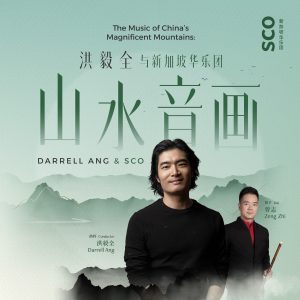
Singapore Chinese Orchestra (SCO) presents The Music of China’s Magnificent Mountains under the baton of the prodigious Singaporean conductor Darrell Ang, a long-time collaborator with SCO and a leading figure in the local and international music scenes. Ang is known for his versatility in working with musicians across different genres and cultures, as well as his visionary approach to interpretation and curation. As a nature lover, Ang has programmed this concert in response to his admiration for the natural world. Under the overarching theme of mountains, the program embarks on a sonic journey across China, exploring the distinct landscapes and cultures of its most celebrated peaks.
The opening piece, Portraits of Mount Wuyi Landscape by Liu Bin, is inspired by the Wuyi Mountains in northern Fujian province, known for its staggering mountain ranges, meandering rivers, tea culture, and rich folk spirit. As such, the four movements take their inspiration from these aspects of the Wuyi Mountains respectively, painting a series of musical portraits that blend the natural landscape with human cultures, symbolising the peaceful co-existence of both.
After exploring the mountains of southern China, we travel to the north with a well-known classic inspired by the magnificence of the Great Wall: The Great Wall Capriccio by Liu Wenjin. Originally composed as an erhu concerto, this piece was later rearranged into an orchestral version by the composer based on musical materials from the original concerto. Similar to the opening piece, the music explores both natural landscapes, such as mountains and rivers crossed by the Great Wall, as well as the Great Wall itself as a cultural heritage, radiating in majestic grandeur.
The first half of the concert closes with a piece that is inspired by the Va people of Yunnan: the first movement from Dianxi Folk Tunes by Guo Wenjing. The piece is inspired by the mountainous region where the Va people live, as well as some of their cultural practices. Listen out for the majestic opening with chordal textures and percussive timbres, representing the grandeur of the mountains, and how that then develops with the juxtaposition of more lyrical and melodious passages.
As we enter the second half of the concert, we are greeted by The Capriccio of the Mountain Folk Song, a dizi concerto by Wang Dongxu. A prize-winning work at the Singapore International Competition for Chinese Orchestral Composition in 2011, this piece will be performed by Zeng Zhi, who also gave its premiere that same year. We are once again brought back to Fujian, this time with a folk song, Can’t Be Happy Without Singing Folk Songs from the Qingliu region. Here, the dizi takes us on a different journey from the first half through its soloistic flair, exploring its virtuosity, lyricism, and dialogue with the orchestra, presented in five distinct sections that culminate in the presentation of the folk song in its entirety.
Concluding the evening with yet another mountain-inspired piece is Sketches in Mountains of Guizhou by Zhu Jian’Er. Originally scored for symphonic orchestra, the piece consists of four movements, each based on folk melodies in Guizhou, highlighting both the natural beauty and cultural richness of the region, known for its ethnic diversity. The composer, who lived in the villages of Guizhou to collect folk melodies for this piece, fuses Western orchestration and compositional techniques with regional musical features, producing a unique harmonic language featuring polytonality, non-triadic and modal harmony. This monumental piece, written in 1982, has since been one of the most significant Chinese symphonic works, setting the groundwork for subsequent generations of Chinese composers. As we approach the end of the concert, it becomes clear that the programme’s unifying theme extends beyond the image of mountains to encompass the cultural landscapes of the various regions. When these contexts are interpreted into sound, music becomes a means through which we may both appreciate and honour nature. In this light, and as a nod to Ang’s reverence for the natural world, the programme ultimately gestures toward a vision of cultural expression and nature existing in peaceful co-existence.