EN
EN 中文
中文
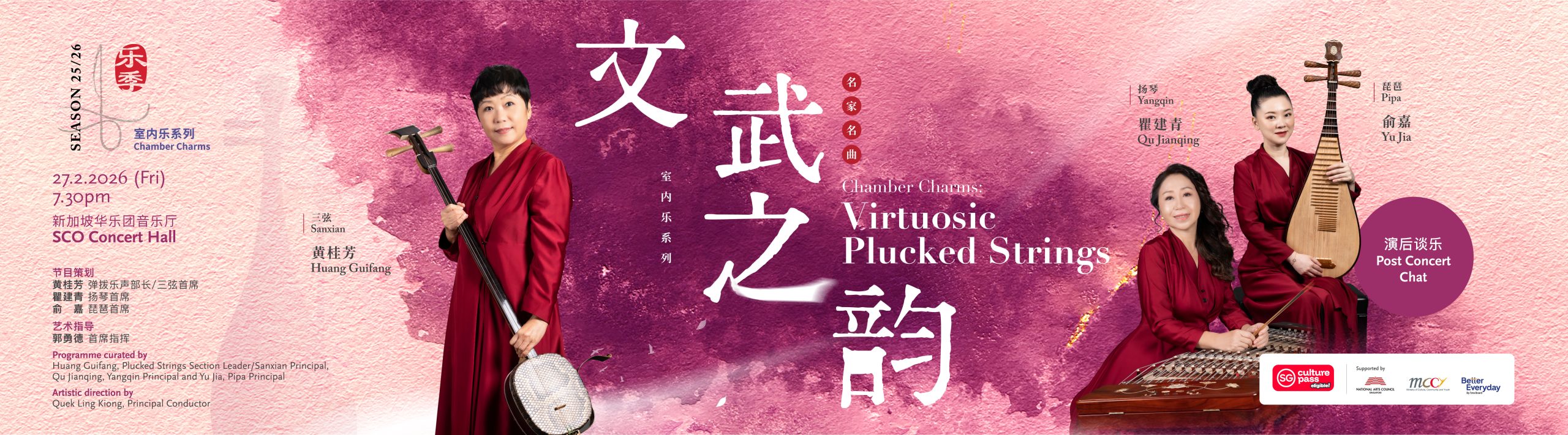


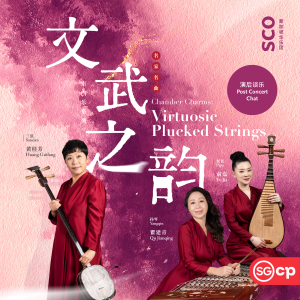
The division of “civil” and “martial” styles in Chinese traditional music is one of its most distinctive aesthetic features. “Civil” works evoke delicate emotions, refined moods, and atmospheric imagery, while “martial” works convey strength, vigor, and heroic grandeur. From the portrayal of noble character in Summer•Lotus to the sweeping, emotionally charged Night Thoughts, Virtuosic Plucked Strings presents some of the most representative and inventive works in both traditions.
Two of acclaimed yangqin master and educator Xiang Zuhua’s most frequently performed works for yangqin, Summer•Lotus and Night Escape of Lin Chong, are featured tonight. Summer•Lotus, inspired by Guangdong Han music, showcases its characteristic elegance and delicate, flowing style. In contrast, Night Escape of Lin Chong draws on the famous Kunqu martial sequence of the same title, portraying the tragic hero’s fateful encounters in the renowned Chinese classic The Water Margin. Both works demonstrate Xiang Zuhua’s highly innovative and influential approach to the yangqin, exploiting its acoustical possibilities through techniques such as altering pitch and timbre with a metallic ring and finger pressure, using a plectrum for tremolo, and employing double-headed mallets for chord production.
Song-Poem: Happy Together, one of the “Thirteen Suites for Strings” popular during the Ming and Qing dynasties, is a civil piece that embodies the refined spirit of literati skilled in courtly arts. These suites, compiled by the Mongolian scholar Rong Zhai in 1814, were intended for the distinctive combination of one huqin with three plucked strings (pipa, sanxian, and zheng). Iconic examples from the collection include The Moon is High, The General’s Command, Three Variations on the Yangguan, and The Gyrfalcon. Tonight’s sanxian version follows the interpretation of the aristocratic musician Pu Xuezhai, edited by Xiao Jiansheng. Fluent in guqin, sanxian, calligraphy, and painting, Pu (1893–1966) was also the elder cousin of the Qing dynasty’s last emperor, Puyi.
Following Song-Poem: Happy Together are two further graceful and evocative “civil” pieces: pipa master Lin Shicheng’s transcription of Mountains and Stream (based on Cao Dongfu’s musical reinterpretation), and composer Zhou Chenglong’s trio Charms of Tanci. Tonight’s pipa solo version of Mountains and Stream belongs to a long lineage of instrumental adaptations inspired by the legendary, moving tale of deep friendship between Yu Boya and Zhong Ziqi. The work is rooted in the tradition of bantou pieces, instrumental preludes used in Henan Dadiao (major-tune) narrative singing. Charms of Tanci captures the refined musical poise of Suzhou Tanci, a narrative singing tradition of the Jiangnan region commonly accompanied by sanxian and pipa.
Similar to the pipa version of Mountains and Stream, Variations in Three Positions (“Sanfan”) is derived from instrumental interludes in narrative performance traditions, specifically Meihua Dagu (Plum Blossom Drum Ballad) of northern China. This genre emerged in the mid-Qing dynasty and flourished in Beijing and Tianjin. Two of Meihua Dagu’s most striking and virtuosic features are its collaborative multi-instrumental playing and the vibrant, expansive “sanfan” major interludes. The sanxian arrangement by Wang Zhi and Tan Longjian embraces florid melodic ornamentation that traverses multiple positions and registers to highlight the instrument’s technical range and dramatic expressive power.
The final three works of the concert—the ancient pipa piece The Conqueror Unarms (Liu Dehai’s version), yangqin solo Night Escape of Lin Chong and the Peking opera tune Night Thoughts (Liu Dehai’s arrangement)—are all classic martial pieces imbued with heroic tragedy. The Conqueror Unarms portrays Xiang Yu, the Hegemon-King of Western Chu, in the anguish of defeat at Gaixia and his farewell to Consort Yu. Night Thoughts, drawn from the Chinese opera Farewell My Concubine and operatic scene Beating the Drum to Scold Cao Cao, employs percussion to evoke both the poignant, final sword dance of Consort Yu and the defiant, righteous spirit of Mi Heng as he confronts authority.
Presented by Section Leader and Sanxian Principal Huang Guifang, Yangqin Principal Qu Jianqing, and Pipa Principal Yu Jia, under the artistic direction of Principal Conductor Quek Ling Kiong, this program of four “civil” and four “martial” musical gems thoroughly showcases the expressive qualities of each plucked string instrument. Through vivid scenes and rich emotions, the audience is invited to relive the enduring grace and romance of Chinese history.