 EN
EN 中文
中文
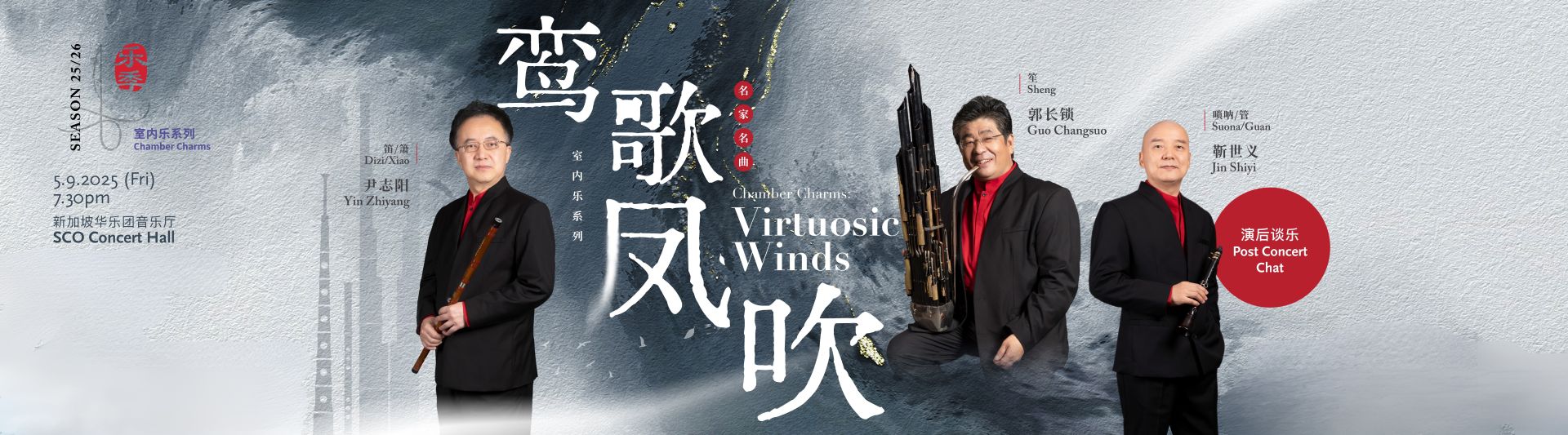

Chamber Charms:
Virtuosic Winds


- Sheng: Guo Changsuo
Composed by Yan Haideng
The Alluring Span of the Peacock
Composed by Yan Haideng
The Alluring Span of the Peacock is a sheng solo piece composed by Yan Haideng in 1957. The peacock is an auspicious animal, and this piece pays tribute to the joyous life of the working class through a depiction of the beauty of the peacock. This piece is based on the tunes of folk songs from Jinbei, Shanxi, and consists of five parts:
(i) Part 1 composes of ad libitum segments in which the rhythms flow freely. Through contrasts between quick and slow rhythms and speeds, as well as between traditional chords and single notes, the composition is upbeat and lively. Especially worth highlighting is the feature that long notes are embellished by dayin (a tapping technique), the nimble quality of the notes painting a vivid picture of a peacock spreading its wings and preparing to take flight.
(ii) Part 2 adopts a mesmerising song-like largo, in which we hear the sheng being played using the hushe technique (a trilling technique) to create a beautiful, relaxed, and lyrical mood. A breathtaking scene of a peacock spreading its vibrant feathers while basking in twilight colors unfolds before the listeners' eyes.
(iii) The tempo in Part 3 changes to a spirited allegretto. Here, the sheng plays chords, single notes, and shuangtu (double tongue) notes successively to paint an energetic and intriguing picture of a peacock hopping and playing in joy.
(iv) Part 4 goes even faster, as the musician employs techniques such as the animated santu (triple tongue) to play short and repeated segments that are highlighted by embellishing notes, as well as sections that echo each other. These elements combine to bring the musical piece to an emotive climax.
(v) Part 5 recreates the flowing melody of Part 2 to paint a poetic and charming scene. As the last segment trails off, it is as if the peacock is flying towards the horizon, disappearing into the distance.
Yan Haideng
Yan Haideng (1930-2004) is a Chinese musician well-versed in the sheng. Besides having composed numerous sheng pieces, Yan Haideng has also written a sheng guidebook titled "How to Play the Sheng" in collaboration with Gao Jinxiang and Xiao Yunxiang. Yan Haideng started his musical training from the time he was a child, as a member of a drums troupe. He excelled in the sheng and was recommended by the dizi musician Liu Guanyue to enroll in the Tianjin People's Art Theater (known as the Tianjin Opera and Dance House today). He has performed outside of China many times on trips with Chinese performance groups, Tianjin Opera and Dance Troupe, and the Consolation Troupe of Literature and Art to North Korea in places such as North Korea, Afghanistan, Egypt, Syria, Japan, and Western European countries.

Yan Haideng
Yan Haideng (1930-2004) is a Chinese musician well-versed in the sheng. Besides having composed numerous sheng pieces, Yan Haideng has also written a sheng guidebook titled "How to Play the Sheng" in collaboration with Gao Jinxiang and Xiao Yunxiang. Yan Haideng started his musical training from the time he was a child, as a member of a drums troupe. He excelled in the sheng and was recommended by the dizi musician Liu Guanyue to enroll in the Tianjin People's Art Theater (known as the Tianjin Opera and Dance House today). He has performed outside of China many times on trips with Chinese performance groups, Tianjin Opera and Dance Troupe, and the Consolation Troupe of Literature and Art to North Korea in places such as North Korea, Afghanistan, Egypt, Syria, Japan, and Western European countries.
Featuring

Guo Changsuo
Beijing-born Guo Changsuo has a love for music since young. He started learning sheng from Wu Xing Shui at the age of nine, and with excellent results, he gained entry into the affiliated secondary school of the Central Conservatory of Music in 1979, studying under the tutelage of Lin Fu Gui. He was later transferred to the affiliated secondary school of the China Conservatory of Music in 1981. Guo Changsuo entered the Chinese Music Department of China Conservatory of Music in 1982 and studied under Zhang Zhi Liang. He represented the conservatory to perform in Hong Kong and was well commended. He joined the China Central Chinese Orchestra as a sheng performer in 1986 and has performed in Japan, Singapore, Hong Kong and Macau. He scored the highest mark in the woodwind and percussion category in the arts examination conducted by the China Cultural Department in 1997. He then joined the Singapore Chinese Orchestra as a sheng performer in late 1997 and is currently the sheng sectional principal.
Guo Changsuo’s delicate, skillful and touching performance has won him numerous commendations.
Gaoyin Sheng
Sheng
Guo Changsuo
Beijing-born Guo Changsuo has a love for music since young. He started learning sheng from Wu Xing Shui at the age of nine, and with excellent results, he gained entry into the affiliated secondary school of the Central Conservatory of Music in 1979, studying under the tutelage of Lin Fu Gui. He was later transferred to the affiliated secondary school of the China Conservatory of Music in 1981. Guo Changsuo entered the Chinese Music Department of China Conservatory of Music in 1982 and studied under Zhang Zhi Liang. He represented the conservatory to perform in Hong Kong and was well commended. He joined the China Central Chinese Orchestra as a sheng performer in 1986 and has performed in Japan, Singapore, Hong Kong and Macau. He scored the highest mark in the woodwind and percussion category in the arts examination conducted by the China Cultural Department in 1997. He then joined the Singapore Chinese Orchestra as a sheng performer in late 1997 and is currently the sheng sectional principal.
Guo Changsuo’s delicate, skillful and touching performance has won him numerous commendations.
- Sheng: Guo Changsuo
- Xiao: Yin Zhiyang
- Guzheng: Xu Hui
Ancient tune, arranged by Du Ciwen
Autumn Yearning at the Dressing Table
Ancient tune, arranged by Du Ciwen
Autumn Yearning at the Dressing Table is an ancient tune. It first appeared as the fourth tune in the pipa suite Songs of the Frontier and was later adapted to xiao solo, guzheng solo and other versions. The piece depicts Wang Zhaojun's arrival at the frontier, grooming herself at the dressing table and evoking self-pity and homesickness.
Du Ciwen
Du Ciwen is a renowned dizi player and first-class performer from China. Over the many years of his career in the arts, he has received numerous accolades both in China and other countries. He has also been a part of many major national-level music performances and exchange programmes. His most famous works, such as Autumn Yearning at the Dressing Table, Song of Chu, Alishan, Do You Hear the Song of My Dizi, and Sunshine in Pamirs enjoy great popularity. These pieces, well-known not just in China but also internationally, have been selected for inclusion in standardized textbooks used throughout China.
Du Ciwen
Du Ciwen is a renowned dizi player and first-class performer from China. Over the many years of his career in the arts, he has received numerous accolades both in China and other countries. He has also been a part of many major national-level music performances and exchange programmes. His most famous works, such as Autumn Yearning at the Dressing Table, Song of Chu, Alishan, Do You Hear the Song of My Dizi, and Sunshine in Pamirs enjoy great popularity. These pieces, well-known not just in China but also internationally, have been selected for inclusion in standardized textbooks used throughout China.
Featuring

Yin Zhiyang
Yin Zhiyang started learning the violin and dizi from his father at the age of eight and later, under the tutelage of professor of Shenyang Conservatory of Music, Kong Qingshan and professor of China Conservatory of Music, Zhang Weiliang. After graduating from the China Conservatory of Music in 1991, he served in the China Central Song and Dance Troupe as a soloist. He joined the SCO in October 1997 as a dizi performer and he is currently the Dizi Principal. He is also the guest professor of Shenyang Conservatory of Music.
Yin Zhiyang received an Outstanding Performance Award at the China National Chinese Music Competition Shan Cheng Cup in 1989 and came in First at the China Central Song and Dance Troupe Audition in 1992. In 1988, Yin Zhiyang performed Bangdi Concerto by Taiwanese composer Ma Shuilong at the Beijing Concert Hall with the China Central Chinese Orchestra, and received critical acclaim for his interpretation. He held a well-received solo recital at the Beijing Concert Hall in 1990, and contributed to music education as an adjudicator with the First Beijing Primary and Secondary School Chinese Instrumental Music Competition in 1994.
He has also produced a solo album of dizi recital pieces. Yin Zhiyang has participated in performances in China, Japan, Vietnam, Malaysia, Hungary, England, France, Taiwan, and Macau. His signature rendition of Divine Melody at the Singapore Arts Festival and London’s Barbican Centre remains talked about today in music circles. A lively music director and chamber musician, he has led performances of works including Butterfly Dreams Concerto, Capriccio of Liu San Jie, San Jie and Cang. In 2008, he performed with the Singapore Symphony Orchestra on Zhu Jian-er’s Fourth Symphony. Later in the same year, he performed Three Variations of the Parting at Yangguan as a soloist in a concert at The Sage Gateshead arts centre in the United Kingdom, with a chamber group from the SCO. In 2009, he returned to the UK with the orchestra, performing at the Edinburgh International Festival as a dizi soloist. In 2010, he held a concert for himself and his students proving his success once again as a remarkable artist.
Qudi
Dizi
Yin Zhiyang
Yin Zhiyang started learning the violin and dizi from his father at the age of eight and later, under the tutelage of professor of Shenyang Conservatory of Music, Kong Qingshan and professor of China Conservatory of Music, Zhang Weiliang. After graduating from the China Conservatory of Music in 1991, he served in the China Central Song and Dance Troupe as a soloist. He joined the SCO in October 1997 as a dizi performer and he is currently the Dizi Principal. He is also the guest professor of Shenyang Conservatory of Music.
Yin Zhiyang received an Outstanding Performance Award at the China National Chinese Music Competition Shan Cheng Cup in 1989 and came in First at the China Central Song and Dance Troupe Audition in 1992. In 1988, Yin Zhiyang performed Bangdi Concerto by Taiwanese composer Ma Shuilong at the Beijing Concert Hall with the China Central Chinese Orchestra, and received critical acclaim for his interpretation. He held a well-received solo recital at the Beijing Concert Hall in 1990, and contributed to music education as an adjudicator with the First Beijing Primary and Secondary School Chinese Instrumental Music Competition in 1994.
He has also produced a solo album of dizi recital pieces. Yin Zhiyang has participated in performances in China, Japan, Vietnam, Malaysia, Hungary, England, France, Taiwan, and Macau. His signature rendition of Divine Melody at the Singapore Arts Festival and London’s Barbican Centre remains talked about today in music circles. A lively music director and chamber musician, he has led performances of works including Butterfly Dreams Concerto, Capriccio of Liu San Jie, San Jie and Cang. In 2008, he performed with the Singapore Symphony Orchestra on Zhu Jian-er’s Fourth Symphony. Later in the same year, he performed Three Variations of the Parting at Yangguan as a soloist in a concert at The Sage Gateshead arts centre in the United Kingdom, with a chamber group from the SCO. In 2009, he returned to the UK with the orchestra, performing at the Edinburgh International Festival as a dizi soloist. In 2010, he held a concert for himself and his students proving his success once again as a remarkable artist.

Xu Hui
Xu Hui started learning the guzheng at a tender age. She was admitted to the Shanghai Conservatory of Music. Under the tutelage of Associate Professor Guo Xue Jun, Xu Hui studied the guzheng, and concurrently studied percussion under Professor Yang Ru Wen. During her course of study, she was awarded scholarships for four consecutive years. She is currently a Guzheng Associate Principal and Percussionist with the Singapore Chinese Orchestra. Xu Hui is a guzheng instructor at the Nanyang Academy of Fine Arts and she is also in the Executive Committee of the Singapore Qinzheng Association.
Xu Hui was the champion at the 1992 International Jiangnan Sizhu Competition. In the same year, she won the first prize at the Shanghai Young Talents Guzheng Competition. Xu Hui was also the first-prize winner at the Eastern China Youth Chinese Music Competition for two consecutive years. In addition, she was awarded a silver medal at the National Cultural Stars Award in 1995.
Xu Hui has staged many performances throughout Asia, Europe and America. She has performed numerous guzheng concertos which include: Midnight at the Maple Bridge, Wind of Falling Plum Blossom, A Peacock Southeast Flew, Desert Dust, Mountains and Water, Dunhuang Tang Ren Wu, Three Characters Classics Capriccio and more. Xu Hui has also performed and staged 3 solo guzheng recital concerts at the Esplanade — Theatres By the Bay. Xu Hui has also collaborated with many renowned musicians and composers and her performances have received well acclaims.
In terms of teaching, Xu Hui has inspired her students to achieve excellence, with many of her students winning various accolades from local and overseas competitions, such as the Singapore Chinese Music Competition (previously known as National Chinese Music Competition), Nanyang International Music Competition and Eastern China Youth Chinese Music Competition.
Guzheng / Percussion
Xu Hui
Xu Hui started learning the guzheng at a tender age. She was admitted to the Shanghai Conservatory of Music. Under the tutelage of Associate Professor Guo Xue Jun, Xu Hui studied the guzheng, and concurrently studied percussion under Professor Yang Ru Wen. During her course of study, she was awarded scholarships for four consecutive years. She is currently a Guzheng Associate Principal and Percussionist with the Singapore Chinese Orchestra. Xu Hui is a guzheng instructor at the Nanyang Academy of Fine Arts and she is also in the Executive Committee of the Singapore Qinzheng Association.
Xu Hui was the champion at the 1992 International Jiangnan Sizhu Competition. In the same year, she won the first prize at the Shanghai Young Talents Guzheng Competition. Xu Hui was also the first-prize winner at the Eastern China Youth Chinese Music Competition for two consecutive years. In addition, she was awarded a silver medal at the National Cultural Stars Award in 1995.
Xu Hui has staged many performances throughout Asia, Europe and America. She has performed numerous guzheng concertos which include: Midnight at the Maple Bridge, Wind of Falling Plum Blossom, A Peacock Southeast Flew, Desert Dust, Mountains and Water, Dunhuang Tang Ren Wu, Three Characters Classics Capriccio and more. Xu Hui has also performed and staged 3 solo guzheng recital concerts at the Esplanade — Theatres By the Bay. Xu Hui has also collaborated with many renowned musicians and composers and her performances have received well acclaims.
In terms of teaching, Xu Hui has inspired her students to achieve excellence, with many of her students winning various accolades from local and overseas competitions, such as the Singapore Chinese Music Competition (previously known as National Chinese Music Competition), Nanyang International Music Competition and Eastern China Youth Chinese Music Competition.
- Xiao: Yin Zhiyang
- Guzheng: Xu Hui
- Guan: Jin Shiyi
Ancient tune, rearranged by Mao Kuangping & Hu Zhihou & Huang Xiaofei
Farewell at Yangguan
Ancient tune, rearranged by Mao Kuangping & Hu Zhihou & Huang Xiaofei
Based on the famous Tang Dynasty poem Farewell at Weicheng by the renowned poet Wang Wei, the work consists of 3 stanzas of lyrics and music accompaniment. The subtle and restrained expression gradually conveys the deep emotions of ancient Chinese scholars when they part from family and friends, as well as their heartfelt wishes for those embarking on distant journeys.
Hu Zhihou
Hu Zhihou, renowned guanzi performer and educator, Professor at the Central Conservatory of Music’s Department of Chinese Instruments. In 1952, he was admitted to the conservatory’s junior programme (now the affiliated high school). As a student and sole successor of the famous musician Yang Yuanheng, he inherited nearly lost virtuoso techniques of the guanzi. After graduating in 1964, he continued teaching at the same conservatory as China’s first professional guanzi instructor.
Hu Zhihou
Hu Zhihou, renowned guanzi performer and educator, Professor at the Central Conservatory of Music’s Department of Chinese Instruments. In 1952, he was admitted to the conservatory’s junior programme (now the affiliated high school). As a student and sole successor of the famous musician Yang Yuanheng, he inherited nearly lost virtuoso techniques of the guanzi. After graduating in 1964, he continued teaching at the same conservatory as China’s first professional guanzi instructor.
Huang Xiaofei
Huang Xiaofei is a conductor, composer, professor at the China Conservatory of Music and a member of the China Musicians Association. Upon graduated from the Department of Composition at the Central Conservatory of Music, Huang Xiaofei remained in her alma mater where she taught at the Chinese Music Department. She later joined the China Conservatory of Music. She had previously held positions as conductor and composer at the Hubei Opera Troupe, China Movie Chinese Orchestra and Dongfang Opera Troupe. In 1992, she was appointed as the professor of the China Conservatory of Music. In 1994, she received a medal and sponsorship from the State Council of the People's Republic of China for her outstanding contribution to the development of Chinese Arts and Culture. While teaching at the China Conservatory of Music, she was invited to conduct and teach in various states and countries including Hong Kong, Taiwan, Singapore and Korea.
Huang Xiaofei
Huang Xiaofei is a conductor, composer, professor at the China Conservatory of Music and a member of the China Musicians Association. Upon graduated from the Department of Composition at the Central Conservatory of Music, Huang Xiaofei remained in her alma mater where she taught at the Chinese Music Department. She later joined the China Conservatory of Music. She had previously held positions as conductor and composer at the Hubei Opera Troupe, China Movie Chinese Orchestra and Dongfang Opera Troupe. In 1992, she was appointed as the professor of the China Conservatory of Music. In 1994, she received a medal and sponsorship from the State Council of the People's Republic of China for her outstanding contribution to the development of Chinese Arts and Culture. While teaching at the China Conservatory of Music, she was invited to conduct and teach in various states and countries including Hong Kong, Taiwan, Singapore and Korea.
Featuring

Jin Shiyi
Jin Shiyi is the President of the Singapore Suona and Guan Society, Suona/Guan Principal of the Singapore Chinese Orchestra, and the first musician in China to achieve a Master’s degree in guanzi performance. His biography is also recorded in The Best of Traditional Chinese Music, Instruments and Musicians. Having shown his musical talent at a young age, he received tutelage from masters such as Zhang Baoling, Liu Fengtong, Hu Haiquan, Hu Zhihou, Zhang Jigui and Cao Jianguo. Jin Shiyi was recruited by the China Movie Orchestra at the tender age of 12. In 1986, Jin Shiyi enrolled into the China Conservatory of Music and graduated with a Master’s degree in 1992. He was offered a teaching position in the Conservatory Department of Instrumental Music upon his graduation from the conservatory.
From 1989 to 2000, Jin Shiyi staged various solo concerts in Beijing, Singapore and Malaysia. He was also invited as a soloist to perform in Taiwan Traditional Arts Festival and Korean Seoul International Folk Music Festival. He has also composed and rearranged a series of suona and guanzi pieces, including Seeking Dreams In The Western Regions, Tribute To Homeland, , The Dark Sky, Hip Hop Orchard Road, The Winds of Marina Bay, Xiao Bai Cai, Wife and West Beyond the Yangguan Pass, to name a few. Moreover, Jin Shiyi and Singapore Chinese Orchestra’s Diyin Suona player, Liu Jiang, created a single reed instrument developed based on the traditional double reed guan named SINGuan, which is highly acclaimed by music critics.
Gaoyin Suona
Suona / Guan
Jin Shiyi
Jin Shiyi is the President of the Singapore Suona and Guan Society, Suona/Guan Principal of the Singapore Chinese Orchestra, and the first musician in China to achieve a Master’s degree in guanzi performance. His biography is also recorded in The Best of Traditional Chinese Music, Instruments and Musicians. Having shown his musical talent at a young age, he received tutelage from masters such as Zhang Baoling, Liu Fengtong, Hu Haiquan, Hu Zhihou, Zhang Jigui and Cao Jianguo. Jin Shiyi was recruited by the China Movie Orchestra at the tender age of 12. In 1986, Jin Shiyi enrolled into the China Conservatory of Music and graduated with a Master’s degree in 1992. He was offered a teaching position in the Conservatory Department of Instrumental Music upon his graduation from the conservatory.
From 1989 to 2000, Jin Shiyi staged various solo concerts in Beijing, Singapore and Malaysia. He was also invited as a soloist to perform in Taiwan Traditional Arts Festival and Korean Seoul International Folk Music Festival. He has also composed and rearranged a series of suona and guanzi pieces, including Seeking Dreams In The Western Regions, Tribute To Homeland, , The Dark Sky, Hip Hop Orchard Road, The Winds of Marina Bay, Xiao Bai Cai, Wife and West Beyond the Yangguan Pass, to name a few. Moreover, Jin Shiyi and Singapore Chinese Orchestra’s Diyin Suona player, Liu Jiang, created a single reed instrument developed based on the traditional double reed guan named SINGuan, which is highly acclaimed by music critics.
- Guan: Jin Shiyi
- Sheng: Guo Changsuo
Henan folk tune, arranged by Li Guanglu
Grand Prelude
Henan folk tune, arranged by Li Guanglu
The music was rearranged based on traditional Henan music, Prelude of the Folk Song. The music was originally a joyous and cheerful opening piece featuring zhuihu (a bowed instrument). The music is full of joy and excitement. Techniques such as the mordent, glissando and polyphony, which are unique to the traditional sheng, are demonstrated in this piece.
Li Guanglu
Li Guanglu is a famous sheng player, educator, and music activist from China. Not just a highly-skilled performer, Li Guanglu is also a talented composer. Being a professional dedicated to the research and promotion of the sheng, he has produced many anthologies related to the sheng, acted as the editor-in-chief on several sheng publications and written numerous academic papers on the arts. Li Guanglu has created and adapted a large number of music pieces, both Chinese and foreign, to highlight the unique characteristics of the sheng. The most iconic work of this type is Fantasia on The Legend of the White Snake.
Li Guanglu
Li Guanglu is a famous sheng player, educator, and music activist from China. Not just a highly-skilled performer, Li Guanglu is also a talented composer. Being a professional dedicated to the research and promotion of the sheng, he has produced many anthologies related to the sheng, acted as the editor-in-chief on several sheng publications and written numerous academic papers on the arts. Li Guanglu has created and adapted a large number of music pieces, both Chinese and foreign, to highlight the unique characteristics of the sheng. The most iconic work of this type is Fantasia on The Legend of the White Snake.
Featuring
Guo Changsuo
Beijing-born Guo Changsuo has a love for music since young. He started learning sheng from Wu Xing Shui at the age of nine, and with excellent results, he gained entry into the affiliated secondary school of the Central Conservatory of Music in 1979, studying under the tutelage of Lin Fu Gui. He was later transferred to the affiliated secondary school of the China Conservatory of Music in 1981. Guo Changsuo entered the Chinese Music Department of China Conservatory of Music in 1982 and studied under Zhang Zhi Liang. He represented the conservatory to perform in Hong Kong and was well commended. He joined the China Central Chinese Orchestra as a sheng performer in 1986 and has performed in Japan, Singapore, Hong Kong and Macau. He scored the highest mark in the woodwind and percussion category in the arts examination conducted by the China Cultural Department in 1997. He then joined the Singapore Chinese Orchestra as a sheng performer in late 1997 and is currently the sheng sectional principal.
Guo Changsuo’s delicate, skillful and touching performance has won him numerous commendations.
Gaoyin Sheng
Sheng
Guo Changsuo
Beijing-born Guo Changsuo has a love for music since young. He started learning sheng from Wu Xing Shui at the age of nine, and with excellent results, he gained entry into the affiliated secondary school of the Central Conservatory of Music in 1979, studying under the tutelage of Lin Fu Gui. He was later transferred to the affiliated secondary school of the China Conservatory of Music in 1981. Guo Changsuo entered the Chinese Music Department of China Conservatory of Music in 1982 and studied under Zhang Zhi Liang. He represented the conservatory to perform in Hong Kong and was well commended. He joined the China Central Chinese Orchestra as a sheng performer in 1986 and has performed in Japan, Singapore, Hong Kong and Macau. He scored the highest mark in the woodwind and percussion category in the arts examination conducted by the China Cultural Department in 1997. He then joined the Singapore Chinese Orchestra as a sheng performer in late 1997 and is currently the sheng sectional principal.
Guo Changsuo’s delicate, skillful and touching performance has won him numerous commendations.
- Sheng: Guo Changsuo
- Dizi: Yin Zhiyang
- Guzheng: Xu Hui
Hunan folk tune, rearranged by Zhao Songting
Orchestrated by Zhang Weiliang
Partridges Flying
Hunan folk tune, rearranged by Zhao Songting
Orchestrated by Zhang Weiliang
Partridges Flying is one of the representative work of Jiangnan dizi. Originally a Hunan folk piece, the music score was first seen in the Chinese Yayue Collection compiled by Yan Gufan in 1926. Dizi virtuoso Zhao Songting rearranged the music based on a poem by Li Bai from the Tang dynasty. In the music performance, the artistic contrast of mellow and delicate, fast and slow, strong and weak, depicts flying partridges far and near, high and low. Allegro is played continuously with the circular breathing technique, from dazzling to unpretentious, achieving the profundity in music.
Zhao Songting
Zhao Songting (1924–2001), a native of Dongyang, Zhejiang, was a renowned dizi master and one of the most influential figures in modern dizi music. Known as the "King of Jiangnan Dizi", he was the founder of the Zhejiang style of dizi performance. Over a career spanning six decades, Zhao integrated northern and southern playing styles and was the first to introduce circular breathing techniques into dizi performance, significantly advancing its artistry. His representative works, such as Morning and San Wu Qi, remain widely performed. He also invented the paidi (Chinese-style pan flute) and authored several important theoretical texts on dizi playing. Zhao held key positions including Honorary President of Zhejiang Art School (now Zhejiang Vocational Academy of Art), Vice Chairman of the Chinese National Orchestra Society, and was a prominent advocate for music education and the preservation of traditional Chinese music.
Zhao Songting
Zhao Songting (1924–2001), a native of Dongyang, Zhejiang, was a renowned dizi master and one of the most influential figures in modern dizi music. Known as the "King of Jiangnan Dizi", he was the founder of the Zhejiang style of dizi performance. Over a career spanning six decades, Zhao integrated northern and southern playing styles and was the first to introduce circular breathing techniques into dizi performance, significantly advancing its artistry. His representative works, such as Morning and San Wu Qi, remain widely performed. He also invented the paidi (Chinese-style pan flute) and authored several important theoretical texts on dizi playing. Zhao held key positions including Honorary President of Zhejiang Art School (now Zhejiang Vocational Academy of Art), Vice Chairman of the Chinese National Orchestra Society, and was a prominent advocate for music education and the preservation of traditional Chinese music.
Featuring
Yin Zhiyang
Yin Zhiyang started learning the violin and dizi from his father at the age of eight and later, under the tutelage of professor of Shenyang Conservatory of Music, Kong Qingshan and professor of China Conservatory of Music, Zhang Weiliang. After graduating from the China Conservatory of Music in 1991, he served in the China Central Song and Dance Troupe as a soloist. He joined the SCO in October 1997 as a dizi performer and he is currently the Dizi Principal. He is also the guest professor of Shenyang Conservatory of Music.
Yin Zhiyang received an Outstanding Performance Award at the China National Chinese Music Competition Shan Cheng Cup in 1989 and came in First at the China Central Song and Dance Troupe Audition in 1992. In 1988, Yin Zhiyang performed Bangdi Concerto by Taiwanese composer Ma Shuilong at the Beijing Concert Hall with the China Central Chinese Orchestra, and received critical acclaim for his interpretation. He held a well-received solo recital at the Beijing Concert Hall in 1990, and contributed to music education as an adjudicator with the First Beijing Primary and Secondary School Chinese Instrumental Music Competition in 1994.
He has also produced a solo album of dizi recital pieces. Yin Zhiyang has participated in performances in China, Japan, Vietnam, Malaysia, Hungary, England, France, Taiwan, and Macau. His signature rendition of Divine Melody at the Singapore Arts Festival and London’s Barbican Centre remains talked about today in music circles. A lively music director and chamber musician, he has led performances of works including Butterfly Dreams Concerto, Capriccio of Liu San Jie, San Jie and Cang. In 2008, he performed with the Singapore Symphony Orchestra on Zhu Jian-er’s Fourth Symphony. Later in the same year, he performed Three Variations of the Parting at Yangguan as a soloist in a concert at The Sage Gateshead arts centre in the United Kingdom, with a chamber group from the SCO. In 2009, he returned to the UK with the orchestra, performing at the Edinburgh International Festival as a dizi soloist. In 2010, he held a concert for himself and his students proving his success once again as a remarkable artist.
Qudi
Dizi
Yin Zhiyang
Yin Zhiyang started learning the violin and dizi from his father at the age of eight and later, under the tutelage of professor of Shenyang Conservatory of Music, Kong Qingshan and professor of China Conservatory of Music, Zhang Weiliang. After graduating from the China Conservatory of Music in 1991, he served in the China Central Song and Dance Troupe as a soloist. He joined the SCO in October 1997 as a dizi performer and he is currently the Dizi Principal. He is also the guest professor of Shenyang Conservatory of Music.
Yin Zhiyang received an Outstanding Performance Award at the China National Chinese Music Competition Shan Cheng Cup in 1989 and came in First at the China Central Song and Dance Troupe Audition in 1992. In 1988, Yin Zhiyang performed Bangdi Concerto by Taiwanese composer Ma Shuilong at the Beijing Concert Hall with the China Central Chinese Orchestra, and received critical acclaim for his interpretation. He held a well-received solo recital at the Beijing Concert Hall in 1990, and contributed to music education as an adjudicator with the First Beijing Primary and Secondary School Chinese Instrumental Music Competition in 1994.
He has also produced a solo album of dizi recital pieces. Yin Zhiyang has participated in performances in China, Japan, Vietnam, Malaysia, Hungary, England, France, Taiwan, and Macau. His signature rendition of Divine Melody at the Singapore Arts Festival and London’s Barbican Centre remains talked about today in music circles. A lively music director and chamber musician, he has led performances of works including Butterfly Dreams Concerto, Capriccio of Liu San Jie, San Jie and Cang. In 2008, he performed with the Singapore Symphony Orchestra on Zhu Jian-er’s Fourth Symphony. Later in the same year, he performed Three Variations of the Parting at Yangguan as a soloist in a concert at The Sage Gateshead arts centre in the United Kingdom, with a chamber group from the SCO. In 2009, he returned to the UK with the orchestra, performing at the Edinburgh International Festival as a dizi soloist. In 2010, he held a concert for himself and his students proving his success once again as a remarkable artist.
Xu Hui
Xu Hui started learning the guzheng at a tender age. She was admitted to the Shanghai Conservatory of Music. Under the tutelage of Associate Professor Guo Xue Jun, Xu Hui studied the guzheng, and concurrently studied percussion under Professor Yang Ru Wen. During her course of study, she was awarded scholarships for four consecutive years. She is currently a Guzheng Associate Principal and Percussionist with the Singapore Chinese Orchestra. Xu Hui is a guzheng instructor at the Nanyang Academy of Fine Arts and she is also in the Executive Committee of the Singapore Qinzheng Association.
Xu Hui was the champion at the 1992 International Jiangnan Sizhu Competition. In the same year, she won the first prize at the Shanghai Young Talents Guzheng Competition. Xu Hui was also the first-prize winner at the Eastern China Youth Chinese Music Competition for two consecutive years. In addition, she was awarded a silver medal at the National Cultural Stars Award in 1995.
Xu Hui has staged many performances throughout Asia, Europe and America. She has performed numerous guzheng concertos which include: Midnight at the Maple Bridge, Wind of Falling Plum Blossom, A Peacock Southeast Flew, Desert Dust, Mountains and Water, Dunhuang Tang Ren Wu, Three Characters Classics Capriccio and more. Xu Hui has also performed and staged 3 solo guzheng recital concerts at the Esplanade — Theatres By the Bay. Xu Hui has also collaborated with many renowned musicians and composers and her performances have received well acclaims.
In terms of teaching, Xu Hui has inspired her students to achieve excellence, with many of her students winning various accolades from local and overseas competitions, such as the Singapore Chinese Music Competition (previously known as National Chinese Music Competition), Nanyang International Music Competition and Eastern China Youth Chinese Music Competition.
Guzheng / Percussion
Xu Hui
Xu Hui started learning the guzheng at a tender age. She was admitted to the Shanghai Conservatory of Music. Under the tutelage of Associate Professor Guo Xue Jun, Xu Hui studied the guzheng, and concurrently studied percussion under Professor Yang Ru Wen. During her course of study, she was awarded scholarships for four consecutive years. She is currently a Guzheng Associate Principal and Percussionist with the Singapore Chinese Orchestra. Xu Hui is a guzheng instructor at the Nanyang Academy of Fine Arts and she is also in the Executive Committee of the Singapore Qinzheng Association.
Xu Hui was the champion at the 1992 International Jiangnan Sizhu Competition. In the same year, she won the first prize at the Shanghai Young Talents Guzheng Competition. Xu Hui was also the first-prize winner at the Eastern China Youth Chinese Music Competition for two consecutive years. In addition, she was awarded a silver medal at the National Cultural Stars Award in 1995.
Xu Hui has staged many performances throughout Asia, Europe and America. She has performed numerous guzheng concertos which include: Midnight at the Maple Bridge, Wind of Falling Plum Blossom, A Peacock Southeast Flew, Desert Dust, Mountains and Water, Dunhuang Tang Ren Wu, Three Characters Classics Capriccio and more. Xu Hui has also performed and staged 3 solo guzheng recital concerts at the Esplanade — Theatres By the Bay. Xu Hui has also collaborated with many renowned musicians and composers and her performances have received well acclaims.
In terms of teaching, Xu Hui has inspired her students to achieve excellence, with many of her students winning various accolades from local and overseas competitions, such as the Singapore Chinese Music Competition (previously known as National Chinese Music Competition), Nanyang International Music Competition and Eastern China Youth Chinese Music Competition.
- Dizi: Yin Zhiyang
- Guzheng: Xu Hui
- Suona: Jin Shiyi
- Sheng: Guo Changsuo
- Bangzi: Meng Jie
Henan folk tune, arranged by Jin Shiyi
Tribute to Homeland
Henan folk tune, arranged by Jin Shiyi
Tribute to Homeland is adapted from several folklore ‘labelled tunes’ of Henan province’s suona music. ‘Labelled tunes’ refer to melodies from various regional and historical contexts, ranging from those that are closely connected to those that share little or no relation. The structure of the music consists of moderato, allegro and a capriccioso section that uses numerous finger and tongue techniques for additional nuances to the pitch and tone as a reflection of Henan’s opera singing style. A mimicry of percussion instruments further induces humour and colour to the piece. Combined with interesting and wide-ranging textures, this piece is an excellent portrayal of the vibrancy and beauty of the suona in the Henan region.
Featuring
Jin Shiyi
Jin Shiyi is the President of the Singapore Suona and Guan Society, Suona/Guan Principal of the Singapore Chinese Orchestra, and the first musician in China to achieve a Master’s degree in guanzi performance. His biography is also recorded in The Best of Traditional Chinese Music, Instruments and Musicians. Having shown his musical talent at a young age, he received tutelage from masters such as Zhang Baoling, Liu Fengtong, Hu Haiquan, Hu Zhihou, Zhang Jigui and Cao Jianguo. Jin Shiyi was recruited by the China Movie Orchestra at the tender age of 12. In 1986, Jin Shiyi enrolled into the China Conservatory of Music and graduated with a Master’s degree in 1992. He was offered a teaching position in the Conservatory Department of Instrumental Music upon his graduation from the conservatory.
From 1989 to 2000, Jin Shiyi staged various solo concerts in Beijing, Singapore and Malaysia. He was also invited as a soloist to perform in Taiwan Traditional Arts Festival and Korean Seoul International Folk Music Festival. He has also composed and rearranged a series of suona and guanzi pieces, including Seeking Dreams In The Western Regions, Tribute To Homeland, , The Dark Sky, Hip Hop Orchard Road, The Winds of Marina Bay, Xiao Bai Cai, Wife and West Beyond the Yangguan Pass, to name a few. Moreover, Jin Shiyi and Singapore Chinese Orchestra’s Diyin Suona player, Liu Jiang, created a single reed instrument developed based on the traditional double reed guan named SINGuan, which is highly acclaimed by music critics.
Gaoyin Suona
Suona / Guan
Jin Shiyi
Jin Shiyi is the President of the Singapore Suona and Guan Society, Suona/Guan Principal of the Singapore Chinese Orchestra, and the first musician in China to achieve a Master’s degree in guanzi performance. His biography is also recorded in The Best of Traditional Chinese Music, Instruments and Musicians. Having shown his musical talent at a young age, he received tutelage from masters such as Zhang Baoling, Liu Fengtong, Hu Haiquan, Hu Zhihou, Zhang Jigui and Cao Jianguo. Jin Shiyi was recruited by the China Movie Orchestra at the tender age of 12. In 1986, Jin Shiyi enrolled into the China Conservatory of Music and graduated with a Master’s degree in 1992. He was offered a teaching position in the Conservatory Department of Instrumental Music upon his graduation from the conservatory.
From 1989 to 2000, Jin Shiyi staged various solo concerts in Beijing, Singapore and Malaysia. He was also invited as a soloist to perform in Taiwan Traditional Arts Festival and Korean Seoul International Folk Music Festival. He has also composed and rearranged a series of suona and guanzi pieces, including Seeking Dreams In The Western Regions, Tribute To Homeland, , The Dark Sky, Hip Hop Orchard Road, The Winds of Marina Bay, Xiao Bai Cai, Wife and West Beyond the Yangguan Pass, to name a few. Moreover, Jin Shiyi and Singapore Chinese Orchestra’s Diyin Suona player, Liu Jiang, created a single reed instrument developed based on the traditional double reed guan named SINGuan, which is highly acclaimed by music critics.
Guo Changsuo
Beijing-born Guo Changsuo has a love for music since young. He started learning sheng from Wu Xing Shui at the age of nine, and with excellent results, he gained entry into the affiliated secondary school of the Central Conservatory of Music in 1979, studying under the tutelage of Lin Fu Gui. He was later transferred to the affiliated secondary school of the China Conservatory of Music in 1981. Guo Changsuo entered the Chinese Music Department of China Conservatory of Music in 1982 and studied under Zhang Zhi Liang. He represented the conservatory to perform in Hong Kong and was well commended. He joined the China Central Chinese Orchestra as a sheng performer in 1986 and has performed in Japan, Singapore, Hong Kong and Macau. He scored the highest mark in the woodwind and percussion category in the arts examination conducted by the China Cultural Department in 1997. He then joined the Singapore Chinese Orchestra as a sheng performer in late 1997 and is currently the sheng sectional principal.
Guo Changsuo’s delicate, skillful and touching performance has won him numerous commendations.
Gaoyin Sheng
Sheng
Guo Changsuo
Beijing-born Guo Changsuo has a love for music since young. He started learning sheng from Wu Xing Shui at the age of nine, and with excellent results, he gained entry into the affiliated secondary school of the Central Conservatory of Music in 1979, studying under the tutelage of Lin Fu Gui. He was later transferred to the affiliated secondary school of the China Conservatory of Music in 1981. Guo Changsuo entered the Chinese Music Department of China Conservatory of Music in 1982 and studied under Zhang Zhi Liang. He represented the conservatory to perform in Hong Kong and was well commended. He joined the China Central Chinese Orchestra as a sheng performer in 1986 and has performed in Japan, Singapore, Hong Kong and Macau. He scored the highest mark in the woodwind and percussion category in the arts examination conducted by the China Cultural Department in 1997. He then joined the Singapore Chinese Orchestra as a sheng performer in late 1997 and is currently the sheng sectional principal.
Guo Changsuo’s delicate, skillful and touching performance has won him numerous commendations.

Meng Jie
Born in Tangshan, Hebei, Meng Jie is currently an honorary member of the China Nationalities Orchestra Society Suona Committee, committee member of the Suona and Guan Society (Singapore) and suona instructor and conductor to many schools in Singapore. His biography is included in The Best of Traditional Chinese Music, Instruments and Musicians (Suona Chapter).
Meng Jie started learning suona at the age of 14 under the tutelage of Yuan Zhenping. First in the entry exam in 1997, Meng Jie received his musical training in Hebei Province Arts School and was under the tutelage of Wang Hongfei. He enrolled into the China Conservatory of Music later on and was awarded the honorary title Excellent Graduate in 2006 where he was under the tutelage of Zuo Jicheng. He has also received tutelage from Chen Jiaqi, Liu Bingchen and Hao Yuqi.
Meng Jie joined the Singapore Chinese Orchestra (SCO) in 2006 and has performed with the SCO in numerous countries in Asia and Europe. He has also since staged 2 solo recitals at the Esplanade – Theatres by the Bay. He was invited to speak for online talks, in the capacity of an honorary member of the China Nationalities Orchestra Society Suona Committee and perform in online concerts.
Gaoyin Suona
Suona / Guan
Meng Jie
Born in Tangshan, Hebei, Meng Jie is currently an honorary member of the China Nationalities Orchestra Society Suona Committee, committee member of the Suona and Guan Society (Singapore) and suona instructor and conductor to many schools in Singapore. His biography is included in The Best of Traditional Chinese Music, Instruments and Musicians (Suona Chapter).
Meng Jie started learning suona at the age of 14 under the tutelage of Yuan Zhenping. First in the entry exam in 1997, Meng Jie received his musical training in Hebei Province Arts School and was under the tutelage of Wang Hongfei. He enrolled into the China Conservatory of Music later on and was awarded the honorary title Excellent Graduate in 2006 where he was under the tutelage of Zuo Jicheng. He has also received tutelage from Chen Jiaqi, Liu Bingchen and Hao Yuqi.
Meng Jie joined the Singapore Chinese Orchestra (SCO) in 2006 and has performed with the SCO in numerous countries in Asia and Europe. He has also since staged 2 solo recitals at the Esplanade – Theatres by the Bay. He was invited to speak for online talks, in the capacity of an honorary member of the China Nationalities Orchestra Society Suona Committee and perform in online concerts.
- Suona: Jin Shiyi
- Sheng: Guo Changsuo
- Bangzi: Meng Jie
- Qudi: Yin Zhiyang, Phang Thean Siong
- Bangdi: Ng Wei Xuan, Zeng Zhi
- Sheng: Guo Changsuo, Ong Yi Horng, Cheng Ho Kwan Kevin, Yang Sin-Yu, Lim Kiong Pin
- Gaoyin Suona: Jin Shiyi, Chang Le, Zhang Shuo
- Zhongyin Suona: Lee Heng Quee, Meng Jie, Boo Chin Kiah, Liu Jiang
- Drum: Boo Chong Wei Benjamin
- Timpani: Tan Loke Chuah
- Cymbal: Ngoh Kheng Seng
- Cymbal/Gong: Teo Teng Tat
- Gong: Shen Guoqin
- Suspend Cymbal/Bangzi: Wu Xiangyang
Composed by Yu Huiyong & Hu Dengtiao
rearranged by Yeo Puay Hian
Theme of Pioneers
Composed by Yu Huiyong & Hu Dengtiao
rearranged by Yeo Puay Hian
During of the end 1950s, China was undergoing a vigorous technological innovation movement. Countless outstanding figures emerged during that period. They used their superior talents to break the new technology barrier. This piece of music celebrates these fronts of the “indomitable, courageous spirit of fearlessness”.
Yu Huiyong
Yu Huiyong (1926–1977) was from Shandong Province. In 1946, he joined the Jiaodong Cultural Association’s Art Troupe, where he studied composition, direction, and the performance of various Chinese musical instruments. After graduating in 1950, Yu remained at the Shanghai Conservatory of Music. During his time in the Theory Department at the conservatory, while specializing in the study of ethnic music, he also explored folk songs, folk arts, Peking Opera, regional operas, and Western classical music. He published several important works, including Shandong Drum Songs and Selected Folk Songs from Jiaodong. He also composed the Chinese orchestral piece Theme of Pioneers. Yu was known for closely integrating traditional Peking Opera vocal styles with Western music, creating vocal arrangements that retained the authenticity of Peking Opera while introducing new innovations and breakthroughs. Later, he also contributed to the musical composition of Peking Operas such as The Azalea Mountain and Combat in the Plains.
Yu Huiyong
Yu Huiyong (1926–1977) was from Shandong Province. In 1946, he joined the Jiaodong Cultural Association’s Art Troupe, where he studied composition, direction, and the performance of various Chinese musical instruments. After graduating in 1950, Yu remained at the Shanghai Conservatory of Music. During his time in the Theory Department at the conservatory, while specializing in the study of ethnic music, he also explored folk songs, folk arts, Peking Opera, regional operas, and Western classical music. He published several important works, including Shandong Drum Songs and Selected Folk Songs from Jiaodong. He also composed the Chinese orchestral piece Theme of Pioneers. Yu was known for closely integrating traditional Peking Opera vocal styles with Western music, creating vocal arrangements that retained the authenticity of Peking Opera while introducing new innovations and breakthroughs. Later, he also contributed to the musical composition of Peking Operas such as The Azalea Mountain and Combat in the Plains.
Hu Dengtiao
Hu Dengtiao (1926-2016) was a China composer and music educator. In 1949, he enrolled at the now Shanghai Conservatory of Music and later remained there to teach. He served as Vice President of the Shanghai Musicians Association and President of the Shanghai Chinese Orchestral Society. In the 1960s, Hu founded the "String Quintet," which became one of the most significant contributions to the field of Chinese folk music. He composed, adapted, and transcribed 35 pieces for the String Quintet. His work Chinese Music Orchestration Techniques is a landmark in this field. Throughout his life, Hu dedicated himself to the creation and teaching of Chinese instrumental music. His compositions and educational philosophy have influenced generations of musicians, and his contributions have had a lasting impact on the development of Chinese music.
Hu Dengtiao
Hu Dengtiao (1926-2016) was a China composer and music educator. In 1949, he enrolled at the now Shanghai Conservatory of Music and later remained there to teach. He served as Vice President of the Shanghai Musicians Association and President of the Shanghai Chinese Orchestral Society. In the 1960s, Hu founded the "String Quintet," which became one of the most significant contributions to the field of Chinese folk music. He composed, adapted, and transcribed 35 pieces for the String Quintet. His work Chinese Music Orchestration Techniques is a landmark in this field. Throughout his life, Hu dedicated himself to the creation and teaching of Chinese instrumental music. His compositions and educational philosophy have influenced generations of musicians, and his contributions have had a lasting impact on the development of Chinese music.
Featuring
Yin Zhiyang
Yin Zhiyang started learning the violin and dizi from his father at the age of eight and later, under the tutelage of professor of Shenyang Conservatory of Music, Kong Qingshan and professor of China Conservatory of Music, Zhang Weiliang. After graduating from the China Conservatory of Music in 1991, he served in the China Central Song and Dance Troupe as a soloist. He joined the SCO in October 1997 as a dizi performer and he is currently the Dizi Principal. He is also the guest professor of Shenyang Conservatory of Music.
Yin Zhiyang received an Outstanding Performance Award at the China National Chinese Music Competition Shan Cheng Cup in 1989 and came in First at the China Central Song and Dance Troupe Audition in 1992. In 1988, Yin Zhiyang performed Bangdi Concerto by Taiwanese composer Ma Shuilong at the Beijing Concert Hall with the China Central Chinese Orchestra, and received critical acclaim for his interpretation. He held a well-received solo recital at the Beijing Concert Hall in 1990, and contributed to music education as an adjudicator with the First Beijing Primary and Secondary School Chinese Instrumental Music Competition in 1994.
He has also produced a solo album of dizi recital pieces. Yin Zhiyang has participated in performances in China, Japan, Vietnam, Malaysia, Hungary, England, France, Taiwan, and Macau. His signature rendition of Divine Melody at the Singapore Arts Festival and London’s Barbican Centre remains talked about today in music circles. A lively music director and chamber musician, he has led performances of works including Butterfly Dreams Concerto, Capriccio of Liu San Jie, San Jie and Cang. In 2008, he performed with the Singapore Symphony Orchestra on Zhu Jian-er’s Fourth Symphony. Later in the same year, he performed Three Variations of the Parting at Yangguan as a soloist in a concert at The Sage Gateshead arts centre in the United Kingdom, with a chamber group from the SCO. In 2009, he returned to the UK with the orchestra, performing at the Edinburgh International Festival as a dizi soloist. In 2010, he held a concert for himself and his students proving his success once again as a remarkable artist.
Qudi
Dizi
Yin Zhiyang
Yin Zhiyang started learning the violin and dizi from his father at the age of eight and later, under the tutelage of professor of Shenyang Conservatory of Music, Kong Qingshan and professor of China Conservatory of Music, Zhang Weiliang. After graduating from the China Conservatory of Music in 1991, he served in the China Central Song and Dance Troupe as a soloist. He joined the SCO in October 1997 as a dizi performer and he is currently the Dizi Principal. He is also the guest professor of Shenyang Conservatory of Music.
Yin Zhiyang received an Outstanding Performance Award at the China National Chinese Music Competition Shan Cheng Cup in 1989 and came in First at the China Central Song and Dance Troupe Audition in 1992. In 1988, Yin Zhiyang performed Bangdi Concerto by Taiwanese composer Ma Shuilong at the Beijing Concert Hall with the China Central Chinese Orchestra, and received critical acclaim for his interpretation. He held a well-received solo recital at the Beijing Concert Hall in 1990, and contributed to music education as an adjudicator with the First Beijing Primary and Secondary School Chinese Instrumental Music Competition in 1994.
He has also produced a solo album of dizi recital pieces. Yin Zhiyang has participated in performances in China, Japan, Vietnam, Malaysia, Hungary, England, France, Taiwan, and Macau. His signature rendition of Divine Melody at the Singapore Arts Festival and London’s Barbican Centre remains talked about today in music circles. A lively music director and chamber musician, he has led performances of works including Butterfly Dreams Concerto, Capriccio of Liu San Jie, San Jie and Cang. In 2008, he performed with the Singapore Symphony Orchestra on Zhu Jian-er’s Fourth Symphony. Later in the same year, he performed Three Variations of the Parting at Yangguan as a soloist in a concert at The Sage Gateshead arts centre in the United Kingdom, with a chamber group from the SCO. In 2009, he returned to the UK with the orchestra, performing at the Edinburgh International Festival as a dizi soloist. In 2010, he held a concert for himself and his students proving his success once again as a remarkable artist.

Phang Thean Siong
Phang Thean Siong is a talented dizi artiste in Singapore. He joined the People’s Association Chinese Orchestra in 1983 and is currently a dizi musician with the Singapore Chinese Orchestra (SCO). He has performed in countries like Malaysia, Japan, Thailand, America, Germany, China and Hong Kong.
He was invited to perform at the Hong Kong Youth Music Camp in 1986. In 1988, he performed with the renowned dizi maestro Yu Xun Fa at the Singapore Arts Festival and was well received by many. In the same year, he also performed as a soloist in the Chinese Woodwind Solo Concert organised by the Singapore National Theatre Trust board. He was invited to perform as a soloist in the Malaysia 2nd National Secondary School Chinese Music Competition in 1991. In 1992, he conducted talks on dizi at the Sarawak Chinese Orchestra Music Camp. In the same year, he performed with the Keat Hong Chinese Orchestra in Thailand at the birthday celebrations of the Thailand queen. In 1998, he performed in Beijing, Shanghai and Xiamen with the SCO in their China Concert Tour and in 2000, in Taipei and Taichung with the SCO.
Phang Thean Siong was awarded a scholarship by the Singapore National Arts Council in 1993. He studied at the Shanghai Conservatory of Music under the tutelage of Maestro Yu Xun Fa. He also performed in the Sixty Anniversary Celebrations of the Conservatory with the Shanghai Movie Orchestra as its guest soloist. Phang Thean Siong performed the dizi concerto Love for the Eagle with the Keat Hong Chinese Orchestra and the Hong Kong Music Lover Chinese Orchestra in Hong Kong in 1994 and received great reviews from various Hong Kong newspapers.
Phang Thean Siong is currently the instructor for many Chinese orchestras in primary and secondary schools, community centres and clubs as well as Nanyang Technological University. His name was recorded in China Xiao and Dizi, published by the Nanjing University Press.
Dadi/Xindi
Dizi
Phang Thean Siong
Phang Thean Siong is a talented dizi artiste in Singapore. He joined the People’s Association Chinese Orchestra in 1983 and is currently a dizi musician with the Singapore Chinese Orchestra (SCO). He has performed in countries like Malaysia, Japan, Thailand, America, Germany, China and Hong Kong.
He was invited to perform at the Hong Kong Youth Music Camp in 1986. In 1988, he performed with the renowned dizi maestro Yu Xun Fa at the Singapore Arts Festival and was well received by many. In the same year, he also performed as a soloist in the Chinese Woodwind Solo Concert organised by the Singapore National Theatre Trust board. He was invited to perform as a soloist in the Malaysia 2nd National Secondary School Chinese Music Competition in 1991. In 1992, he conducted talks on dizi at the Sarawak Chinese Orchestra Music Camp. In the same year, he performed with the Keat Hong Chinese Orchestra in Thailand at the birthday celebrations of the Thailand queen. In 1998, he performed in Beijing, Shanghai and Xiamen with the SCO in their China Concert Tour and in 2000, in Taipei and Taichung with the SCO.
Phang Thean Siong was awarded a scholarship by the Singapore National Arts Council in 1993. He studied at the Shanghai Conservatory of Music under the tutelage of Maestro Yu Xun Fa. He also performed in the Sixty Anniversary Celebrations of the Conservatory with the Shanghai Movie Orchestra as its guest soloist. Phang Thean Siong performed the dizi concerto Love for the Eagle with the Keat Hong Chinese Orchestra and the Hong Kong Music Lover Chinese Orchestra in Hong Kong in 1994 and received great reviews from various Hong Kong newspapers.
Phang Thean Siong is currently the instructor for many Chinese orchestras in primary and secondary schools, community centres and clubs as well as Nanyang Technological University. His name was recorded in China Xiao and Dizi, published by the Nanjing University Press.

Zeng Zhi
A graduate of the China Conservatory of Music in the dizi and xiao, Zeng Zhi began learning the piano at 6 years old, and at 10 years old began to learn the dizi with professor of Hunan Province Art Institute, Wang Jue. Today, Zeng Zhi has mastered the dizi, xiao, hulusi, bawu and other wind instruments.
In August 2002, he won the Most Outstanding Award at the inaugural China National Ethnic Music Competition. In 2004, he was admitted to the China Conservatory under the tutelage of dizi and xiao pedagogue Zhang Wei Liang. Since then he has played at the National Grand Theatre, Beijing Concert Hall, the Beijing Poly Theater and the Forbidden City Concert Hall. In 2005, he joined the Prince of Nine Tones Ensemble, forging a professional career. The same year, he participated in “Taihe Invitation”, a TV show commemorating the Mid Autumn festival organised by Phoenix Television at the Forbidden City. The 2006 CCTV Dream China Spring Festival program featured him as a guest, and in the same year he recorded music for the Chinese Theatre drama, A Doll’s House. In 2007, Zeng Zhi joined the China Conservatory Orchestra, performing at the Lucerne KKL Culture and Art Center, the Golden Hall in Vienna, Austria, and various venues in Heidelberg, Germany, Luxembourg Milan and Alexandria in Egypt. In 2008, his UK tour with the British Dragon Troupe was hailed as a success and since then he has played in Zaragoa, Spain and also in, Newcastle, England.
In 2008, Zeng Zhi joined SCO as dizi musician. In 2011, he successfully held a solo concert at the Esplanade — Theatres on the Bay. Zeng Zhi recorded for the winning piece, The Cappricio of the Mountain Folk Song of the 2011 Singapore International Competition for Chinese Orchestral Composition. He was the soloist for SCO concerts A Scenic Musical Trail, Casual Classical and Harmonies from Taiwan, and played in the pieces The Capriccio of the Mountain Folk Song, Cang and Whirling Dance. He has also given interviews for Lianhe Zaobao, FM88.3 and 958 Capital FM.
He's currently an instructor for Singapore National Youth Chinese Orchestra and in various school institutions in Singapore. He also teaches at He Yue Zhai Guqin Music and Arts Centre and leads the 新月组合, a Chinese music group.
Bangdi
Dizi
Zeng Zhi
A graduate of the China Conservatory of Music in the dizi and xiao, Zeng Zhi began learning the piano at 6 years old, and at 10 years old began to learn the dizi with professor of Hunan Province Art Institute, Wang Jue. Today, Zeng Zhi has mastered the dizi, xiao, hulusi, bawu and other wind instruments.
In August 2002, he won the Most Outstanding Award at the inaugural China National Ethnic Music Competition. In 2004, he was admitted to the China Conservatory under the tutelage of dizi and xiao pedagogue Zhang Wei Liang. Since then he has played at the National Grand Theatre, Beijing Concert Hall, the Beijing Poly Theater and the Forbidden City Concert Hall. In 2005, he joined the Prince of Nine Tones Ensemble, forging a professional career. The same year, he participated in “Taihe Invitation”, a TV show commemorating the Mid Autumn festival organised by Phoenix Television at the Forbidden City. The 2006 CCTV Dream China Spring Festival program featured him as a guest, and in the same year he recorded music for the Chinese Theatre drama, A Doll’s House. In 2007, Zeng Zhi joined the China Conservatory Orchestra, performing at the Lucerne KKL Culture and Art Center, the Golden Hall in Vienna, Austria, and various venues in Heidelberg, Germany, Luxembourg Milan and Alexandria in Egypt. In 2008, his UK tour with the British Dragon Troupe was hailed as a success and since then he has played in Zaragoa, Spain and also in, Newcastle, England.
In 2008, Zeng Zhi joined SCO as dizi musician. In 2011, he successfully held a solo concert at the Esplanade — Theatres on the Bay. Zeng Zhi recorded for the winning piece, The Cappricio of the Mountain Folk Song of the 2011 Singapore International Competition for Chinese Orchestral Composition. He was the soloist for SCO concerts A Scenic Musical Trail, Casual Classical and Harmonies from Taiwan, and played in the pieces The Capriccio of the Mountain Folk Song, Cang and Whirling Dance. He has also given interviews for Lianhe Zaobao, FM88.3 and 958 Capital FM.
He's currently an instructor for Singapore National Youth Chinese Orchestra and in various school institutions in Singapore. He also teaches at He Yue Zhai Guqin Music and Arts Centre and leads the 新月组合, a Chinese music group.

Ng Wei Xuan
Wei Xuan pushes the boundaries of the Dizi as he hopes to uncover untapped avenues of musical expression. With a unique approach, the traditional instrument transforms into a poetic body that seeks for a story in sound.
He reflects fondly upon his participation in Path. 9, art and sound installation by multidisciplinary artist Boedi Widjaja, captivating audiences during Singapore Art Week 2018. In 2019, he recorded for the local short film Bodhi, an original composition by local composer Sulwyn Lok, winning the Singapore National Youth Film Awards 2019 - Best Original Music Award. In 2021, Wei Xuan premiered Dizi concerto 'From Afar, the Moonlight', composed by Sulwyn Lok, commissioned by the local Chinese Wind Percussion ensemble, Reverberance. In 2023, he premiered chamber work 'The Absence of', graphic score by local composer Rebecca Tan at Royal College of Music in London. In the same year, he worked with visual artist Hong Shu-ying, co-producing the music for her artwork ‘found on paper, made in minds’, premiering at The Substation’s Re-Connect/Centre/Converge: The Arts Festival and later featured at the Angkor Photo Festival & Workshops in Cambodia in 2024.
Wei Xuan was the first runner-up for the Dizi Open category in the National Chinese Music Competition 2018. With a deep-seated passion for Chinese chamber music, Wei Xuan won the first prize for the Ensemble category in Singapore Chinese Music Competition 2020, alongside Reverberance. He also clinched the top spot for the same category in Singapore Chinese Music Competition 2022 with NAFA Chinese Ensemble, a testament to his unwavering commitment and passion for his craft.
Wei Xuan graduated in 2023 with a Bachelor in Music (Honours) from the Nanyang Academy of Fine Arts, in partnership with the esteemed Royal College of Music (London) and Central Conservatory of Music (Beijing), under the tutelage of Yin Zhiyang, Section Leader (Winds and Percussion) and Dizi Principal of the Singapore Chinese Orchestra.
Wei Xuan joined the Singapore Chinese Orchestra as a Dizi musician in May 2023.
Dadi/Xindi
Dizi
Ng Wei Xuan
Wei Xuan pushes the boundaries of the Dizi as he hopes to uncover untapped avenues of musical expression. With a unique approach, the traditional instrument transforms into a poetic body that seeks for a story in sound.
He reflects fondly upon his participation in Path. 9, art and sound installation by multidisciplinary artist Boedi Widjaja, captivating audiences during Singapore Art Week 2018. In 2019, he recorded for the local short film Bodhi, an original composition by local composer Sulwyn Lok, winning the Singapore National Youth Film Awards 2019 - Best Original Music Award. In 2021, Wei Xuan premiered Dizi concerto 'From Afar, the Moonlight', composed by Sulwyn Lok, commissioned by the local Chinese Wind Percussion ensemble, Reverberance. In 2023, he premiered chamber work 'The Absence of', graphic score by local composer Rebecca Tan at Royal College of Music in London. In the same year, he worked with visual artist Hong Shu-ying, co-producing the music for her artwork ‘found on paper, made in minds’, premiering at The Substation’s Re-Connect/Centre/Converge: The Arts Festival and later featured at the Angkor Photo Festival & Workshops in Cambodia in 2024.
Wei Xuan was the first runner-up for the Dizi Open category in the National Chinese Music Competition 2018. With a deep-seated passion for Chinese chamber music, Wei Xuan won the first prize for the Ensemble category in Singapore Chinese Music Competition 2020, alongside Reverberance. He also clinched the top spot for the same category in Singapore Chinese Music Competition 2022 with NAFA Chinese Ensemble, a testament to his unwavering commitment and passion for his craft.
Wei Xuan graduated in 2023 with a Bachelor in Music (Honours) from the Nanyang Academy of Fine Arts, in partnership with the esteemed Royal College of Music (London) and Central Conservatory of Music (Beijing), under the tutelage of Yin Zhiyang, Section Leader (Winds and Percussion) and Dizi Principal of the Singapore Chinese Orchestra.
Wei Xuan joined the Singapore Chinese Orchestra as a Dizi musician in May 2023.
Guo Changsuo
Beijing-born Guo Changsuo has a love for music since young. He started learning sheng from Wu Xing Shui at the age of nine, and with excellent results, he gained entry into the affiliated secondary school of the Central Conservatory of Music in 1979, studying under the tutelage of Lin Fu Gui. He was later transferred to the affiliated secondary school of the China Conservatory of Music in 1981. Guo Changsuo entered the Chinese Music Department of China Conservatory of Music in 1982 and studied under Zhang Zhi Liang. He represented the conservatory to perform in Hong Kong and was well commended. He joined the China Central Chinese Orchestra as a sheng performer in 1986 and has performed in Japan, Singapore, Hong Kong and Macau. He scored the highest mark in the woodwind and percussion category in the arts examination conducted by the China Cultural Department in 1997. He then joined the Singapore Chinese Orchestra as a sheng performer in late 1997 and is currently the sheng sectional principal.
Guo Changsuo’s delicate, skillful and touching performance has won him numerous commendations.
Gaoyin Sheng
Sheng
Guo Changsuo
Beijing-born Guo Changsuo has a love for music since young. He started learning sheng from Wu Xing Shui at the age of nine, and with excellent results, he gained entry into the affiliated secondary school of the Central Conservatory of Music in 1979, studying under the tutelage of Lin Fu Gui. He was later transferred to the affiliated secondary school of the China Conservatory of Music in 1981. Guo Changsuo entered the Chinese Music Department of China Conservatory of Music in 1982 and studied under Zhang Zhi Liang. He represented the conservatory to perform in Hong Kong and was well commended. He joined the China Central Chinese Orchestra as a sheng performer in 1986 and has performed in Japan, Singapore, Hong Kong and Macau. He scored the highest mark in the woodwind and percussion category in the arts examination conducted by the China Cultural Department in 1997. He then joined the Singapore Chinese Orchestra as a sheng performer in late 1997 and is currently the sheng sectional principal.
Guo Changsuo’s delicate, skillful and touching performance has won him numerous commendations.

Ong Yi Horng
Ong Yi Horng started learning the dizi and sheng from Ng Kok Tsai during his school days in Manjusri Secondary School and has since been actively involved in the Chinese Orchestra. Under the tutelage of several reputable sheng maestros, he had acquired diverse techniques and is able to create his own unique style by blending the essence of the techniques.
In 1988, Ong Yi Horng joined the Theatre Arts Troupe Chinese Orchestra as a sheng player. He joined the NTUC Chinese Orchestra as a principal sheng player in 1993 and became a full-time sheng player in the SAF Chinese Orchestra in the same year. Ong subsequently auditioned successfully for the sheng musician position in the Singapore Chinese Orchestra in 1997 and has been with the Orchestra since. He is currently also the instructor for sheng and suona for Cheng San Community Club Chinese Orchestra, and is the instructor of the woodwind section for several schools.
With the Singapore Chinese Orchestra, Ong Yi Horng has performed in Beijing, Shanghai and Xiamen in 1998, and participated in the Taipei Arts Festival in 2000. He has traveled with other orchestra groups to China, Egypt and Malaysia for public and festival performances. In July 2000, he staged a solo performance with Lin Kiong Pin, Tan Loke Chuah and Ling Hwee Loong and had received high accolades. In June 2003, Ong Yi Horng was being invited to be a sheng instructor in the Chinese Orchestra Camp 2003 for Secondary Schools organized by the Ministry of Education. He is a popular guest performer in many public concerts, often assuming the roles of sheng soloist and sheng lead player.
Gaoyin Sheng
Sheng
Ong Yi Horng
Ong Yi Horng started learning the dizi and sheng from Ng Kok Tsai during his school days in Manjusri Secondary School and has since been actively involved in the Chinese Orchestra. Under the tutelage of several reputable sheng maestros, he had acquired diverse techniques and is able to create his own unique style by blending the essence of the techniques.
In 1988, Ong Yi Horng joined the Theatre Arts Troupe Chinese Orchestra as a sheng player. He joined the NTUC Chinese Orchestra as a principal sheng player in 1993 and became a full-time sheng player in the SAF Chinese Orchestra in the same year. Ong subsequently auditioned successfully for the sheng musician position in the Singapore Chinese Orchestra in 1997 and has been with the Orchestra since. He is currently also the instructor for sheng and suona for Cheng San Community Club Chinese Orchestra, and is the instructor of the woodwind section for several schools.
With the Singapore Chinese Orchestra, Ong Yi Horng has performed in Beijing, Shanghai and Xiamen in 1998, and participated in the Taipei Arts Festival in 2000. He has traveled with other orchestra groups to China, Egypt and Malaysia for public and festival performances. In July 2000, he staged a solo performance with Lin Kiong Pin, Tan Loke Chuah and Ling Hwee Loong and had received high accolades. In June 2003, Ong Yi Horng was being invited to be a sheng instructor in the Chinese Orchestra Camp 2003 for Secondary Schools organized by the Ministry of Education. He is a popular guest performer in many public concerts, often assuming the roles of sheng soloist and sheng lead player.

Cheng Ho Kwan Kevin
Kevin Cheng is currently a sheng musician of Singapore Chinese Orchestra. He graduated from the Hong Kong Academy for Performing Arts (HKAPA) with First Class Honours. Principal sheng teachers include: Cheng Tak-wai, Loo Sze-wang, Hu Tianquan and Weng Zhenfa.
Born and raised in Hong Kong, Kevin won numerous awards and scholarships over the years and his major solo appearances in the past include: Kwan Nai-chung’s Peacock and Keith Hon’s Groovy II with HKAPA Symphony Orchestra (2011 & 2014); Qian Zhaoxi’s Tianshan Rhapsody with Hong Kong Youth Chinese Orchestra (2011); Ng Cheuk-yin’s The Seventh Month with Singapore Chinese Orchestra (2016) and with HKAPA Chinese Orchestra (2018); solo recitals at Hong Kong City Hall (2015), Esplanade, Singapore (2015) and Yale-NUS College, Singapore (2017); and guest appearance at Setouchi International Arts Festival (2010), Singapore International Festival of Arts (2016) and the 50th Hong Kong Arts Festival.
Kevin is also dedicated in music education and has given many concerts, lectures and workshops in schools and universities including the Yale-NUS College in Singapore, the Hong Kong Academy for Performing Arts in Hong Kong, etc. He currently also serves as Council Member of Singapore Chinese Music Federation Youth Chapter, Teacher Artist of Singapore National Youth Chinese Orchestra and Instructor of Resonance – Sheng Ensemble.
Since 2003, he has collaborated and gone on performance tours with different orchestras and ensembles, covering many countries and regions.
Apart from his performance endeavours, Kevin is an avid arranger and he has received commissions from Singapore Chinese Orchestra, Dingyi Music Company, The Purple Symphony, etc. He is currently studying composition under the tutelage of Law Wai Lun.
Zhongyin Sheng
Sheng
Cheng Ho Kwan Kevin
Kevin Cheng is currently a sheng musician of Singapore Chinese Orchestra. He graduated from the Hong Kong Academy for Performing Arts (HKAPA) with First Class Honours. Principal sheng teachers include: Cheng Tak-wai, Loo Sze-wang, Hu Tianquan and Weng Zhenfa.
Born and raised in Hong Kong, Kevin won numerous awards and scholarships over the years and his major solo appearances in the past include: Kwan Nai-chung’s Peacock and Keith Hon’s Groovy II with HKAPA Symphony Orchestra (2011 & 2014); Qian Zhaoxi’s Tianshan Rhapsody with Hong Kong Youth Chinese Orchestra (2011); Ng Cheuk-yin’s The Seventh Month with Singapore Chinese Orchestra (2016) and with HKAPA Chinese Orchestra (2018); solo recitals at Hong Kong City Hall (2015), Esplanade, Singapore (2015) and Yale-NUS College, Singapore (2017); and guest appearance at Setouchi International Arts Festival (2010), Singapore International Festival of Arts (2016) and the 50th Hong Kong Arts Festival.
Kevin is also dedicated in music education and has given many concerts, lectures and workshops in schools and universities including the Yale-NUS College in Singapore, the Hong Kong Academy for Performing Arts in Hong Kong, etc. He currently also serves as Council Member of Singapore Chinese Music Federation Youth Chapter, Teacher Artist of Singapore National Youth Chinese Orchestra and Instructor of Resonance – Sheng Ensemble.
Since 2003, he has collaborated and gone on performance tours with different orchestras and ensembles, covering many countries and regions.
Apart from his performance endeavours, Kevin is an avid arranger and he has received commissions from Singapore Chinese Orchestra, Dingyi Music Company, The Purple Symphony, etc. He is currently studying composition under the tutelage of Law Wai Lun.

Yang Sin-Yu
Yang Sin-Yu, a young sheng virtuoso from Taiwan, was the former Assistant Sheng Principal of the Hong Kong Chinese Orchestra (HKCO) before joining the Singapore Chinese Orchestra as a zhongyin sheng musician in 2021. She is also working as a sheng/suona instructor in various schools.
Yang's interest in the sheng was evident since her childhood days, during which she decided that her lifelong aspiration is to be a sheng musician. Later on, Yang studied the instrument under Huang Lung-Yi in Taiwan. In order to gain a deeper understanding of the classical sheng repertoire, Yang, with the strong support of her parents, travelled all over China to seek guidance from virtually every renowned sheng maestro and even became one of the few Taiwanese musicians that learnt directly from the famous Hu Tianquan. When Yang was in high school, she was already a regular winner in several major competitions in Taiwan, including the All Taiwan Regional Competition for Students, the Chinese Music Association of the Republic of China Competition - Sheng Solo category, and the Bronze Bell Awards. To further hone her sheng performance techniques, Yang enrolled in the Central Conservatory of Music in Beijing and studied under Professor Yang Shoucheng. During her time as an undergraduate student, she was twice awarded scholarships from the Conservatory. In 2006, Yang was invited as one of the performing artists for the album Famous Sheng Musicians -- The Fine Art Series, produced by the China Nationalities Orchestra Society (CNOS). In the album, Yang performed a Lusheng solo piece titled New Songs Sung by Yao Children. In 2008, Yang won the Silver Award in the first Sheng Performance Competition in Beijing organized by CNOS and the Bronze Award in lusheng solo for Exotic Instruments of the Ethnic Minorities presented by the Wenhua Arts Institutes Awards. In 2014, Yang won the First Prize and Best Stage Presence Award at a sheng competition presented by the National Chinese Orchestra of Taiwan (NCO). In 2015 and 2016, Yang performed the sheng solo Sound of the Shengs with HKCO twice as the sheng solo and lead performer. In 2015, she was invited to perform the sheng concerto Rainbow at the World of Sheng concert with NCO. During the concert, she also debuted Reed, a sheng and organ concerto. In 2018, Yang was invited to perform the sheng concerto Peacock with HKCO and Guan Naizhong. In the same year, she was also invited to perform Reed at the National Chinese Orchestra Xing Ju Dian Concert. Over the years, Yang has worked with numerous orchestras, including Beijing Radio Chinese Orchestra, China National Orchestra, Hong Kong Chinese Orchestra, and Macao Chinese Orchestra. Yang has demonstrated her versatility and skill in a wide range of musical genres as well as her mastery of ethnic instruments such as the lusheng, hulusheng, and bawusheng. In 2022, Yang worked with Chen Yi-Wei to compose the sheng solo Between the Perimeters, published by the Taipei Chinese Orchestra.
Zhongyin Sheng
Sheng
Yang Sin-Yu
Yang Sin-Yu, a young sheng virtuoso from Taiwan, was the former Assistant Sheng Principal of the Hong Kong Chinese Orchestra (HKCO) before joining the Singapore Chinese Orchestra as a zhongyin sheng musician in 2021. She is also working as a sheng/suona instructor in various schools.
Yang's interest in the sheng was evident since her childhood days, during which she decided that her lifelong aspiration is to be a sheng musician. Later on, Yang studied the instrument under Huang Lung-Yi in Taiwan. In order to gain a deeper understanding of the classical sheng repertoire, Yang, with the strong support of her parents, travelled all over China to seek guidance from virtually every renowned sheng maestro and even became one of the few Taiwanese musicians that learnt directly from the famous Hu Tianquan. When Yang was in high school, she was already a regular winner in several major competitions in Taiwan, including the All Taiwan Regional Competition for Students, the Chinese Music Association of the Republic of China Competition - Sheng Solo category, and the Bronze Bell Awards. To further hone her sheng performance techniques, Yang enrolled in the Central Conservatory of Music in Beijing and studied under Professor Yang Shoucheng. During her time as an undergraduate student, she was twice awarded scholarships from the Conservatory. In 2006, Yang was invited as one of the performing artists for the album Famous Sheng Musicians -- The Fine Art Series, produced by the China Nationalities Orchestra Society (CNOS). In the album, Yang performed a Lusheng solo piece titled New Songs Sung by Yao Children. In 2008, Yang won the Silver Award in the first Sheng Performance Competition in Beijing organized by CNOS and the Bronze Award in lusheng solo for Exotic Instruments of the Ethnic Minorities presented by the Wenhua Arts Institutes Awards. In 2014, Yang won the First Prize and Best Stage Presence Award at a sheng competition presented by the National Chinese Orchestra of Taiwan (NCO). In 2015 and 2016, Yang performed the sheng solo Sound of the Shengs with HKCO twice as the sheng solo and lead performer. In 2015, she was invited to perform the sheng concerto Rainbow at the World of Sheng concert with NCO. During the concert, she also debuted Reed, a sheng and organ concerto. In 2018, Yang was invited to perform the sheng concerto Peacock with HKCO and Guan Naizhong. In the same year, she was also invited to perform Reed at the National Chinese Orchestra Xing Ju Dian Concert. Over the years, Yang has worked with numerous orchestras, including Beijing Radio Chinese Orchestra, China National Orchestra, Hong Kong Chinese Orchestra, and Macao Chinese Orchestra. Yang has demonstrated her versatility and skill in a wide range of musical genres as well as her mastery of ethnic instruments such as the lusheng, hulusheng, and bawusheng. In 2022, Yang worked with Chen Yi-Wei to compose the sheng solo Between the Perimeters, published by the Taipei Chinese Orchestra.

Lim Kiong Pin
Lim Kiong Pin is a Diyin Sheng player in the Singapore Chinese Orchestra. His areas of expertise include performance, conducting, coaching, and composition. He learnt to play the Sheng during his secondary school years, with Mr. Ng Tok Tsai as his mentor. He also studied Suona performance with Mr. Lee Heng Quee, Mr. Jin Shiyi, and Mr. Ding Huaicheng. Since the age of 15, he has performed regularly with the People's Association Chinese Orchestra (predecessor of the Singapore Chinese Orchestra). He became a full-time member of the People's Association Chinese Orchestra in 1996 and joined the Singapore Chinese Orchestra in 1997.
For music composition, he studied harmony with Mr. Phoon Yew Tien and Mr. Tan Chan Boon. His notable composition works include Dark Sky Blues (wind and percussion ensemble), Rhythm of Drums (2001 National Day Parade), Overture 2004 (SCO’s Mega Concert), Bali Dreams (ensemble), Summer Rain (ensemble for plucked-strings, harp and cello) among others. In 2002, he received a cultural scholarship from the Singapore Hokkien Huay Kuan to attend a conducting workshop in the Czech Republic, where he studied under mentors such as Tsung Yeh, Johannes Schlaefli, and Kirk Trevor
Diyin Sheng
Sheng
Lim Kiong Pin
Lim Kiong Pin is a Diyin Sheng player in the Singapore Chinese Orchestra. His areas of expertise include performance, conducting, coaching, and composition. He learnt to play the Sheng during his secondary school years, with Mr. Ng Tok Tsai as his mentor. He also studied Suona performance with Mr. Lee Heng Quee, Mr. Jin Shiyi, and Mr. Ding Huaicheng. Since the age of 15, he has performed regularly with the People's Association Chinese Orchestra (predecessor of the Singapore Chinese Orchestra). He became a full-time member of the People's Association Chinese Orchestra in 1996 and joined the Singapore Chinese Orchestra in 1997.
For music composition, he studied harmony with Mr. Phoon Yew Tien and Mr. Tan Chan Boon. His notable composition works include Dark Sky Blues (wind and percussion ensemble), Rhythm of Drums (2001 National Day Parade), Overture 2004 (SCO’s Mega Concert), Bali Dreams (ensemble), Summer Rain (ensemble for plucked-strings, harp and cello) among others. In 2002, he received a cultural scholarship from the Singapore Hokkien Huay Kuan to attend a conducting workshop in the Czech Republic, where he studied under mentors such as Tsung Yeh, Johannes Schlaefli, and Kirk Trevor
Jin Shiyi
Jin Shiyi is the President of the Singapore Suona and Guan Society, Suona/Guan Principal of the Singapore Chinese Orchestra, and the first musician in China to achieve a Master’s degree in guanzi performance. His biography is also recorded in The Best of Traditional Chinese Music, Instruments and Musicians. Having shown his musical talent at a young age, he received tutelage from masters such as Zhang Baoling, Liu Fengtong, Hu Haiquan, Hu Zhihou, Zhang Jigui and Cao Jianguo. Jin Shiyi was recruited by the China Movie Orchestra at the tender age of 12. In 1986, Jin Shiyi enrolled into the China Conservatory of Music and graduated with a Master’s degree in 1992. He was offered a teaching position in the Conservatory Department of Instrumental Music upon his graduation from the conservatory.
From 1989 to 2000, Jin Shiyi staged various solo concerts in Beijing, Singapore and Malaysia. He was also invited as a soloist to perform in Taiwan Traditional Arts Festival and Korean Seoul International Folk Music Festival. He has also composed and rearranged a series of suona and guanzi pieces, including Seeking Dreams In The Western Regions, Tribute To Homeland, , The Dark Sky, Hip Hop Orchard Road, The Winds of Marina Bay, Xiao Bai Cai, Wife and West Beyond the Yangguan Pass, to name a few. Moreover, Jin Shiyi and Singapore Chinese Orchestra’s Diyin Suona player, Liu Jiang, created a single reed instrument developed based on the traditional double reed guan named SINGuan, which is highly acclaimed by music critics.
Gaoyin Suona
Suona / Guan
Jin Shiyi
Jin Shiyi is the President of the Singapore Suona and Guan Society, Suona/Guan Principal of the Singapore Chinese Orchestra, and the first musician in China to achieve a Master’s degree in guanzi performance. His biography is also recorded in The Best of Traditional Chinese Music, Instruments and Musicians. Having shown his musical talent at a young age, he received tutelage from masters such as Zhang Baoling, Liu Fengtong, Hu Haiquan, Hu Zhihou, Zhang Jigui and Cao Jianguo. Jin Shiyi was recruited by the China Movie Orchestra at the tender age of 12. In 1986, Jin Shiyi enrolled into the China Conservatory of Music and graduated with a Master’s degree in 1992. He was offered a teaching position in the Conservatory Department of Instrumental Music upon his graduation from the conservatory.
From 1989 to 2000, Jin Shiyi staged various solo concerts in Beijing, Singapore and Malaysia. He was also invited as a soloist to perform in Taiwan Traditional Arts Festival and Korean Seoul International Folk Music Festival. He has also composed and rearranged a series of suona and guanzi pieces, including Seeking Dreams In The Western Regions, Tribute To Homeland, , The Dark Sky, Hip Hop Orchard Road, The Winds of Marina Bay, Xiao Bai Cai, Wife and West Beyond the Yangguan Pass, to name a few. Moreover, Jin Shiyi and Singapore Chinese Orchestra’s Diyin Suona player, Liu Jiang, created a single reed instrument developed based on the traditional double reed guan named SINGuan, which is highly acclaimed by music critics.

Chang Le
Chang Le was born into a family of suona musicians in Taiyuan, Shanxi Province and inherited his family’s passion and devotion for the suona, performing on the instrument since he was 8 years old.
In 2000, he was admitted in Middle School of the China Conservatory of Music where he studied with acclaimed suona musicians Wang Gao Lin, Hou Yan Qiu and Zhou Dong Chao. During his studies, he was also the suona principal in the National Youth Chinese Orchestra which toured widely within China. Upon graduation in 2006, he commenced studies at the Singapore Raffles Conservatory of Music under the tutelage of SCO’s suona musician Liu Jiang, and also joined the Singapore Youth Chinese Orchestra (SYCO) as suona principal.
In 2008, he performed the Song of Guangzhong suona concerto with SCO and the Mending Jar suona solo piece in a SYCO chamber concert in 2009.
Chang Le has also performed at the Istana for former Singapore President SR. Nathan and participated in a recording of the MediaCorp Good Morning Singapore! programme, and was awarded the LCM Performance Award in Chinese Music Diploma.
In 2009, he was featured as a key performer in the Youth Talent Concert organised by the Singapore Press Holdings’ Chinese Newspapers Division in the President’s Challenge annual charity drive.
Chang Le joined SCO as the suona associate principal in 2013.
Zhongyin Suona
Suona / Guan
Chang Le
Chang Le was born into a family of suona musicians in Taiyuan, Shanxi Province and inherited his family’s passion and devotion for the suona, performing on the instrument since he was 8 years old.
In 2000, he was admitted in Middle School of the China Conservatory of Music where he studied with acclaimed suona musicians Wang Gao Lin, Hou Yan Qiu and Zhou Dong Chao. During his studies, he was also the suona principal in the National Youth Chinese Orchestra which toured widely within China. Upon graduation in 2006, he commenced studies at the Singapore Raffles Conservatory of Music under the tutelage of SCO’s suona musician Liu Jiang, and also joined the Singapore Youth Chinese Orchestra (SYCO) as suona principal.
In 2008, he performed the Song of Guangzhong suona concerto with SCO and the Mending Jar suona solo piece in a SYCO chamber concert in 2009.
Chang Le has also performed at the Istana for former Singapore President SR. Nathan and participated in a recording of the MediaCorp Good Morning Singapore! programme, and was awarded the LCM Performance Award in Chinese Music Diploma.
In 2009, he was featured as a key performer in the Youth Talent Concert organised by the Singapore Press Holdings’ Chinese Newspapers Division in the President’s Challenge annual charity drive.
Chang Le joined SCO as the suona associate principal in 2013.

Zhang Shuo
Zhang Shuo graduated from the Central Conservatory of Music, where he specialized in the guan and studied under Professor Hu Zhihou, a renowned guan instructor and musician. As a student, Zhang Shuo did well in school and performed in multiple major concerts, often in the capacity of a soloist. In 2014, he was the soloist for the Guan Concerto in the Wang Shi Chinese Orchestral Works Concert; in the same year, he also performed solo in the Liu Wenjin Guan Music Works Concert, which was part of the 4th Guan Chinese Music Week event. In addition, Zhang was also the lead guan player in the 2015 special performance put up by the Jinqing Wind and Percussion Ensemble at the Beijing Concert Hall. In 2013, Zhang Shuo received the Outstanding Performance Award in the Professional Category in the Chinese Instrumental Music Folk Music Central Judging together with the other members of the Jinqing Wind and Percussion Ensemble. This is the highest award given out by China's Ministry of Culture. In 2012, the group was awarded the Outstanding Award in the 2012 CCTV Chinese Instrumental Music TV Competition.
Zhang Shuo joined the Singapore Chinese Orchestra in 2019.
Guan
Suona / Guan
Zhang Shuo
Zhang Shuo graduated from the Central Conservatory of Music, where he specialized in the guan and studied under Professor Hu Zhihou, a renowned guan instructor and musician. As a student, Zhang Shuo did well in school and performed in multiple major concerts, often in the capacity of a soloist. In 2014, he was the soloist for the Guan Concerto in the Wang Shi Chinese Orchestral Works Concert; in the same year, he also performed solo in the Liu Wenjin Guan Music Works Concert, which was part of the 4th Guan Chinese Music Week event. In addition, Zhang was also the lead guan player in the 2015 special performance put up by the Jinqing Wind and Percussion Ensemble at the Beijing Concert Hall. In 2013, Zhang Shuo received the Outstanding Performance Award in the Professional Category in the Chinese Instrumental Music Folk Music Central Judging together with the other members of the Jinqing Wind and Percussion Ensemble. This is the highest award given out by China's Ministry of Culture. In 2012, the group was awarded the Outstanding Award in the 2012 CCTV Chinese Instrumental Music TV Competition.
Zhang Shuo joined the Singapore Chinese Orchestra in 2019.

Lee Heng Quee
Lee Heng Quee started learning the dizi at the age of 13 when he was a secondary school student. He studied under Lum Yan Sing and Yeo Siew Mong. He joined the People’s Association Youth Chinese Orchestra in1981. He showed keen interest in souna then and decided to learn its performing techniques.
Lee Heng Quee won the First, Second and Third prizes in the National Music Competition Dizi Senior and Open Categories in 1981, 1983 and 1985 respectively.
In 1985, he joined the People’s Association Chinese Orchestra as a full-time musician. He often performed as a suona soloist and his performances received high acclaims. To further improve and perfect his suona performing skills, he went to Beijing to study under suona maestro Wu Wei. Returning from Beijing, he performed two suona concerti entitled Beautiful Shanxi and Victory Celebration accompanied by the Foochow Clan Chinese Orchestra and the People’s Association Chinese Orchestra in 1987 and 1990. His performances were well accredited. A concert entitled Recital by Lee Heng Quee and Wang Jian Hua was held in 1996 and won much praise and favourable commends from the Chinese orchestra circle.
Not only is Lee active in the local Chinese Orchestra scene, he has also represented Singapore to perform in Malaysia, Hong Kong, Japan, Dijon (France) and Michelen (Belgium). At present, he is the conductor of several secondary schools’ Chinese orchestras.
Zhongyin Suona
Suona / Guan
Lee Heng Quee
Lee Heng Quee started learning the dizi at the age of 13 when he was a secondary school student. He studied under Lum Yan Sing and Yeo Siew Mong. He joined the People’s Association Youth Chinese Orchestra in1981. He showed keen interest in souna then and decided to learn its performing techniques.
Lee Heng Quee won the First, Second and Third prizes in the National Music Competition Dizi Senior and Open Categories in 1981, 1983 and 1985 respectively.
In 1985, he joined the People’s Association Chinese Orchestra as a full-time musician. He often performed as a suona soloist and his performances received high acclaims. To further improve and perfect his suona performing skills, he went to Beijing to study under suona maestro Wu Wei. Returning from Beijing, he performed two suona concerti entitled Beautiful Shanxi and Victory Celebration accompanied by the Foochow Clan Chinese Orchestra and the People’s Association Chinese Orchestra in 1987 and 1990. His performances were well accredited. A concert entitled Recital by Lee Heng Quee and Wang Jian Hua was held in 1996 and won much praise and favourable commends from the Chinese orchestra circle.
Not only is Lee active in the local Chinese Orchestra scene, he has also represented Singapore to perform in Malaysia, Hong Kong, Japan, Dijon (France) and Michelen (Belgium). At present, he is the conductor of several secondary schools’ Chinese orchestras.
Meng Jie
Born in Tangshan, Hebei, Meng Jie is currently an honorary member of the China Nationalities Orchestra Society Suona Committee, committee member of the Suona and Guan Society (Singapore) and suona instructor and conductor to many schools in Singapore. His biography is included in The Best of Traditional Chinese Music, Instruments and Musicians (Suona Chapter).
Meng Jie started learning suona at the age of 14 under the tutelage of Yuan Zhenping. First in the entry exam in 1997, Meng Jie received his musical training in Hebei Province Arts School and was under the tutelage of Wang Hongfei. He enrolled into the China Conservatory of Music later on and was awarded the honorary title Excellent Graduate in 2006 where he was under the tutelage of Zuo Jicheng. He has also received tutelage from Chen Jiaqi, Liu Bingchen and Hao Yuqi.
Meng Jie joined the Singapore Chinese Orchestra (SCO) in 2006 and has performed with the SCO in numerous countries in Asia and Europe. He has also since staged 2 solo recitals at the Esplanade – Theatres by the Bay. He was invited to speak for online talks, in the capacity of an honorary member of the China Nationalities Orchestra Society Suona Committee and perform in online concerts.
Gaoyin Suona
Suona / Guan
Meng Jie
Born in Tangshan, Hebei, Meng Jie is currently an honorary member of the China Nationalities Orchestra Society Suona Committee, committee member of the Suona and Guan Society (Singapore) and suona instructor and conductor to many schools in Singapore. His biography is included in The Best of Traditional Chinese Music, Instruments and Musicians (Suona Chapter).
Meng Jie started learning suona at the age of 14 under the tutelage of Yuan Zhenping. First in the entry exam in 1997, Meng Jie received his musical training in Hebei Province Arts School and was under the tutelage of Wang Hongfei. He enrolled into the China Conservatory of Music later on and was awarded the honorary title Excellent Graduate in 2006 where he was under the tutelage of Zuo Jicheng. He has also received tutelage from Chen Jiaqi, Liu Bingchen and Hao Yuqi.
Meng Jie joined the Singapore Chinese Orchestra (SCO) in 2006 and has performed with the SCO in numerous countries in Asia and Europe. He has also since staged 2 solo recitals at the Esplanade – Theatres by the Bay. He was invited to speak for online talks, in the capacity of an honorary member of the China Nationalities Orchestra Society Suona Committee and perform in online concerts.

Boo Chin Kiah
He started learning dizi at the age of nine. He started learning the cizhongyin suona after joining the National Theatre Club Chinese Orchestra in 1979. He is currently the suona performer with the Singapore Chinese Orchestra. He won the first prize in Dizi Open Section of the National Music Competition (1981 & 1982). He jointly staged a dizi and erhu solo concert with Ann Hong Mui in 1991. He has performed in China, Brunei, Japan, Korea, Malaysia, Thailand and America, etc.
Cizhongyin Suona
Suona / Guan
Boo Chin Kiah
He started learning dizi at the age of nine. He started learning the cizhongyin suona after joining the National Theatre Club Chinese Orchestra in 1979. He is currently the suona performer with the Singapore Chinese Orchestra. He won the first prize in Dizi Open Section of the National Music Competition (1981 & 1982). He jointly staged a dizi and erhu solo concert with Ann Hong Mui in 1991. He has performed in China, Brunei, Japan, Korea, Malaysia, Thailand and America, etc.

Liu Jiang
Born in Shanxi Taiyuan, China, Liu Jiang learnt the suona from his father since young. Liu Jiang graduated from the China Conservatory of Music in 1997 under the tutelage of Wang Gaolin, Hu Haiquan and Ding Huaicheng. In 2005, Liu Jiang joined the Singapore Chinese Orchestra as its Zhongyin and Diyin Suona musician. Liu Jiang has also since then been coaching students of Chinese Orchestras in various local educational institutions including National University of Singapore, Nanyang Academy of Fine Arts as a Suona Sectional Instructor.
Diyin Suona
Suona / Guan
Liu Jiang
Born in Shanxi Taiyuan, China, Liu Jiang learnt the suona from his father since young. Liu Jiang graduated from the China Conservatory of Music in 1997 under the tutelage of Wang Gaolin, Hu Haiquan and Ding Huaicheng. In 2005, Liu Jiang joined the Singapore Chinese Orchestra as its Zhongyin and Diyin Suona musician. Liu Jiang has also since then been coaching students of Chinese Orchestras in various local educational institutions including National University of Singapore, Nanyang Academy of Fine Arts as a Suona Sectional Instructor.

Boo Chong Wei Benjamin
Benjamin Boo is a highly regarded percussionist and an active performer in Singapore’s classical and contemporary music scene. He joined the Singapore Chinese Orchestra (SCO) in March 2018 and served as Percussionist until September 2022, before being appointed Principal Percussion in October 2022.
Benjamin began his musical training in piano at the age of three under the guidance of his parents. At nine, he was introduced to Chinese Percussion under the baton of his father through his primary school’s Chinese Orchestra. A year later, he commenced formal studies with Mr Quek Ling Kiong, Principal Conductor of the SCO, with whom he studied Chinese percussion for over a decade. On Mr Quek’s recommendation, Benjamin also began studying Western percussion with Mr Ngoh Kheng Seng (SCO), laying the foundation for his dual specialisation.
In 2007, Benjamin enrolled at the Nanyang Academy of Fine Arts (NAFA) to study Western percussion under the National Arts Council Georgette Chen Bursaries Award. He obtained his Diploma in Music Performance in 2010 under the tutelage of Mark Suter (Associate Principal Percussion, Singapore Symphony Orchestra), and subsequently furthered his studies in music theory with Cultural Medallion recipient Mr Phoon Yew Tien. In 2014, Benjamin graduated with First-Class Honours for his Bachelor of Music (Hons) through the NAFA–Royal College of Music (RCM) joint degree programme.
He continued his postgraduate studies at the Royal College of Music, London, graduating in 2016 with a Master of Performance (Distinction), supported by the Neville Wathen Award. During his time in London, Benjamin studied with distinguished percussionists including David Hockings, She-e Wu, Matt Perry, and Ralph Salmins. His strong grounding in traditional Chinese percussion enabled him to teach and perform Chinese percussion within RCM’s Percussion Department. He also performed with leading ensembles such as The Philharmonia Orchestra, Royal Philharmonic Orchestra, BBC Symphony Orchestra, and the musical Motown, and was selected for the BBC Symphony Orchestra Pathway Scheme (2014–2015).
An accomplished competition laureate, Benjamin led his ensemble Symphonic Percussion to Championship at the inaugural NAC Chinese Music Competition for Percussion in 2008. In 2014, he was awarded Third Prize in the Chinese Percussion Solo Category and First Prize in the Western Percussion (Marimba) Solo Category at the International Chinese Arts Festival Percussion Competition. He also received Third Prize in the Mridangam Open Category at the National Indian Music Competition in 2017.
Benjamin is a founding member of both the Singapore National Youth Chinese Orchestra (SNYCO) and the Orchestra of the Music Makers (OMM), serving as SNYCO’s Principal Percussion from 2009 to 2012. With OMM, he represented Singapore at the Cheltenham and Lichfield Music Festivals in 2012. He has been actively freelancing with the SCO and SSO from a young age, and has collaborated across genres and disciplines, including a performance with Arts Fission Dance Company at the Mapping Melbourne Festival in 2016.
Internationally, Benjamin toured Italy and Germany in 2017 with his Double Bassist duo The Untouchables, featured at Zappanale #28, the Frank Zappa Music Festival. In 2019, he co-founded the ensemble 新月MUSA, in collaboration with local Chinese instrumental band MUSA, representing Singapore on China’s major Chinese instrumental television programme 国乐大典. Benjamin also performed in different parts of Europe including Berlin, Greek and Prague; In 2022, he was part of the quintet representing SCO at Klassik Open Air in Nuremberg, a highly acclaimed performance attended by over 75,000 audience members.
Benjamin is one of the Directors of the Singapore Percussion Association (SPA), he is also the Co-Founder and Ensemble Principal of Reverberance, a Singapore-based Chinese wind and percussion ensemble dedicated to redefining Chinese music through innovative integration of traditional and contemporary elements.
He proudly endorses Innovative Percussion and Pantheon Percussion.
Percussion
Boo Chong Wei Benjamin
Benjamin Boo is a highly regarded percussionist and an active performer in Singapore’s classical and contemporary music scene. He joined the Singapore Chinese Orchestra (SCO) in March 2018 and served as Percussionist until September 2022, before being appointed Principal Percussion in October 2022.
Benjamin began his musical training in piano at the age of three under the guidance of his parents. At nine, he was introduced to Chinese Percussion under the baton of his father through his primary school’s Chinese Orchestra. A year later, he commenced formal studies with Mr Quek Ling Kiong, Principal Conductor of the SCO, with whom he studied Chinese percussion for over a decade. On Mr Quek’s recommendation, Benjamin also began studying Western percussion with Mr Ngoh Kheng Seng (SCO), laying the foundation for his dual specialisation.
In 2007, Benjamin enrolled at the Nanyang Academy of Fine Arts (NAFA) to study Western percussion under the National Arts Council Georgette Chen Bursaries Award. He obtained his Diploma in Music Performance in 2010 under the tutelage of Mark Suter (Associate Principal Percussion, Singapore Symphony Orchestra), and subsequently furthered his studies in music theory with Cultural Medallion recipient Mr Phoon Yew Tien. In 2014, Benjamin graduated with First-Class Honours for his Bachelor of Music (Hons) through the NAFA–Royal College of Music (RCM) joint degree programme.
He continued his postgraduate studies at the Royal College of Music, London, graduating in 2016 with a Master of Performance (Distinction), supported by the Neville Wathen Award. During his time in London, Benjamin studied with distinguished percussionists including David Hockings, She-e Wu, Matt Perry, and Ralph Salmins. His strong grounding in traditional Chinese percussion enabled him to teach and perform Chinese percussion within RCM’s Percussion Department. He also performed with leading ensembles such as The Philharmonia Orchestra, Royal Philharmonic Orchestra, BBC Symphony Orchestra, and the musical Motown, and was selected for the BBC Symphony Orchestra Pathway Scheme (2014–2015).
An accomplished competition laureate, Benjamin led his ensemble Symphonic Percussion to Championship at the inaugural NAC Chinese Music Competition for Percussion in 2008. In 2014, he was awarded Third Prize in the Chinese Percussion Solo Category and First Prize in the Western Percussion (Marimba) Solo Category at the International Chinese Arts Festival Percussion Competition. He also received Third Prize in the Mridangam Open Category at the National Indian Music Competition in 2017.
Benjamin is a founding member of both the Singapore National Youth Chinese Orchestra (SNYCO) and the Orchestra of the Music Makers (OMM), serving as SNYCO’s Principal Percussion from 2009 to 2012. With OMM, he represented Singapore at the Cheltenham and Lichfield Music Festivals in 2012. He has been actively freelancing with the SCO and SSO from a young age, and has collaborated across genres and disciplines, including a performance with Arts Fission Dance Company at the Mapping Melbourne Festival in 2016.
Internationally, Benjamin toured Italy and Germany in 2017 with his Double Bassist duo The Untouchables, featured at Zappanale #28, the Frank Zappa Music Festival. In 2019, he co-founded the ensemble 新月MUSA, in collaboration with local Chinese instrumental band MUSA, representing Singapore on China’s major Chinese instrumental television programme 国乐大典. Benjamin also performed in different parts of Europe including Berlin, Greek and Prague; In 2022, he was part of the quintet representing SCO at Klassik Open Air in Nuremberg, a highly acclaimed performance attended by over 75,000 audience members.
Benjamin is one of the Directors of the Singapore Percussion Association (SPA), he is also the Co-Founder and Ensemble Principal of Reverberance, a Singapore-based Chinese wind and percussion ensemble dedicated to redefining Chinese music through innovative integration of traditional and contemporary elements.
He proudly endorses Innovative Percussion and Pantheon Percussion.

Tan Loke Chuah
Tan Loke Chuah is a versatile musician armed with a Bachelor of Music Education (Honours) from the University of Toronto. Besides performing full-time as an Associate Principal (Percussion) with the Singapore Chinese Orchestra (SCO), he contributes to the Arts as a performer of both Western and Chinese percussion ensemble, an instrumental teacher, a percussion educator through master classes and clinics, a conductor of percussion groups, Chinese orchestras and symphonic bands, as well as an arts administrator who contributed to the inception of the National Youth Percussion Festival and the Chinese Orchestra Winter Festival in Hong Kong Disneyland. He is currently serving as a teacher-artiste for the Singapore National Youth Chinese Orchestra percussion section. He was invited as a jury for the 42th Macao Young Musicians Competition.
Tan Loke Chuah received tutelage from Gregorz Markewicz (former Singapore Symphony Orchestra Percussion Principal), Russell Hartenberger (Nexus member), Robin Engelman (Nexus member), John Rudolf (Toronto Symphony Percussion Principal), Beverly Johnston (Solo Percussion Artist) and John Brownell (North York Symphony Timpanist) amongst others. He has been involved in the local music scene from young, through participation in the Singapore Youth Orchestra, NUS Orchestra, NUSS-SLT Orchestra, SSO and its Percussion Group, Singapore Armed Forces Chinese Orchestra and various other bands. He has performed overseas with North York Symphony, Scarborough Philharmonic, Toronto Wind Symphony, University of Toronto Symphony Orchestra and Concert Band, University of Toronto Percussion Ensemble, as well as Nishikawa Ensemble. In addition, he performed as a soloist with the SCO both locally as well as in Europe. He was also involved in several released recordings with SSO, SCO and Nishikawa Ensemble.
Percussion
Tan Loke Chuah
Tan Loke Chuah is a versatile musician armed with a Bachelor of Music Education (Honours) from the University of Toronto. Besides performing full-time as an Associate Principal (Percussion) with the Singapore Chinese Orchestra (SCO), he contributes to the Arts as a performer of both Western and Chinese percussion ensemble, an instrumental teacher, a percussion educator through master classes and clinics, a conductor of percussion groups, Chinese orchestras and symphonic bands, as well as an arts administrator who contributed to the inception of the National Youth Percussion Festival and the Chinese Orchestra Winter Festival in Hong Kong Disneyland. He is currently serving as a teacher-artiste for the Singapore National Youth Chinese Orchestra percussion section. He was invited as a jury for the 42th Macao Young Musicians Competition.
Tan Loke Chuah received tutelage from Gregorz Markewicz (former Singapore Symphony Orchestra Percussion Principal), Russell Hartenberger (Nexus member), Robin Engelman (Nexus member), John Rudolf (Toronto Symphony Percussion Principal), Beverly Johnston (Solo Percussion Artist) and John Brownell (North York Symphony Timpanist) amongst others. He has been involved in the local music scene from young, through participation in the Singapore Youth Orchestra, NUS Orchestra, NUSS-SLT Orchestra, SSO and its Percussion Group, Singapore Armed Forces Chinese Orchestra and various other bands. He has performed overseas with North York Symphony, Scarborough Philharmonic, Toronto Wind Symphony, University of Toronto Symphony Orchestra and Concert Band, University of Toronto Percussion Ensemble, as well as Nishikawa Ensemble. In addition, he performed as a soloist with the SCO both locally as well as in Europe. He was also involved in several released recordings with SSO, SCO and Nishikawa Ensemble.

Ngoh Kheng Seng
Ngoh Kheng Seng currently serves as a percussionist / timpanist with the SCO which he joined in 1997. He began his training at the age of 12 when he joined his secondary school marching band. He joined the Singapore Youth Orchestra (now SNYO) in 1986 and was under the tutelage of Singapore Symphony Orchestra (SSO) percussionists Lim Meng Keh, Mark De Souza and principal timpanist Grzegorz Markiewicz. In 1987, he was invited by Maestro Choo Hoey to freelance for the SSO.
Ngoh Kheng Seng had the honour to be one of the first percussionists to join and perform with the Asian Youth Orchestra under Maestro Yehudi Menuhin in 1989 and 1990 respectively. During his tenure with the SSO, he was also awarded the best percussionist for 2 years by Maestro Lim Yau. Between 2001-2003, Ngoh Kheng Seng was the chairman of the National Youth Percussion Festival.
An active learner and extensive percussion educator, Ngoh Kheng Seng attended numerous timpani master classes – Cloyd Duff (2008), Alan Abel (2012) – and ASEAN music workshop for orchestra and band to further his knowledge on percussion and orchestral music making. He strongly believes in translating what he has learnt into teaching. Currently Ngoh Kheng Seng is coaching award winning Bands and Chinese Orchestras and has been the percussion instructor for the Singapore Youth Chinese Orchestra since 2003.
Percussion
Ngoh Kheng Seng
Ngoh Kheng Seng currently serves as a percussionist / timpanist with the SCO which he joined in 1997. He began his training at the age of 12 when he joined his secondary school marching band. He joined the Singapore Youth Orchestra (now SNYO) in 1986 and was under the tutelage of Singapore Symphony Orchestra (SSO) percussionists Lim Meng Keh, Mark De Souza and principal timpanist Grzegorz Markiewicz. In 1987, he was invited by Maestro Choo Hoey to freelance for the SSO.
Ngoh Kheng Seng had the honour to be one of the first percussionists to join and perform with the Asian Youth Orchestra under Maestro Yehudi Menuhin in 1989 and 1990 respectively. During his tenure with the SSO, he was also awarded the best percussionist for 2 years by Maestro Lim Yau. Between 2001-2003, Ngoh Kheng Seng was the chairman of the National Youth Percussion Festival.
An active learner and extensive percussion educator, Ngoh Kheng Seng attended numerous timpani master classes – Cloyd Duff (2008), Alan Abel (2012) – and ASEAN music workshop for orchestra and band to further his knowledge on percussion and orchestral music making. He strongly believes in translating what he has learnt into teaching. Currently Ngoh Kheng Seng is coaching award winning Bands and Chinese Orchestras and has been the percussion instructor for the Singapore Youth Chinese Orchestra since 2003.

Teo Teng Tat
Teo Teng Tat has been with the SCO since 1997. In addition to touring Europe and China with them, he has also been involved in many of their large-scale cultural performances at festivals and special events. In 2007, he was the appointed drums instructor for the National Day Parade. Teo Teng Tat holds diplomas from the Royal Academy of Music and the London College of Music. He is also a member of the Chinese Percussion Association.
Percussion
Teo Teng Tat
Teo Teng Tat has been with the SCO since 1997. In addition to touring Europe and China with them, he has also been involved in many of their large-scale cultural performances at festivals and special events. In 2007, he was the appointed drums instructor for the National Day Parade. Teo Teng Tat holds diplomas from the Royal Academy of Music and the London College of Music. He is also a member of the Chinese Percussion Association.

Shen Guoqin
Born in Shanghai, Shen Guoqin admitted to Shanghai Chinese Orchestra Academy in 1978, studied under yangqin masters Zhou Hui and Ding Yanyi, as well as percussion with Xue Baolun and Li Minxiong. Between 1981 and 1997, he was a yangqin and percussion musician with the Shanghai Chinese Orchestra. During this period, he also won first prize at the 1st Jiangnan Si Zhu Competition and second prize at the 6th Shanghai Spring International Music Festival. He joined SCO as percussionist in 1997.
Percussion
Shen Guoqin
Born in Shanghai, Shen Guoqin admitted to Shanghai Chinese Orchestra Academy in 1978, studied under yangqin masters Zhou Hui and Ding Yanyi, as well as percussion with Xue Baolun and Li Minxiong. Between 1981 and 1997, he was a yangqin and percussion musician with the Shanghai Chinese Orchestra. During this period, he also won first prize at the 1st Jiangnan Si Zhu Competition and second prize at the 6th Shanghai Spring International Music Festival. He joined SCO as percussionist in 1997.

Wu Xiangyang
Wu Xiangyang, a percussionist from Shanghai. Wu Xiangyang started learning percussion and piano from his father at a tender age. He graduated from the Shanghai Conservatory of Music under the tutelage of Li Min Xiong and Xue Bao Lun. He served as the Percussion Sectional Principal at the Shanghai and Jiangxi Song and Dance Theatres. Currently, he is a Singapore Chinese Orchestra percussionist. In 1992 and 1993, he won the second prize at the International Jiangnan Chinese Orchestra Music Competition and the first prize at the Taiwan Southeast Asia University Students’ Composition and Performance categories respectively. He has performed in Beijing, Shanghai and Xiamen with the Singapore Chinese Orchestra.
Percussion
Wu Xiangyang
Wu Xiangyang, a percussionist from Shanghai. Wu Xiangyang started learning percussion and piano from his father at a tender age. He graduated from the Shanghai Conservatory of Music under the tutelage of Li Min Xiong and Xue Bao Lun. He served as the Percussion Sectional Principal at the Shanghai and Jiangxi Song and Dance Theatres. Currently, he is a Singapore Chinese Orchestra percussionist. In 1992 and 1993, he won the second prize at the International Jiangnan Chinese Orchestra Music Competition and the first prize at the Taiwan Southeast Asia University Students’ Composition and Performance categories respectively. He has performed in Beijing, Shanghai and Xiamen with the Singapore Chinese Orchestra.
- Qudi: Yin Zhiyang, Phang Thean Siong
- Bangdi: Ng Wei Xuan, Zeng Zhi
- Sheng: Guo Changsuo, Ong Yi Horng, Cheng Ho Kwan Kevin, Yang Sin-Yu, Lim Kiong Pin
- Gaoyin Suona: Jin Shiyi, Chang Le, Zhang Shuo
- Zhongyin Suona: Lee Heng Quee, Meng Jie, Boo Chin Kiah, Liu Jiang
- Drum: Boo Chong Wei Benjamin
- Timpani: Tan Loke Chuah
- Cymbal: Ngoh Kheng Seng
- Cymbal/Gong: Teo Teng Tat
- Gong: Shen Guoqin
- Suspend Cymbal/Bangzi: Wu Xiangyang
Yin Zhiyang, Winds & Percussion Section Leader/Dizi Principal
Guo Changsuo, Sheng Principal
Jin Shiyi, Suona/Guan Principal
Quek Ling Kiong, Principal Conductor
Programme Notes
By Zhang Heyang
Amid the quiet resilience of the pandemic years, the Singapore Chinese Orchestra (SCO)’s chamber concert series found renewed life in the intimacy and agility of small ensembles. This Chamber Charms: Virtuosic Winds concert brings the dizi, xiao, sheng and suona into a close conversation of 7 finely etched works, from solos to small ensembles, each distilling the essence of a region, the imagery of a culture and the unmistakable virtuosity of SCO’s own musicians.
The concert opens with The Alluring Span of the Peacock, a sheng solo composed by Yan Haideng in 1957. Inspired by folk melodies from northern Shanxi, the music unfolds in 5 vivid scenes that follow the peacock’s slow, sunlit unfurling of its plumage and its lively, playful steps. The sheng flows between glowing chords and a clear, song-like line, its voice brightened by quick trills, light double-tonguing, and graceful ornaments — keeping the folk melody’s warmth while showing the peacock’s elegance and life.
Next work, Autumn Yearning at the Dressing Table, an ancient melody reimagined by Du Ciwen as an intimate dialogue between xiao and guzheng. Drawn from a section of the pipa classic Song of the Frontier, it evokes the gentle homesickness of Wang Zhaojun, as a new arrival from beyond the Great Wall who paused by the river to arrange her hair. Du’s arrangement unfolds in 4 scenes — the vastness of the frontier, the grace of her adornment, the quiet ache of longing, and the plaintive tones of her solitude, blending the timeless elegance with finely shaded emotions.
The third piece, Farewell at Yangguan, is based on Wang Wei’s Tang-dynasty poem “Seeing Yuan’er Off to Anxi.” Its main theme returns 3 times, each more tender and reflective than the last, gradually easing into a calm, unhurried close. Whether played on qin, dizi or zheng, it conveys the quiet affection and goodwill of an ancient farewell.
Grand Prelude, adapted from a traditional Henan overture that was once used as a prelude to local opera performances with a burst of spirited energy. In this solo arrangement for sheng by Li Guanglu, rolling chords, flutter-tonguing and crisp tonguing patterns light up the quick tempo. Vivid and full of rustic colour, it brims with the sense of a lively stage just as the curtain sweeps open.
Partridges Flying draws on a Hunan folk tune with its title echoing the Tang poet Li Bai’s line that lends the music a tinge of historical longing. In Zhao Songting’s adaptation, the dizi traces the birds’ flight — now near, now far, rising and dipping, with the delicate embellishments of the Jiangnan silk-and-bamboo style. A lively finale adds a fast tempo and circular breathing that drive the music to a fiery close. Zhang Weiliang’s arrangement enriches the accompaniment and balances lyric grace with virtuosic display.
Tribute to Homeland is adapted from several labelled tunes of Henan province’s suona tradition. In Jin Shiyi’s arrangement, the flavour of Henan opera singing and its distinctive percussion patterns are kept intact. The moderato is mellow and resonant, while the fast and “flying” sections press forward with fiery momentum. Ornamentations such as slides, shakes, bends, and turns come in swift succession, making the work both a heartfelt salute to the homeland and a showcase of the suona’s expressive range.
During the late 1950s in China, ambitious national campaigns to boost production took off. Theme of Pioneers by Yu Huiyong and Hu Dengtiao captured the unshakable spirit of the pioneers who forged new paths for the nation. In this chamber arrangement by local pioneer musician Yeo Puay Hian, the dizi, sheng, and suona call to one another in bright, ringing phrases over the crisp heartbeat of the percussion, hence, carry the music forward with the same sense of purpose and pride that inspired its creation.
In Virtuosic Winds, the 7 finely crafted works flow together into a soundscape that spans regions and eras — where the peacock spreads its radiant feathers, the partridge takes flight, the hinterland holds its quiet sorrows and the Yangguan (last stop for travellers leaving China to the Western Regions) echoes with parting words.
SCO In Focus

Quek Ling Kiong
Quek Ling Kiong is the first Principal Conductor of the Singapore Chinese Orchestra (SCO) to have been born and bred in Singapore. Widely hailed as

About The Orchestra
Singapore Chinese Orchestra
Founded in 1996, the Singapore Chinese Orchestra (SCO) is Singapore’s only full-time professional Chinese orchestra. With more than 1.5 million music lovers every year who attend its concerts or tune in to its digital streams, it is renowned for its excellence in traditional Chinese music as well as its unique Singapore flavour. More than 80 musicians comprise the SCO, which is located at the Singapore Conference Hall in downtown Singapore. It is helmed by Principal Conductor Quek Ling Kiong, who took over the baton in 2023 from Music Director Tsung Yeh (2002-2022; named Conductor Emeritus in 2023).
SCO has impressed a broadening audience with its blockbuster presentations and is fast establishing itself around the world.Over the years, the SCO has toured major cities in Asia and Europe, such as Beijing, Shanghai, Hong Kong, and London. Notable appearances include critically acclaimed concerts in 2007, 2018, and 2023 at the China Shanghai International Arts Festival, a 2019 performance in Gwangju, South Korea, as well as a European concert tour that year to Berlin, Prague, Forli (Italy), and Loannina (Greece). In 2022, its musicians travelled to Germany to perform with the Nuremberg Symphony Orchestra at Klassik Open Air, playing to more than 75,000 people.
In the spirit of cross-cultural collaboration, the SCO recorded Butterfly Lovers with Grammy Award-winning violinist Joshua Bell in 2018. The recording broke into the United Kingdom’s Official Specialist Classical Chart Top 20 when it was released in 2023 – a first for a Chinese orchestra.
Besides being a National Arts flagship company, the orchestra draws on a wide range of musical influences from Singapore, Southeast Asia and beyond. MEPAAN, a production staged in conjunction with Sarawak-based creative agency The Tuyang Initiative for the 2022 Singapore International Festival of Arts, combined stirring orchestral strains with haunting indigenous melodies. The orchestra also continues to commission original compositions, as well as arrangements of works from different genres, such as pop, jazz, Western classical music, and folk tunes of other ethnic groups.
In keeping with its standing as a “People’s Orchestra”, the SCO is committed to fostering a love for traditional Chinese music among the wider public. Through extensive education and outreach programmes, including community concerts, workshops, and competitions, it nurtures the next generation of musicians and listeners. The Caring Series, launched in 2007, has brought the healing power of music to people in hospitals, hospices, and elderly homes. The orchestra’s musicians also perform regularly at schools, and work closely with the Singapore National Youth Chinese Orchestra (SNYCO).
The SCO has published several books on its history and outstanding musicians. The People’s Orchestra (2016) looks back on the ensemble’s first two decades as a professional orchestra, and SCO Hidden Gems was released in 2021 to mark its 25th anniversary. That same year, the orchestra launched a Digital Archival Portal, a repository of house programmes, music scores, recordings and more, which will support academic research.
Through these efforts, the SCO continues to further its mission as a top Chinese orchestra that will inspire and inform generations of music lovers for decades to come.

Quek Ling Kiong
Quek Ling Kiong is the first Principal Conductor of the Singapore Chinese Orchestra (SCO) to have been born and bred in Singapore. Widely hailed as the "People's Conductor", he has more than 25 years of professional musical experience under his belt. He assumed the role of Principal Conductor in 2023, after a decade as its Resident Conductor.
He began his journey with the SCO in 1997 as its Percussion Principal after graduating from the Shanghai Conservatory of Music. A rising star, Quek went on to earn the Singapore National Arts Council's (NAC) prestigious Young Artist Award in 2002. As his focus shifted to conducting, he became SCO's first Conducting Assistant in 2003, before heading to the Zurich University of the Arts where he obtained a diploma in advanced studies in 2008. He took up the baton as the SCO's Associate Conductor upon returning. Quek curated three concert seasons since he took over musical leadership as Principal Conductor, and has led the SCO to successful concert tours and international arts festivals, such as the China Shanghai International Arts Festival in 2023 and the China Tour in 2024.
Quek is active in the international music scene, with a robust reputation beyond Singapore's shores. He has guest-conducted esteemed Chinese orchestras such as the Shanghai Chinese Orchestra, Guangdong Chinese Orchestra, Jilin Chinese Orchestra, Hong Kong Chinese Orchestra, Taipei Chinese Orchestra and Kaohsiung Chinese Orchestra. He also conducted symphony orchestras in the Czech Republic during a residency in Europe. Well-versed in the musical cultures of East and West, he counts maestros Tay Teow Kiat, Xia Feiyun, Tsung Yeh, Johannes Schlaefli, Marc Kissoczy, Kirk Trevor, Jorma Panula and Kurt Masur and Kirk Trevor among his diverse mentors.
Besides helming one of the world's leading Chinese orchestras, Quek is also passionate about education. He is the Music Director of the Singapore National Youth Chinese Orchestra (SNYCO) and has conducted it since 2004, taking it on tours to Chinese cities of Shanghai, Beijing, Suzhou and Guangzhou, Eastern Malaysian cities of Kota Kinabalu and Kuching. Quek has also led the SNYCO to international arts festivals such as the Tainan International Arts Festival, Hsinchu Chinese Music Festival and East Malaysia Chinese Music Festival. As Principal Guest Conductor of Singapore's Ding Yi Music Company (2016-2022), he also conceptualised the Ding Yi Chinese Chamber Music Festival and the composition festival Composium.
Quek is known for his bold, charismatic approach to conducting and bringing Chinese orchestral music to the masses through innovative programmes and storytelling. He led the SCO ensemble in sold-out and acclaimed shows such as the Young Children's Concert, Young People's Concert, Mother's Day Concert, and Concert-In-Progress. In line with his desire to bring music to all, he became the Artistic Director of Singapore and Hong Kong's largest inclusive orchestras – The Purple Symphony and True Colors Symphony – in 2015 and 2019 respectively.
His achievements have garnered him accolades such as the NAC Cultural Fellowship (2013) , the Meritorious Award by the Composers and Authors Society of Singapore (2016), and the Singapore Chinese Cultural Contribution Award in the individual category (2025). The Quek Ling Kiong Arts and Culture Scholarship was also established at the Singapore Management University in 2019 in honour of his contributions to the arts.
Upcoming Concerts


Our Team

Board of Directors
Board of Directors (15 September 2025 to 31 August 2028)
Patron
Lee Hsien Loong
Senior Minister
Chairman
Mr Ng Siew Quan
Partner,
PricewaterhouseCoopers LLP
Honorary Chairmen
Mr Chew Keng Juea
Mr Robin Hu Yee Cheng
Mr Patrick Lee Kwok Kie
Deputy Chairman
Mr William Ong Boon Hwee
Partner,
Allen & Gledhill LLP
Directors
Dr Chua Siew Ling
Principal Master Teacher (Music),
Ministry of Education
Ms Han Yong May
Executive Editor,
Lianhe Zaobao, SPH Media
Mr Lam Kun Kin
Chairman,
REACH Community Services Ltd
Mr Lee Boon Teck
Partner,
Audit and Assurance
Deloitte & Touche LLP
Mr Lee Woon Shiu
Group Head,
Wealth Planning, Family Office
and Insurance Solutions,
DBS Bank
Mr Low Eng Teong
Chief Executive Officer,
National Arts Council
Mr Eric James Watson
Composer

Management & Administration
Support Us


Supported By


Partners
Official Airline

Official Payment Partner

A Partner of

Search This Site
Here are some useful links
SCO30 Anniversary Sale
30% OFF
Selected Concerts
Ends 31 August 2026
Search This Site
Here are some useful links
SCO30 Anniversary Sale
30% OFF
Selected Concerts
Ends 31 August 2026